

20 Centésimos – Uruguay
Uruguay
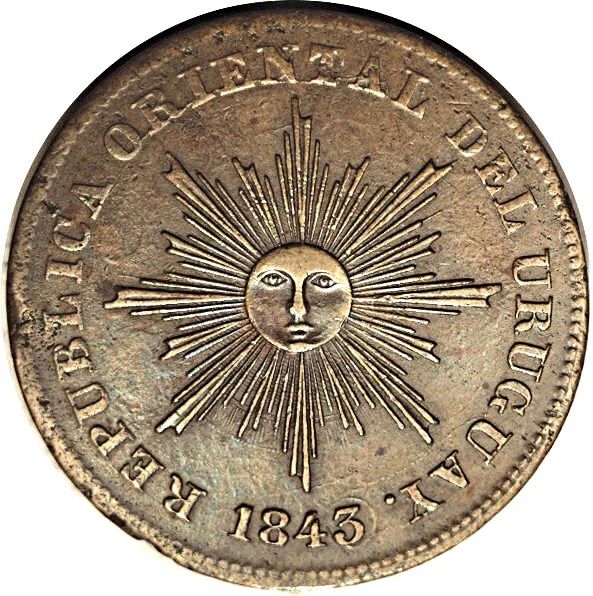
Obverse
Description:
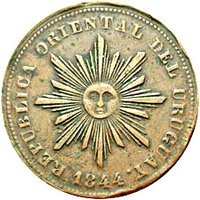
Radiant sun with a face, country name encircling, date below.
Inscription:
REPUBLICA ORIENTAL DEL URUGUAY
1840
1840
Translation:
ORIENTAL REPUBLIC OF URUGUAY
1840
1840
Script: Latin
Language: Spanish
Engraver: Agustin Jouve
Reverse
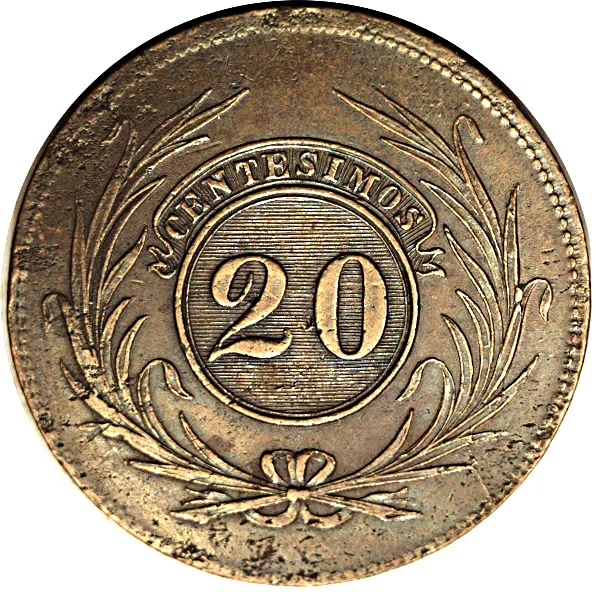
Description:
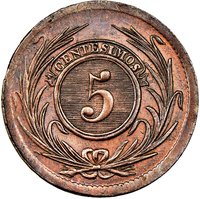
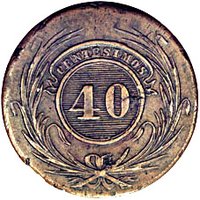
Value within a double wreath.
Inscription:
CENTESIMOS
20
20
Translation:
Twenty Centésimos
Script: Latin
Language: Spanish
Engraver: Agustin Jouve
Edge
SmoothLiso
Mints
| Name | Mark |
|---|---|
| Casa de Moneda | — |
Mintings
| Year | Mint Mark | Mintage | Quality | Collection |
|---|---|---|---|---|
| 1840 | — | 18,500 | ||
| 1843 | — | 15,000 | ||
| 1844 | — | 10,000 |
Historical background
In 1840, Uruguay, then known as the Estado Oriental del Uruguay, was immersed in profound monetary chaos following its independence from Brazil in 1828. The young nation’s economy was crippled by the ongoing Guerra Grande (1839-1851), a complex civil and international conflict that pitted the Colorado and Blanco political factions against each other, with foreign intervention from both Argentina and Brazil. This state of constant warfare devastated the rural economy, disrupted trade, and left the government in Montevideo with empty coffers and no capacity to establish a stable fiscal system.
The currency landscape was a fragmented and unreliable patchwork. There was no official national currency issued by a central bank. Instead, circulation was dominated by a multitude of foreign coins, primarily Spanish, Argentine, and Brazilian silver pesos and gold ounces, alongside privately issued paper notes from merchant houses and local banks of dubious solvency. The most significant attempt to create a national currency, the "peso fuerte" decreed in 1839, failed to gain traction due to a lack of public confidence and the government's inability to back it with precious metal reserves. Consequently, the value of any medium of exchange was highly unstable and varied by region.
This monetary anarchy severely hampered commerce and state-building. Transactions were fraught with uncertainty, as the value of coins depended on their metal content, origin, and wear, while paper notes often became worthless if the issuing entity collapsed. The government resorted to confiscations and forced loans to fund the war, further eroding economic trust. Thus, in 1840, Uruguay's currency situation was not merely one of inflation but of a fundamental absence of a unified monetary authority, reflecting the broader political instability and violence that characterized the nation's first decades.
The currency landscape was a fragmented and unreliable patchwork. There was no official national currency issued by a central bank. Instead, circulation was dominated by a multitude of foreign coins, primarily Spanish, Argentine, and Brazilian silver pesos and gold ounces, alongside privately issued paper notes from merchant houses and local banks of dubious solvency. The most significant attempt to create a national currency, the "peso fuerte" decreed in 1839, failed to gain traction due to a lack of public confidence and the government's inability to back it with precious metal reserves. Consequently, the value of any medium of exchange was highly unstable and varied by region.
This monetary anarchy severely hampered commerce and state-building. Transactions were fraught with uncertainty, as the value of coins depended on their metal content, origin, and wear, while paper notes often became worthless if the issuing entity collapsed. The government resorted to confiscations and forced loans to fund the war, further eroding economic trust. Thus, in 1840, Uruguay's currency situation was not merely one of inflation but of a fundamental absence of a unified monetary authority, reflecting the broader political instability and violence that characterized the nation's first decades.
💎 Very Rare