

1000 Escudos – Portugal
Non-circulating coins
Commemoration: 500th Annviersary of the Treaty of Tordesillas
Series: System 1981-2001
Portugal
Obverse
Description:
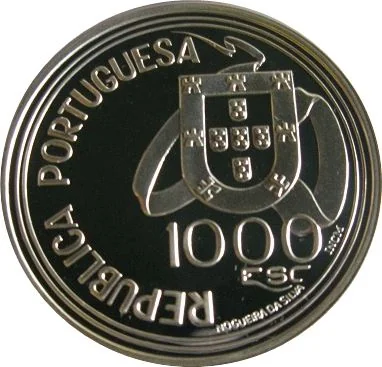
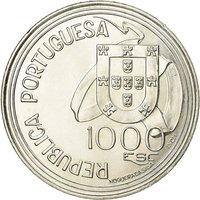
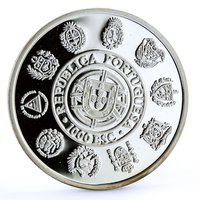
Quinas, Portugal's imperial coat of arms, above value.
Inscription:
REPUBLICA PORTUGUESA
1000
ESC
NOGUEIRA DA SILVA
INCM
1000
ESC
NOGUEIRA DA SILVA
INCM
Translation:
Portuguese Republic
1000
ESC
Nogueira da Silva
INCM
1000
ESC
Nogueira da Silva
INCM
Script: Latin
Language: Portuguese
Engraver: Manuel da Silva Nogueira
Reverse
Description:
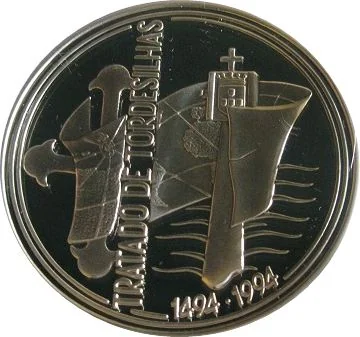
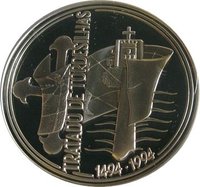
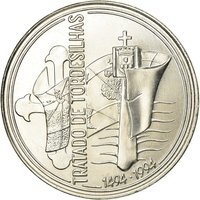
World map on a scroll labeled "TRATADO DE TORDESILHAS." A cross behind it denotes Spain; a scepter within it denotes Portugal.
Inscription:
TRATADO DE TORDESILHAS
1494-1994
1494-1994
Script: Latin
Engraver: Manuel da Silva Nogueira
Edge
Reeded
Mintings
| Year | Mint Mark | Mintage | Quality | Collection |
|---|---|---|---|---|
| 1994 | — | 10,000 | Proof |
Historical background
In 1994, Portugal's currency situation was defined by its strategic and disciplined participation in the European Monetary System (EMS) and its determined march toward European Economic and Monetary Union (EMU). The country's currency, the escudo (PTE), was operating within the EMS Exchange Rate Mechanism (ERM), which required it to maintain a fixed but adjustable parity against a central European Currency Unit (ECU) and, by extension, relative stability against other member currencies, most importantly the Deutsche Mark. This period followed a significant devaluation in 1992, which had realigned the escudo's central rate to a more competitive level, and by 1994, the currency was demonstrating notable stability within its narrow fluctuation band of ±2.25%.
This stability was not accidental but the result of a concerted national policy effort. The Banco de Portugal, the country's central bank, pursued a tight monetary policy focused on inflation reduction and exchange rate stability, often shadowing the policies of the German Bundesbank to maintain credibility. High interest rates were used to defend the escudo's peg and curb domestic demand, a necessary but painful strategy that came with the economic cost of subdued growth. The primary driver was political: fulfilling the Maastricht Treaty convergence criteria on inflation, interest rates, budget deficits, and exchange rate stability was the paramount national objective to secure Portugal's place in the first wave of the single European currency.
Consequently, the currency landscape in 1994 was one of transition and preparation. The escudo was effectively in a "hard currency" regime, serving as a training ground for the impending loss of monetary sovereignty. Financial markets and institutions were beginning to adapt to a future without the escudo, while the government's fiscal austerity measures aimed to rein in the public deficit to meet the Maastricht targets. Thus, the story of the escudo in 1994 is one of a currency being carefully managed not for its own long-term future, but to ensure its orderly retirement and Portugal's entry into the Eurozone, which was ultimately achieved on January 1, 1999.
This stability was not accidental but the result of a concerted national policy effort. The Banco de Portugal, the country's central bank, pursued a tight monetary policy focused on inflation reduction and exchange rate stability, often shadowing the policies of the German Bundesbank to maintain credibility. High interest rates were used to defend the escudo's peg and curb domestic demand, a necessary but painful strategy that came with the economic cost of subdued growth. The primary driver was political: fulfilling the Maastricht Treaty convergence criteria on inflation, interest rates, budget deficits, and exchange rate stability was the paramount national objective to secure Portugal's place in the first wave of the single European currency.
Consequently, the currency landscape in 1994 was one of transition and preparation. The escudo was effectively in a "hard currency" regime, serving as a training ground for the impending loss of monetary sovereignty. Financial markets and institutions were beginning to adapt to a future without the escudo, while the government's fiscal austerity measures aimed to rein in the public deficit to meet the Maastricht targets. Thus, the story of the escudo in 1994 is one of a currency being carefully managed not for its own long-term future, but to ensure its orderly retirement and Portugal's entry into the Eurozone, which was ultimately achieved on January 1, 1999.
Series: System 1981-2001
⭐ Rare