

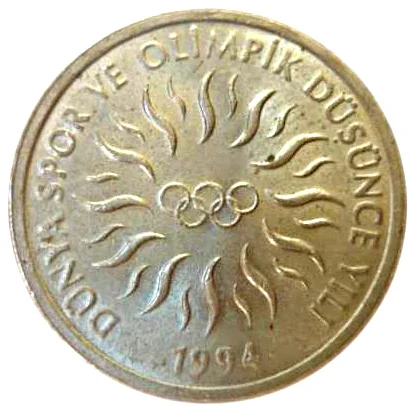
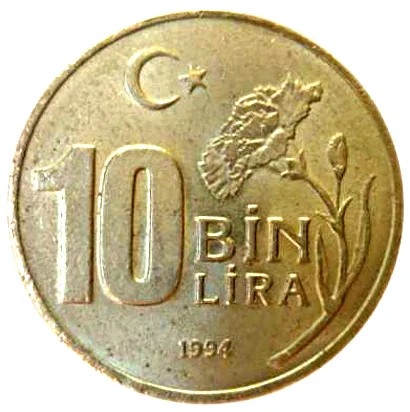
10000 Lira – Turkey
Circulating commemorative coins
Commemoration: 1994 Olympics
Turkey
Context

Material

References
KM: #Click to copy to clipboard1042
Numista: #14239
Value
Exchange value: 10000 TRL
Inflation-adjusted value: 43121614.10 TRL
Obverse
Script: Latin
Reverse
Inscription:
10 BIN LIRA
1994
1994
Script: Latin
Edge
Reeded with inscription
Legend:
TURKIYE CUMHURIYETI
Translation:
Republic of Turkey
Language: Turkish
Mintings
| Year | Mint Mark | Mintage | Quality | Collection |
|---|---|---|---|---|
| 1994 | — | 500,000 |
Historical background
The Turkish economy entered 1994 in a state of severe fragility, culminating in a full-blown currency and debt crisis in April. Years of populist economic policies, including high public spending and wage increases, had led to chronic fiscal deficits. These were primarily financed by short-term domestic borrowing at unsustainably high real interest rates, creating a vicious cycle of debt servicing that consumed an ever-larger portion of the budget. This unsustainable fiscal posture, combined with a heavily regulated and overvalued fixed exchange rate, eroded confidence and left the economy acutely vulnerable to capital flight.
The crisis was triggered in early 1994 when foreign reserves plummeted as investors lost faith, forcing the government to devalue the Turkish lira by over 50% in a single day. This dramatic devaluation, part of a broader stabilization program announced on April 5th, shattered the fixed exchange rate regime. Inflation, already high, skyrocketed to an annual rate of over 150% by mid-year, severely eroding purchasing power. The government was compelled to seek a standby agreement with the International Monetary Fund (IMF) to secure emergency funding, committing to stringent austerity measures, including sharp cuts in public spending and accelerated privatization.
The 1994 crisis had profound consequences, causing a deep recession with a 6% contraction in GDP and a sharp decline in living standards. It exposed the fundamental weaknesses of Turkey's economic governance, particularly the peril of combining loose fiscal policy with a rigid exchange rate. While the immediate crisis was stabilized by the IMF program, the underlying structural issues—including persistent public sector deficits and high inflation—were not fully resolved, setting the stage for future financial instability in the years that followed.
The crisis was triggered in early 1994 when foreign reserves plummeted as investors lost faith, forcing the government to devalue the Turkish lira by over 50% in a single day. This dramatic devaluation, part of a broader stabilization program announced on April 5th, shattered the fixed exchange rate regime. Inflation, already high, skyrocketed to an annual rate of over 150% by mid-year, severely eroding purchasing power. The government was compelled to seek a standby agreement with the International Monetary Fund (IMF) to secure emergency funding, committing to stringent austerity measures, including sharp cuts in public spending and accelerated privatization.
The 1994 crisis had profound consequences, causing a deep recession with a 6% contraction in GDP and a sharp decline in living standards. It exposed the fundamental weaknesses of Turkey's economic governance, particularly the peril of combining loose fiscal policy with a rigid exchange rate. While the immediate crisis was stabilized by the IMF program, the underlying structural issues—including persistent public sector deficits and high inflation—were not fully resolved, setting the stage for future financial instability in the years that followed.
🌱 Fairly Common