

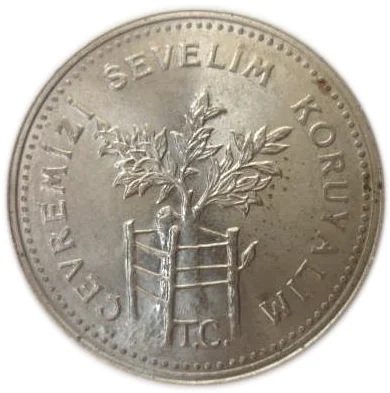
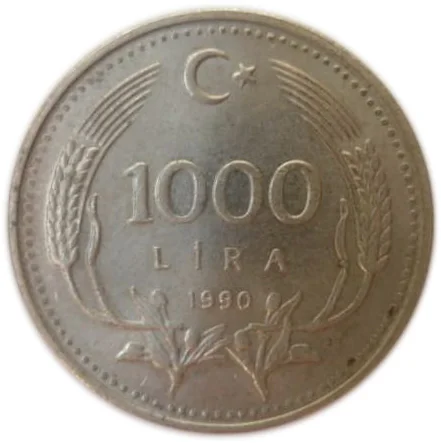
1000 Lira – Turkey
Circulating commemorative coins
Commemoration: Environmental protection
Turkey
Context
Material
References
KM: #Click to copy to clipboard996
Numista: #14237
Value
Exchange value: 1000 TRL
Inflation-adjusted value: 32410148.68 TRL
Mintings
| Year | Mint Mark | Mintage | Quality | Collection |
|---|---|---|---|---|
| 1990 | — | 500,000 |
Historical background
Turkey entered the 1990s in a precarious economic state, characterized by chronic high inflation, persistent budget deficits, and a heavy reliance on short-term foreign capital inflows. The decade prior had seen a significant liberalization of the economy, moving away from statism, but this transition was poorly managed. The government's continued reliance on the Central Bank to finance large public sector deficits became the primary engine of inflation, which remained stubbornly in the double-digits, often exceeding 60-70% annually. This environment eroded the value of the Turkish Lira (TL) and led to a widespread "dollarization" of the economy, as citizens and businesses sought refuge in foreign currencies to preserve savings.
The currency regime itself was a complex and unstable system. Officially, the TL operated under a "managed float" or a "crawling peg" system, where the Central Bank would intermittently devalue the currency against a basket of foreign currencies, primarily the US Dollar and German Mark, in an attempt to keep pace with inflation and maintain export competitiveness. However, these devaluations were often too little, too late, and were frequently preceded by periods of intense speculation and capital flight. The government maintained strict capital controls on paper, but a vast and active black market for foreign exchange thrived, creating a significant divergence between official and unofficial exchange rates and further undermining confidence in the lira.
This volatile backdrop set the stage for the recurring currency crises that would define the Turkish 1990s. The combination of loose fiscal policy, political instability with frequent coalition governments, and the increasing liberalization of the capital account without strong institutional safeguards made the economy highly vulnerable to sudden shifts in investor sentiment. The decade would be marked by a painful cycle: periods of high growth fueled by hot money would lead to large current account deficits, eventually triggering a loss of confidence, a speculative attack on the lira, and a severe economic contraction, followed by an International Monetary Fund (IMF) stabilization program—a cycle that repeated in 1994 and again at the decade's end, culminating in the devastating crisis of 2001.
The currency regime itself was a complex and unstable system. Officially, the TL operated under a "managed float" or a "crawling peg" system, where the Central Bank would intermittently devalue the currency against a basket of foreign currencies, primarily the US Dollar and German Mark, in an attempt to keep pace with inflation and maintain export competitiveness. However, these devaluations were often too little, too late, and were frequently preceded by periods of intense speculation and capital flight. The government maintained strict capital controls on paper, but a vast and active black market for foreign exchange thrived, creating a significant divergence between official and unofficial exchange rates and further undermining confidence in the lira.
This volatile backdrop set the stage for the recurring currency crises that would define the Turkish 1990s. The combination of loose fiscal policy, political instability with frequent coalition governments, and the increasing liberalization of the capital account without strong institutional safeguards made the economy highly vulnerable to sudden shifts in investor sentiment. The decade would be marked by a painful cycle: periods of high growth fueled by hot money would lead to large current account deficits, eventually triggering a loss of confidence, a speculative attack on the lira, and a severe economic contraction, followed by an International Monetary Fund (IMF) stabilization program—a cycle that repeated in 1994 and again at the decade's end, culminating in the devastating crisis of 2001.
🌱 Fairly Common