

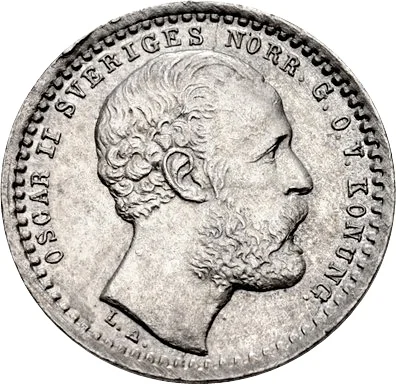
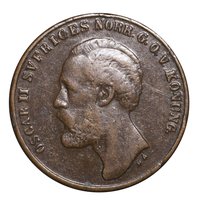
Obverse
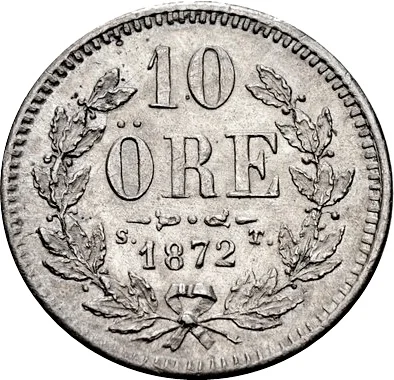
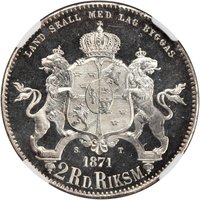
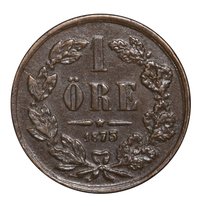
Reverse
Edge
Mints
| Name | Mark |
|---|---|
| Kungliga Myntet | — |
Mintings
| Year | Mint Mark | Mintage | Quality | Collection |
|---|---|---|---|---|
| 1872 | — | 120,000 | ||
| 1873 | — | 635,440 |
Historical background
In 1872, Sweden stood at a monetary crossroads, transitioning from a centuries-old system to a modern, standardized one. For decades, the nation had operated with the riksdaler riksmynt, a silver-based currency that was stable but increasingly isolated. The broader European trend, spearheaded by the German Empire, was moving toward the gold standard, which promised greater international trade efficiency and monetary stability. Furthermore, Sweden's participation in the Scandinavian Monetary Union (established in 1873 with Denmark and Norway) necessitated a fundamental reform to create a common currency framework with its neighbors.
The pivotal change was the adoption of the gold standard and the introduction of the krona (plural: kronor), meaning "crown," to replace the riksdaler. The Riksdag (Swedish parliament) passed the necessary legislation in 1872, setting the conversion rate at 1 riksdaler = 1 krona. This reform formally took effect in 1873, but the preparatory legal and financial groundwork was decisively laid in 1872. The new krona was subdivided into 100 öre, moving away from the old system of skilling and creating a decimal system that was easier to use and calculate.
This shift was driven by pragmatism and economic ambition. Swedish policymakers and industrialists sought deeper integration into the flourishing European economy, particularly with Germany, a major trading partner. By aligning its currency with the emerging gold-standard bloc and its Scandinavian allies, Sweden aimed to reduce exchange rate risks, attract foreign investment, and foster industrial growth. Thus, the currency situation in 1872 was one of deliberate and strategic preparation, marking the end of an era and positioning Sweden firmly within the modern European financial system.
The pivotal change was the adoption of the gold standard and the introduction of the krona (plural: kronor), meaning "crown," to replace the riksdaler. The Riksdag (Swedish parliament) passed the necessary legislation in 1872, setting the conversion rate at 1 riksdaler = 1 krona. This reform formally took effect in 1873, but the preparatory legal and financial groundwork was decisively laid in 1872. The new krona was subdivided into 100 öre, moving away from the old system of skilling and creating a decimal system that was easier to use and calculate.
This shift was driven by pragmatism and economic ambition. Swedish policymakers and industrialists sought deeper integration into the flourishing European economy, particularly with Germany, a major trading partner. By aligning its currency with the emerging gold-standard bloc and its Scandinavian allies, Sweden aimed to reduce exchange rate risks, attract foreign investment, and foster industrial growth. Thus, the currency situation in 1872 was one of deliberate and strategic preparation, marking the end of an era and positioning Sweden firmly within the modern European financial system.
💎 Very Rare