

50 öre – Sweden
Add to wishlist
Sweden
Context
Year: 1862
Issuer: Sweden
Ruler: Charles XV
Currency:
(1855—1873)
Demonetized: Yes
Total mintage: 2,319
Material
References
KM: #
Numista: #37758
Value
Bullion value: $8.00
Obverse
Description:
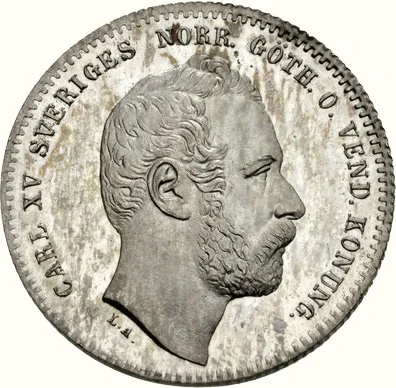
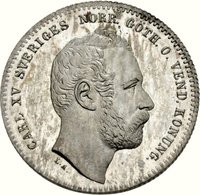
King's head right, encircled by inscription. Engraver's initials below neck.
Inscription:
CARL XV SVERIGES NORR. GÖTH. O. VEND. KONUNG.
L.A.
L.A.
Translation:
CARL XV SWEDEN'S NORR. GÖTH. AND VEND. KING.
L.A.
L.A.
Script: Latin
Language: Swedish
Engraver: Lea Ahlborn
Reverse
Description:
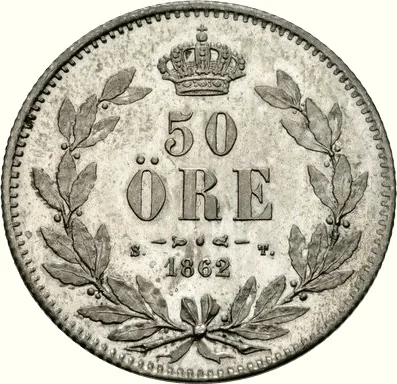
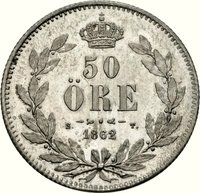
Crown above value and date, encircled by laurel wreath.
Inscription:
50
ÖRE
S. T.
1862
ÖRE
S. T.
1862
Translation:
Fifty Öre
Saint Thecla
1862
Saint Thecla
1862
Script: Latin
Engraver: Lea Ahlborn
Edge
Mints
| Name | Mark |
|---|---|
| Kungliga Myntet | — |
Mintings
| Year | Mint Mark | Mintage | Quality | Collection |
|---|---|---|---|---|
| 1862 | — | 2,319 | Prooflike |
Historical background
In 1862, Sweden’s currency system was in a state of transition, firmly anchored to the silver standard. The riksdaler riksmynt was the official unit of account, but the monetary landscape was complex and fragmented. Alongside government-issued notes from the Riksbank, there was a significant circulation of private banknotes issued by numerous enskilda banker (private commercial banks). This multiplicity of issuers, while facilitating credit and economic activity, created concerns over uniformity and trust, as the value and acceptance of these private notes could vary.
The period was also marked by a chronic shortage of small-denomination coinage, which severely hampered everyday transactions. To fill this gap, a widespread and unofficial system of token coins and private myntsedlar (coin notes) issued by merchants and factories circulated locally. This practice, though a practical necessity, highlighted the state’s inability to provide a sufficient and uniform metallic currency for the entire economy, leading to inefficiency and confusion in trade.
These issues were part of a broader ongoing debate about monetary reform. The 1850s had seen the establishment of the Scandinavian Monetary Union (with Denmark and Norway) planned for 1873, which would eventually replace the silver-based riksdaler with the gold-based krona. Therefore, 1862 represents a point where Sweden was grappling with the practical shortcomings of its old system while moving deliberately, albeit slowly, toward the modern, standardized, and state-controlled currency system that the union promised.
The period was also marked by a chronic shortage of small-denomination coinage, which severely hampered everyday transactions. To fill this gap, a widespread and unofficial system of token coins and private myntsedlar (coin notes) issued by merchants and factories circulated locally. This practice, though a practical necessity, highlighted the state’s inability to provide a sufficient and uniform metallic currency for the entire economy, leading to inefficiency and confusion in trade.
These issues were part of a broader ongoing debate about monetary reform. The 1850s had seen the establishment of the Scandinavian Monetary Union (with Denmark and Norway) planned for 1873, which would eventually replace the silver-based riksdaler with the gold-based krona. Therefore, 1862 represents a point where Sweden was grappling with the practical shortcomings of its old system while moving deliberately, albeit slowly, toward the modern, standardized, and state-controlled currency system that the union promised.
✨ Legendary