

2 tangas – Portuguese India
Add to wishlist
India
Context
Year: 1934
Country: India
Issuer: Portuguese India
Period:
(1910—1961)
Currency:
(1880—1958)
Demonetization: 1958
Total mintage: 150,000
Material
Diameter: 19.05 mm
Weight: 3 g
Thickness: 1.5 mm
Shape: Round
Composition: Copper-nickel
Technique: Milled
Alignment: Coin alignment
flip
References
KM: #
Numista: #37746
Obverse
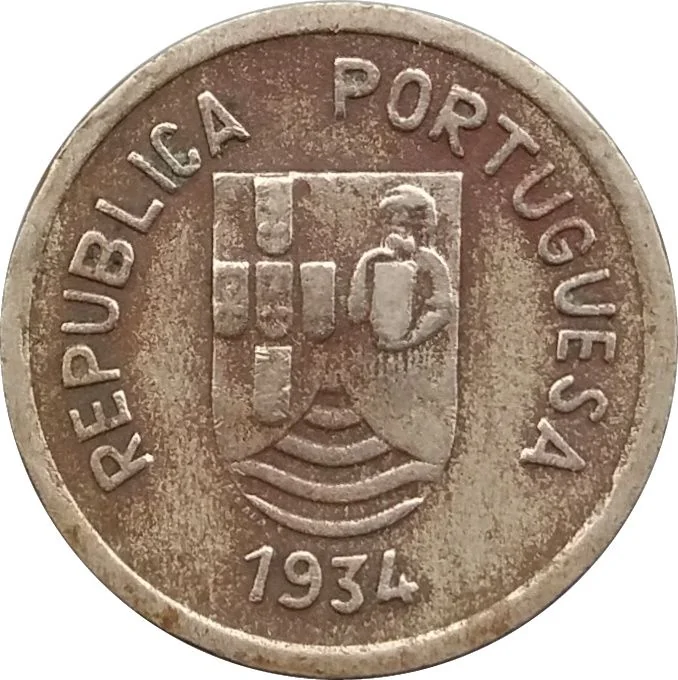
Inscription:
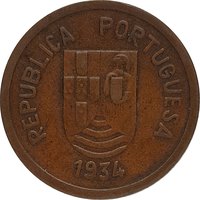
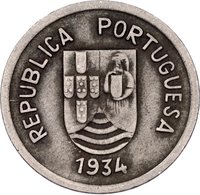
REPUBLICA PORTUGUESA
1934
1934
Translation:
PORTUGUESE REPUBLIC
1934
1934
Script: Latin
Language: Portuguese
Reverse
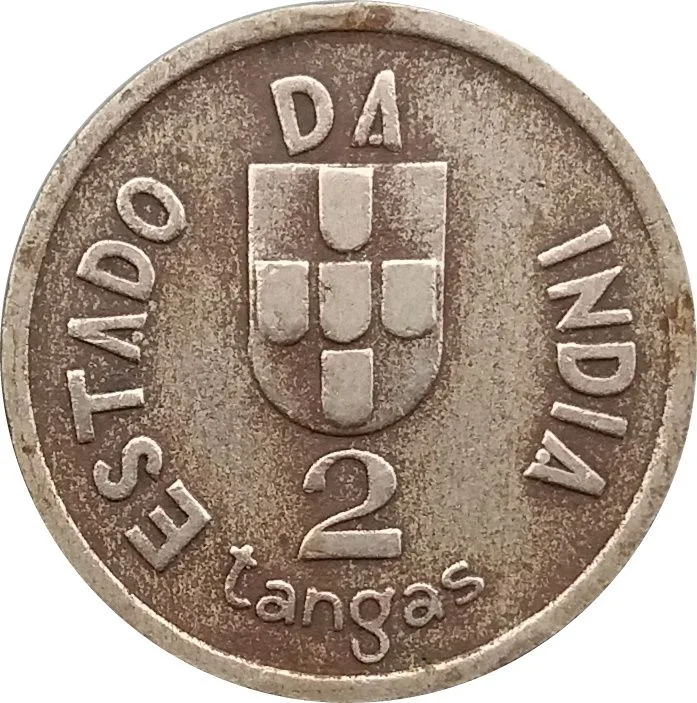
Inscription:
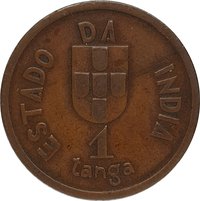
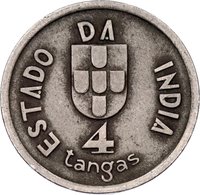
ESTADO DA INDIA
2 TANGAS
2 TANGAS
Script: Latin
Edge
Plain
Mints
| Name | Mark |
|---|---|
| Imprensa Nacional - Casa da Moeda | — |
Mintings
| Year | Mint Mark | Mintage | Quality | Collection |
|---|---|---|---|---|
| 1934 | — | 150,000 |
Historical background
In 1934, the currency situation in Portuguese India (Goa, Daman, and Diu) was characterized by a complex and practical dual-system, operating under the overarching monetary authority of Portugal. The official currency was the Portuguese Indian Rupia (INR), which was pegged at a fixed parity to the Portuguese Escudo (1 Rupia = 1 Escudo). However, this official currency circulated alongside and was heavily influenced by the ubiquitous British Indian Rupee, which dominated regional trade due to the territory's extensive economic and social links with British India. The Portuguese Indian Rupia itself was not a distinct banknote but rather a unit of account, with actual notes being Portuguese Escudo bills stamped with their value in Rupias.
This monetary duality created a unique environment where the official exchange rate with the Escudo was often disconnected from the market reality. The value of the stamped Portuguese notes in daily commerce was effectively determined by their fluctuating conversion rate against the stronger British Indian Rupee on the bustling black market in Panjim. Consequently, while the state administered its finances in the official Rupia/Escudo, the vast majority of local commerce, wages, and prices were mentally calculated and often transacted in terms of British Indian currency, leading to confusion and arbitrage opportunities.
The situation in 1934 was one of administrative strain and economic contradiction. Lisbon's attempts to enforce a Lisbon-centric currency peg were undermined by Goa's geographical and economic reality. This period highlighted the territory's liminal position—politically tied to a European empire but economically integrated into the Indian subcontinent. The system persisted until 1959, when a major monetary reform finally introduced a distinct Portuguese Indian banknote, though the region's economic orientation remained firmly towards India until its liberation in 1961.
This monetary duality created a unique environment where the official exchange rate with the Escudo was often disconnected from the market reality. The value of the stamped Portuguese notes in daily commerce was effectively determined by their fluctuating conversion rate against the stronger British Indian Rupee on the bustling black market in Panjim. Consequently, while the state administered its finances in the official Rupia/Escudo, the vast majority of local commerce, wages, and prices were mentally calculated and often transacted in terms of British Indian currency, leading to confusion and arbitrage opportunities.
The situation in 1934 was one of administrative strain and economic contradiction. Lisbon's attempts to enforce a Lisbon-centric currency peg were undermined by Goa's geographical and economic reality. This period highlighted the territory's liminal position—politically tied to a European empire but economically integrated into the Indian subcontinent. The system persisted until 1959, when a major monetary reform finally introduced a distinct Portuguese Indian banknote, though the region's economic orientation remained firmly towards India until its liberation in 1961.
🌟 Limited