

5 rials – Iran
Add to wishlist
Iran
Context
Years: 1968–1978
Issuer: Iran
Ruler: Mohammad Reza
Currency:
(since 1932)
Demonetized: Yes
Total mintage: 153,770,076
Material
References
KM: #
Numista: #3763
Value
Exchange value: 5 IRR
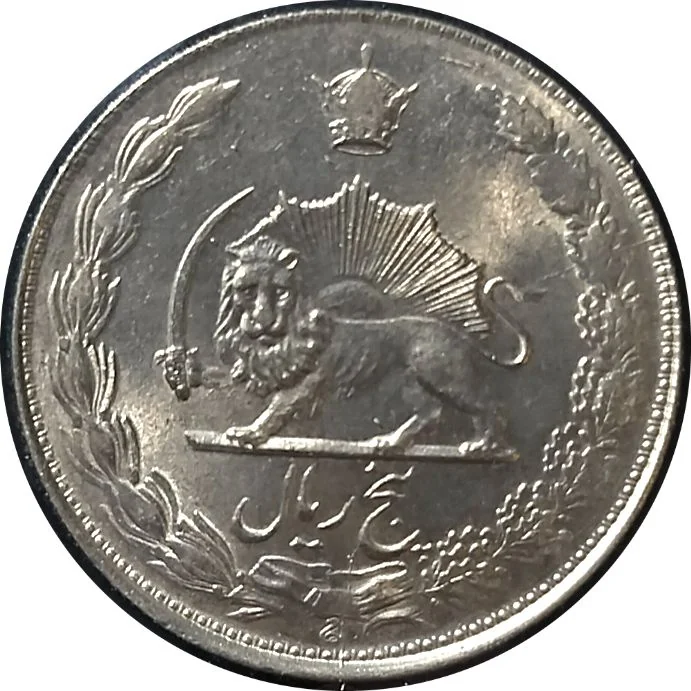
Obverse
Description:
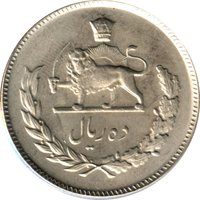
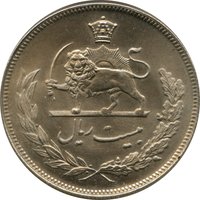
Lion rampant with sword below a crown.
Inscription:
پنج ریال
Translation:
Five Rials
Language: Persian
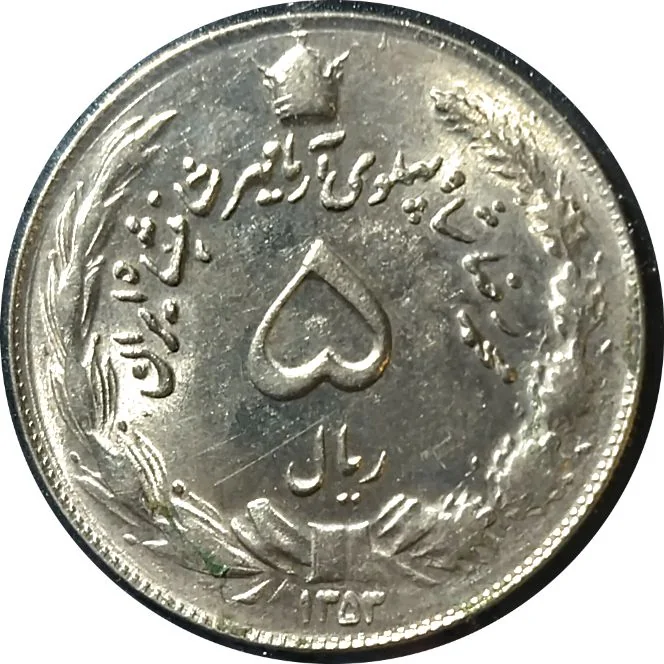
Reverse
Description:
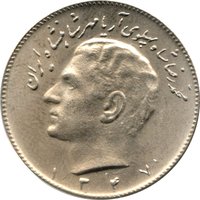
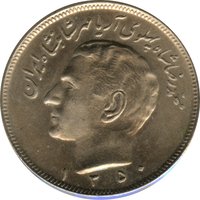
Mohammad Reza Pahlavi, 5 Rials.
Inscription:
محمدرضا شاه پهلوی آریامهر شاهنشاه ایران
۵
ریال
۱۳۵۳
۵
ریال
۱۳۵۳
Translation:
Mohammad Reza Shah Pahlavi Aryamehr, Shahanshah of Iran
5
Rials
1353
5
Rials
1353
Language: Persian
Edge
Reeded
Mints
| Name | Mark |
|---|---|
| Tehran | — |
Mintings
| Year | Mint Mark | Mintage | Quality | Collection |
|---|---|---|---|---|
| 1968 | — | 7,745,056 | ||
| 1969 | — | 9,192,559 | ||
| 1970 | — | 7,300,485 | ||
| 1971 | — | 10,159,976 | ||
| 1972 | — | 20,582,000 | ||
| 1973 | — | 23,590,000 | ||
| 1974 | — | — | ||
| 1975 | — | 27,294,000 | ||
| 1977 | — | 47,906,000 | ||
| 1978 | — | — | ||
| 1978 | — | — |
Historical background
In 1968, Iran’s currency situation was characterized by relative stability and strength, underpinned by a period of significant economic growth and rising oil revenues. The national currency, the rial, was pegged to the U.S. dollar at a fixed rate of 75.75 rials per dollar, an exchange regime established in 1957. This peg provided a solid anchor for trade and investment, fostering confidence during a decade of ambitious modernization and industrialization projects under the Shah's "White Revolution." The country's substantial foreign exchange reserves, bolstered by its position as a major oil exporter, comfortably supported this fixed parity.
This stability, however, existed within a broader context of underlying inflationary pressures and a growing dependence on a single commodity. While the official exchange rate remained firm, government spending fueled by oil wealth was beginning to increase the money supply and demand for imports, creating nascent inflationary trends. The economy’s rapid, state-led expansion often outpaced the development of domestic productive capacity, leading to bottlenecks and rising costs. Furthermore, the fixed exchange rate, while beneficial for stability, masked these inflationary pressures and could make non-oil exports less competitive over time.
Consequently, the currency picture in 1968 was one of surface-level calm masking longer-term vulnerabilities. The regime successfully maintained the peg and avoided any balance of payments crises, projecting an image of a modernizing, financially sound nation. Yet, the economic model reliant on booming oil income to finance development and subsidize the currency sowed the seeds for future challenges. The disconnect between the strong official rial and the domestic economy's inflationary trajectory would become more pronounced in the following decade, especially after the 1973 oil price shock, eventually leading to significant devaluation and economic dislocation in the late 1970s.
This stability, however, existed within a broader context of underlying inflationary pressures and a growing dependence on a single commodity. While the official exchange rate remained firm, government spending fueled by oil wealth was beginning to increase the money supply and demand for imports, creating nascent inflationary trends. The economy’s rapid, state-led expansion often outpaced the development of domestic productive capacity, leading to bottlenecks and rising costs. Furthermore, the fixed exchange rate, while beneficial for stability, masked these inflationary pressures and could make non-oil exports less competitive over time.
Consequently, the currency picture in 1968 was one of surface-level calm masking longer-term vulnerabilities. The regime successfully maintained the peg and avoided any balance of payments crises, projecting an image of a modernizing, financially sound nation. Yet, the economic model reliant on booming oil income to finance development and subsidize the currency sowed the seeds for future challenges. The disconnect between the strong official rial and the domestic economy's inflationary trajectory would become more pronounced in the following decade, especially after the 1973 oil price shock, eventually leading to significant devaluation and economic dislocation in the late 1970s.
🌱 Very Common