

10 Gulden – Netherlands
Netherlands
Context
Years: 1892–1897
Issuer: Netherlands 
Ruler: Wilhelmina
Currency:
(1817—2001)
Demonetized: Yes
Total mintage: 453,906
Material
References
KM: #Click to copy to clipboard118
Numista: #37612
Value
Exchange value: 10 NLG
Bullion value: $1010.10
Obverse
Description:
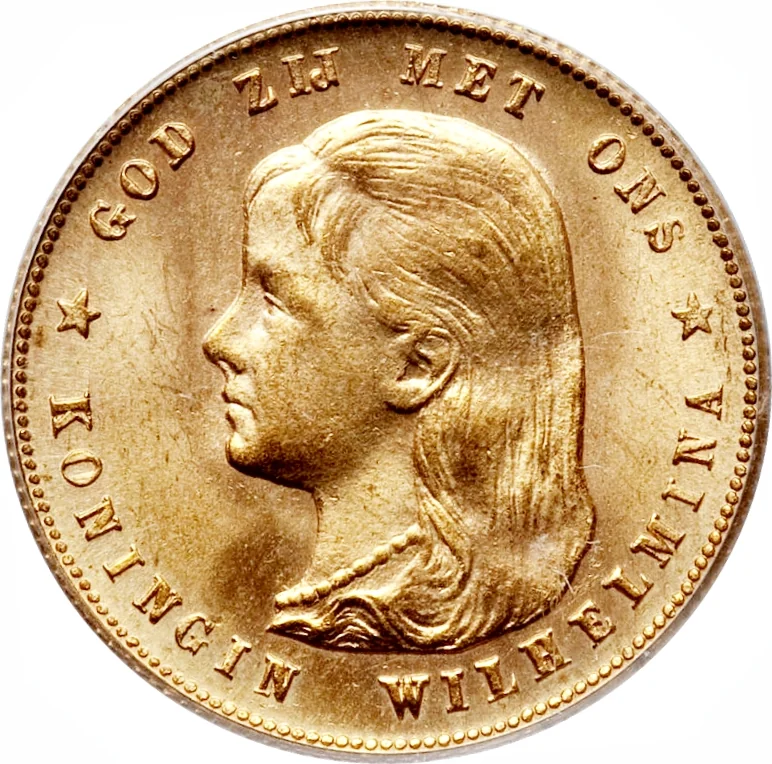
Queen Wilhelmina, facing left, with loose hair and pearls.
Inscription:
★ GOD ZIJ MET ONS ★
KONINGIN WILHELMINA
KONINGIN WILHELMINA
Translation:
★ GOD BE WITH US ★
QUEEN WILHELMINA
QUEEN WILHELMINA
Script: Latin
Language: Dutch
Engraver: Willem Jacobus Schammer
Reverse
Description:
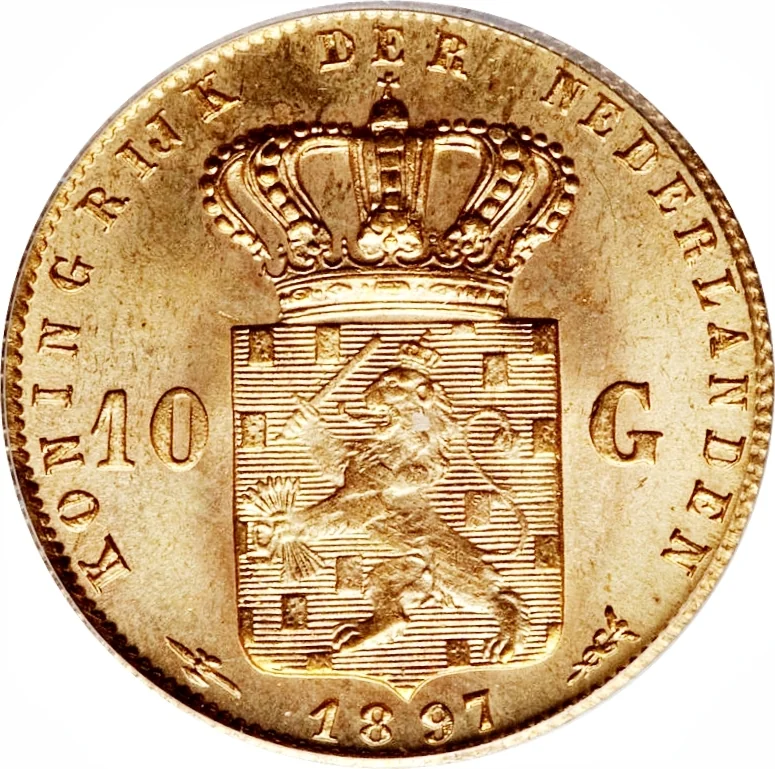
Coat of arms flanking value, year beneath.
Inscription:
KONINGRIJK DER NEDERLANDEN
10 G
1897
10 G
1897
Translation:
Kingdom of the Netherlands
10 Guilders
1897
10 Guilders
1897
Script: Latin
Language: Dutch
Engraver: Willem Jacobus Schammer
Edge
Reeded
Categories
| Symbol> Crown |
| Symbols> Coat of Arms |
Mints
| Name | Mark |
|---|---|
| Royal Dutch Mint | — |
Mintings
| Year | Mint Mark | Mintage | Quality | Collection |
|---|---|---|---|---|
| 1892 | — | 61 | ||
| 1892 | — | — | Proof | |
| 1895 | — | 149 | ||
| 1895 | — | — | Proof | |
| 1897 | — | 453,696 |
Historical background
In 1892, the Netherlands operated under a bimetallic system in theory, but in practice it was part of the Latin Monetary Union, a European attempt to standardize currency based on a gold standard with fixed exchange rates between member states. The Dutch guilder was defined as containing 0.6048 grams of fine gold, making it a stable and trusted currency internationally. However, this period was one of transition and tension, as the global scarcity of silver and the fluctuating values of precious metals posed significant challenges to the stability of the bimetallic agreements.
Domestically, the situation was marked by a protracted political debate known as the "muntkwestie" (currency question). This debate pitted proponents of the gold standard against those who favored retaining a role for silver, often for reasons of colonial trade (particularly with the Dutch East Indies, which used a silver-based system). The year 1892 fell within the lengthy deliberations that would ultimately lead to the Gold Standard Act of 1875... but which was only fully implemented in 1877. Wait, that seems contradictory.
Correction: There is a chronological discrepancy in the initial response. The critical Dutch legislation, the Gold Standard Act, was passed in 1875 and came into effect in 1877, formally abandoning bimetallism. Therefore, by 1892, the Netherlands had been firmly on the gold standard for 15 years. The guilder was a stable gold-backed currency. The relevant background for 1892 is thus one of consolidation, not transition. The major debates of the 1870s were settled, and the currency was integrated into the international gold standard system, facilitating trade and investment. Any contemporary discussions would have focused on minor technical adjustments or the ongoing management of colonial currency systems, rather than a fundamental choice over the monetary standard.
Domestically, the situation was marked by a protracted political debate known as the "muntkwestie" (currency question). This debate pitted proponents of the gold standard against those who favored retaining a role for silver, often for reasons of colonial trade (particularly with the Dutch East Indies, which used a silver-based system). The year 1892 fell within the lengthy deliberations that would ultimately lead to the Gold Standard Act of 1875... but which was only fully implemented in 1877. Wait, that seems contradictory.
Correction: There is a chronological discrepancy in the initial response. The critical Dutch legislation, the Gold Standard Act, was passed in 1875 and came into effect in 1877, formally abandoning bimetallism. Therefore, by 1892, the Netherlands had been firmly on the gold standard for 15 years. The guilder was a stable gold-backed currency. The relevant background for 1892 is thus one of consolidation, not transition. The major debates of the 1870s were settled, and the currency was integrated into the international gold standard system, facilitating trade and investment. Any contemporary discussions would have focused on minor technical adjustments or the ongoing management of colonial currency systems, rather than a fundamental choice over the monetary standard.
🌟 Uncommon