

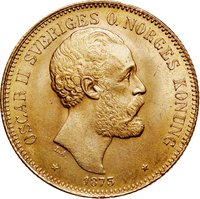
Obverse
Description:
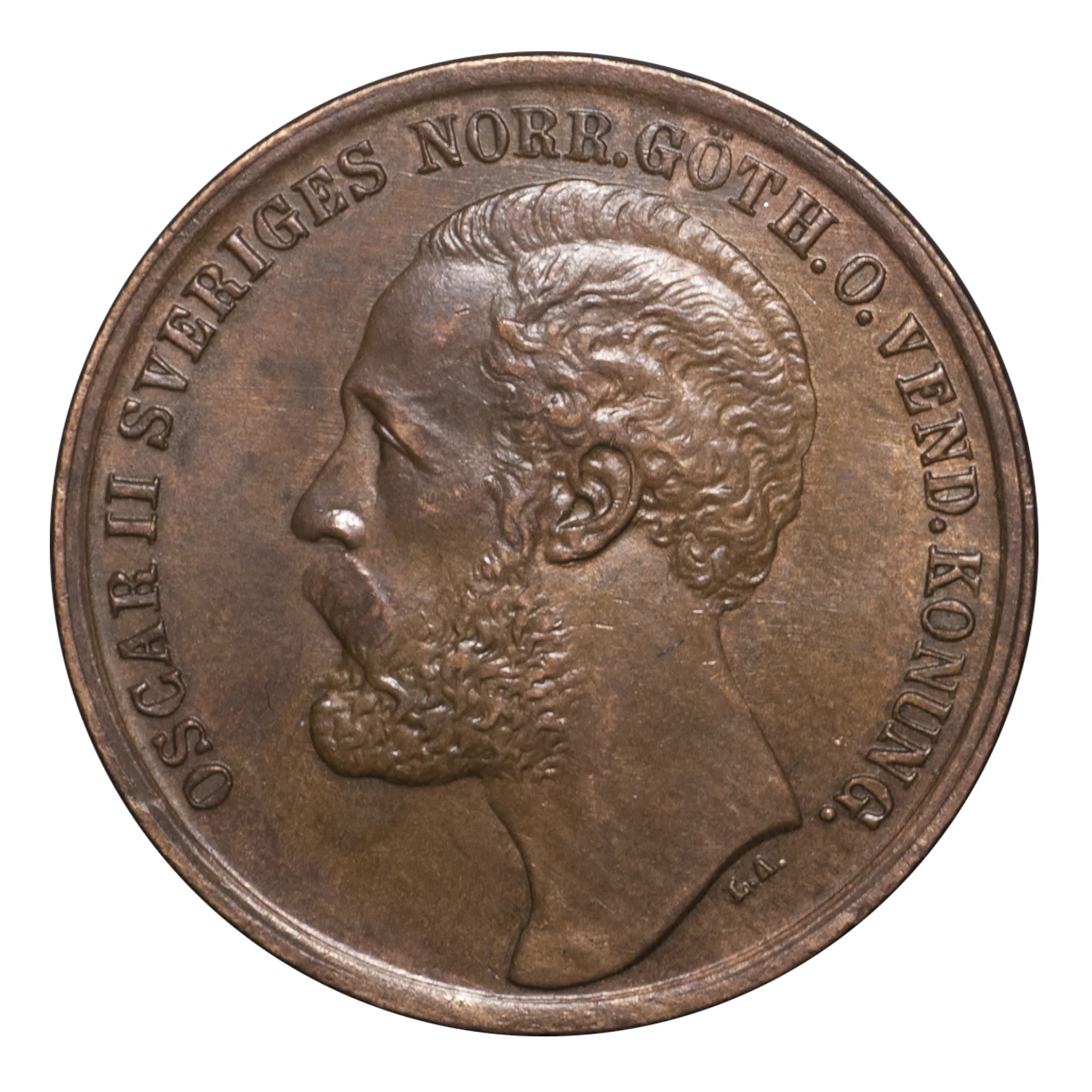
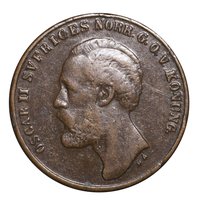
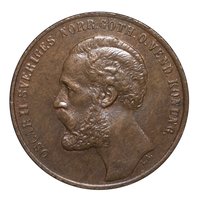
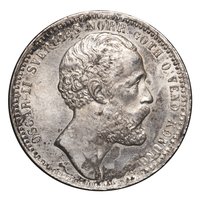
King's head left, within inscription. Engraver's initials below neck.
Inscription:
OSCAR II SVERIGES NORR.GÖTH.O.VEND.KONUNG.
L.A.
L.A.
Translation:
Oscar II, Sweden's, Norway's, Goths' and Wends' King.
Script: Latin
Language: Swedish
Engraver: Lea Ahlborn
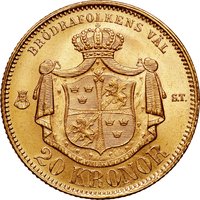
Reverse
Edge
Plain
Mints
| Name | Mark |
|---|---|
| Kungliga Myntet | — |
Mintings
| Year | Mint Mark | Mintage | Quality | Collection |
|---|---|---|---|---|
| 1873 | — | 791,420 |
Historical background
In the decades leading up to 1873, Sweden operated on a complex and cumbersome dual-currency system. The primary unit was the Riksdaler Riksmynt, a silver-based currency, but it existed alongside the older Riksdaler Specie, which was valued at a fixed rate of four times the former. This system, with its confusing exchange rates and calculations in multiples of four, was inefficient for both domestic commerce and international trade. Furthermore, the global shift towards the gold standard, led by Britain, made Sweden's silver-based currency increasingly isolated and vulnerable to fluctuations in the value of silver, which was depreciating during this period.
Recognizing these economic handicaps, Sweden sought a modern, stable, and internationally aligned monetary system. The solution was found through regional cooperation with Denmark, and later Norway, forming the Scandinavian Monetary Union (SMU) in 1873. The central reform was the adoption of a new common gold standard currency, the krona (crown), which replaced the Riksdaler at a rate of 1 krona = 0.5 Riksdaler Riksmynt. The krona was subdivided into 100 öre, introducing a decimal system that greatly simplified everyday transactions and bookkeeping.
Thus, the year 1873 marked a decisive break from Sweden's archaic monetary past. The introduction of the krona and membership in the Scandinavian Monetary Union successfully modernized the national economy, provided stability through the gold standard, and facilitated trade with major European partners. While the political union eventually dissolved, the monetary reforms proved permanent, establishing the framework for Sweden's modern currency, which retains the name "krona" to this day.
Recognizing these economic handicaps, Sweden sought a modern, stable, and internationally aligned monetary system. The solution was found through regional cooperation with Denmark, and later Norway, forming the Scandinavian Monetary Union (SMU) in 1873. The central reform was the adoption of a new common gold standard currency, the krona (crown), which replaced the Riksdaler at a rate of 1 krona = 0.5 Riksdaler Riksmynt. The krona was subdivided into 100 öre, introducing a decimal system that greatly simplified everyday transactions and bookkeeping.
Thus, the year 1873 marked a decisive break from Sweden's archaic monetary past. The introduction of the krona and membership in the Scandinavian Monetary Union successfully modernized the national economy, provided stability through the gold standard, and facilitated trade with major European partners. While the political union eventually dissolved, the monetary reforms proved permanent, establishing the framework for Sweden's modern currency, which retains the name "krona" to this day.
Series: 1873 Sweden circulation coins
🌟 Limited