

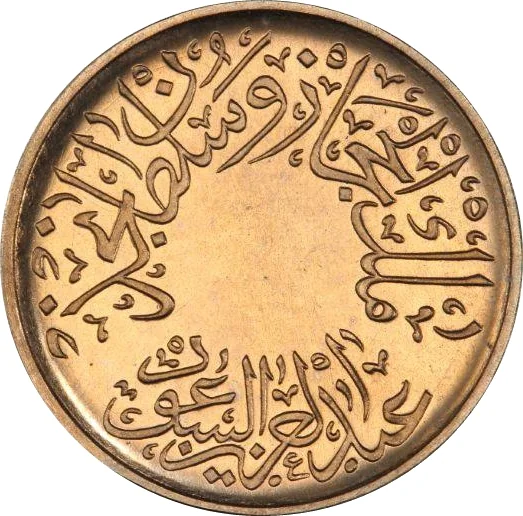
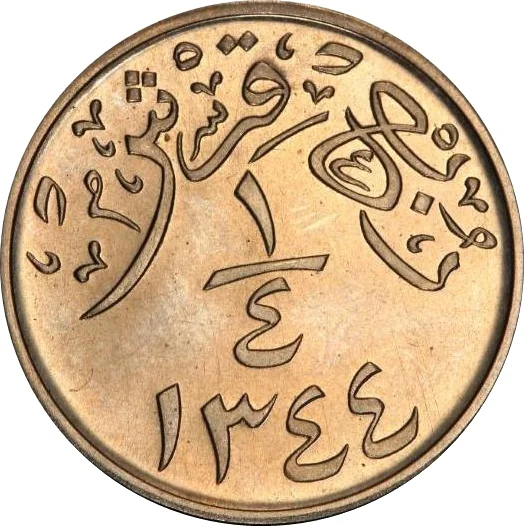
¼ qirsh – Hejaz and Nejd
Add to wishlist
Saudi Arabia
Context
Year: 1926
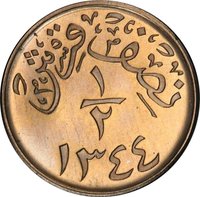
Islamic (Hijri) Year:: 1344
Country: Saudi Arabia
Issuer: Hejaz and Nejd
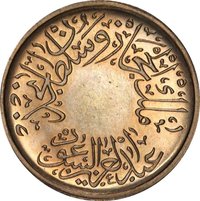
Ruler: Abdulaziz bin Abdulrahman
Currency:
(1925—1960)
Demonetized: Yes
Material
Diameter: 20 mm
Weight: 4.25 g
Shape: Round
Composition: Copper-nickel
Technique: Milled
Alignment: Medal alignment
flip
References
KM: #
Numista: #14212
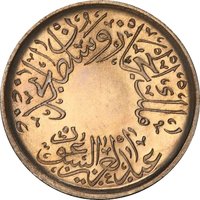
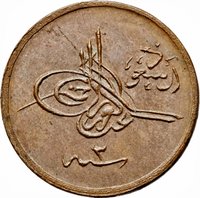
Obverse
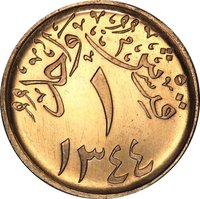
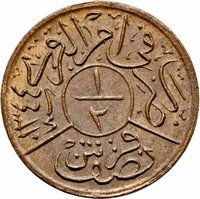
Reverse
Edge
Mintings
| Year | Mint Mark | Mintage | Quality | Collection |
|---|---|---|---|---|
| 1926 | — | — | ||
| 1926 | — | — | Proof |
Historical background
In 1926, the currency situation in the Hejaz and Nejd (the two main regions soon to be unified as the Kingdom of Saudi Arabia in 1932) was complex and fragmented, reflecting the recent and still-consolidating political union under Abdulaziz Ibn Saud. The Hejaz, with its holy cities of Mecca and Medina and a long history of international pilgrimage and trade, used a variety of currencies. The primary official coin was the Ottoman qirsh (piastre), but in practice, British gold sovereigns, Egyptian pounds, Indian rupees, and Maria Theresa thalers all circulated widely, their values fluctuating with market demand. This monetary mosaic was a legacy of the region's integration into global commerce and the recent collapse of Ottoman authority.
In contrast, the interior region of Nejd had a simpler but more isolated currency system, primarily based on silver. The main unit was the riyal, which referred specifically to the Maria Theresa thaler, alongside local silver coins minted in Riyadh and other towns. The value of these coins was largely tied to their intrinsic silver weight, and paper money was non-existent. The economic life of Nejd was more insular, with trade often conducted via barter or these silver coins, and lacked the intense foreign currency influx seen in the Red Sea ports of the Hejaz.
This monetary disunity posed a significant challenge to Ibn Saud's state-building project, hindering efficient administration, trade between the regions, and the establishment of a unified national economy. Recognizing this, 1926 marked a pivotal year of centralization. Following his conquest of the Hejaz, Ibn Saud moved quickly to assert monetary control, issuing new silver coins bearing his name for the first time across both regions. These steps, initiated in 1925-1926 and expanded in 1927, began the slow process of displacing the myriad of foreign coins and laid the essential groundwork for a single, state-controlled currency system in the nascent kingdom.
In contrast, the interior region of Nejd had a simpler but more isolated currency system, primarily based on silver. The main unit was the riyal, which referred specifically to the Maria Theresa thaler, alongside local silver coins minted in Riyadh and other towns. The value of these coins was largely tied to their intrinsic silver weight, and paper money was non-existent. The economic life of Nejd was more insular, with trade often conducted via barter or these silver coins, and lacked the intense foreign currency influx seen in the Red Sea ports of the Hejaz.
This monetary disunity posed a significant challenge to Ibn Saud's state-building project, hindering efficient administration, trade between the regions, and the establishment of a unified national economy. Recognizing this, 1926 marked a pivotal year of centralization. Following his conquest of the Hejaz, Ibn Saud moved quickly to assert monetary control, issuing new silver coins bearing his name for the first time across both regions. These steps, initiated in 1925-1926 and expanded in 1927, began the slow process of displacing the myriad of foreign coins and laid the essential groundwork for a single, state-controlled currency system in the nascent kingdom.
🌟 Uncommon