

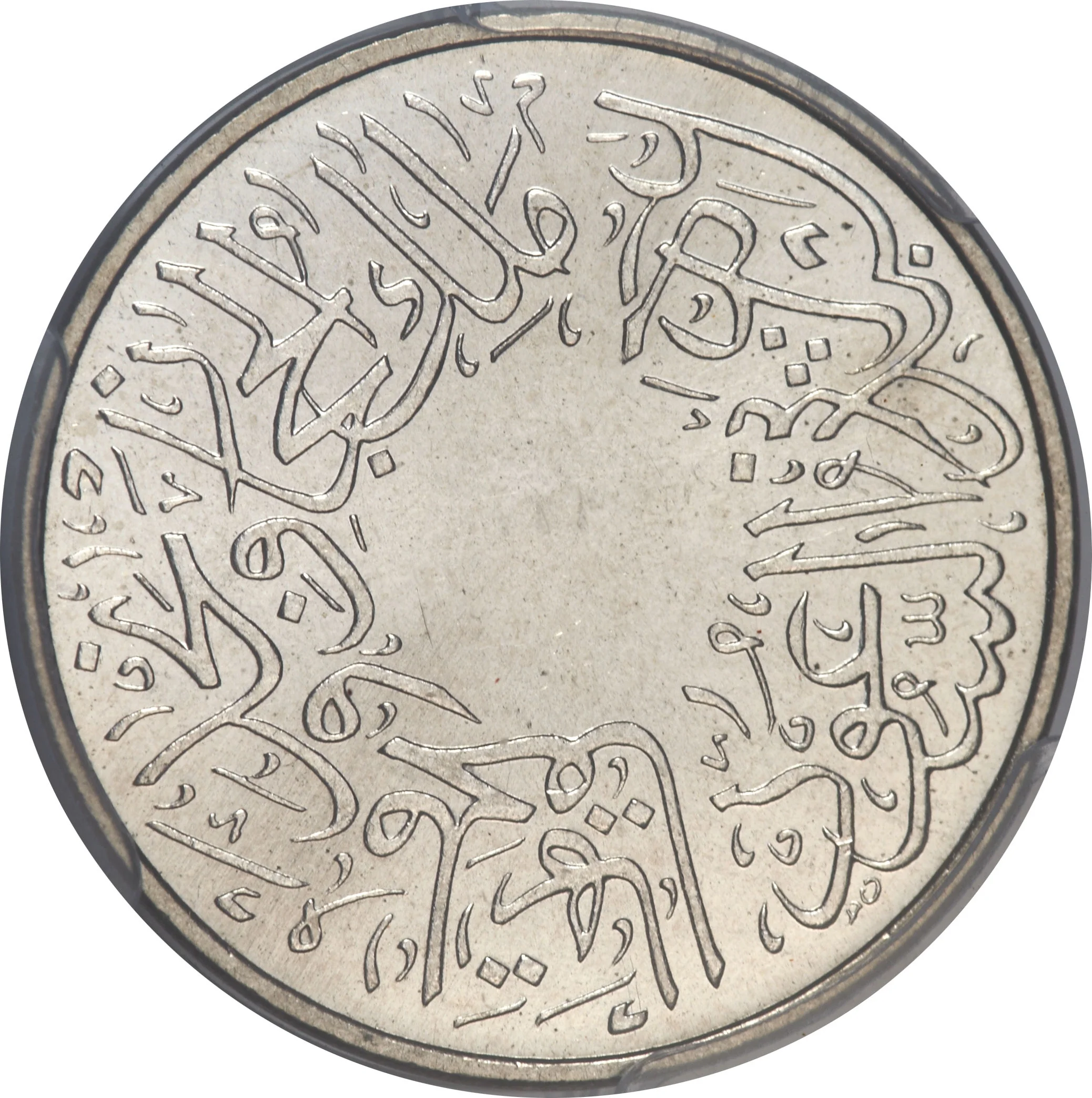
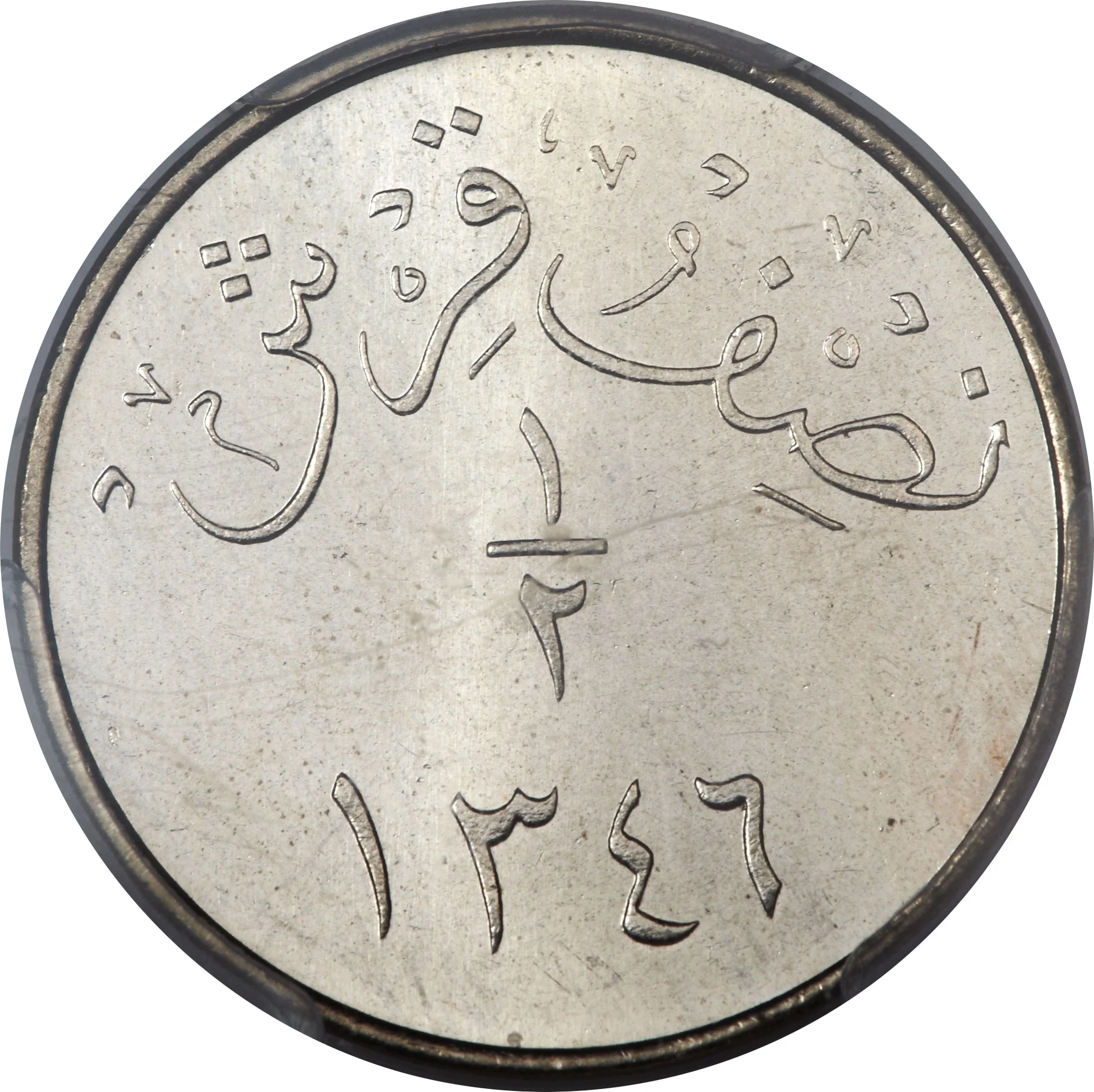
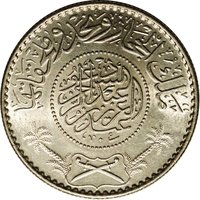
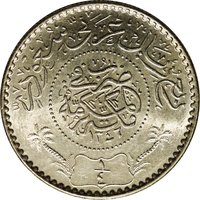
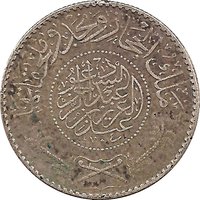
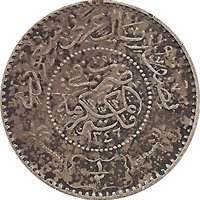
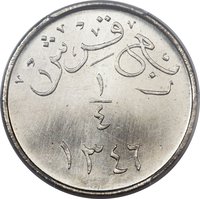
½ qirsh – Hejaz and Nejd
Add to wishlist
Saudi Arabia
Context
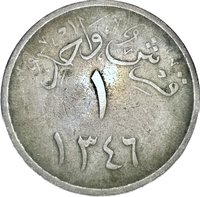
Year: 1928
Islamic (Hijri) Year:: 1346
Country: Saudi Arabia
Issuer: Hejaz and Nejd
Ruler: Abdulaziz bin Abdulrahman
Currency:
(1925—1960)
Demonetized: Yes
Total mintage: 3,000,000
Material
Diameter: 23 mm
Weight: 5 g
Shape: Round
Composition: Copper-nickel
Technique: Milled
Alignment: Medal alignment
flip
References
KM: #
Numista: #14211
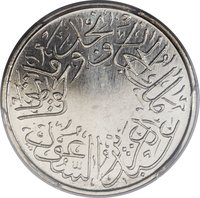
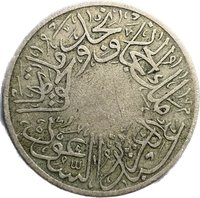
Obverse
Edge
Mintings
| Year | Mint Mark | Mintage | Quality | Collection |
|---|---|---|---|---|
| 1928 | — | 3,000,000 | ||
| 1928 | — | — | Proof |
Historical background
In 1928, the currency situation in the dual kingdoms of Hejaz and Nejd (unified in 1932 as Saudi Arabia) was a complex and transitional reflection of the region's recent political unification. The Hejaz, with its holy cities and long history of trade and pilgrimage, primarily used the Ottoman gold lira and silver rival (riyal), alongside a multitude of foreign coins from the British sovereign to the Indian rupee and Maria Theresa thaler. Nejd, more isolated and tribal, relied heavily on silver rivals, often minted locally or imported, and conducted significant trade through barter. This monetary fragmentation created practical difficulties for administration and commerce across the newly consolidated realm of Sultan Abdulaziz Ibn Saud.
Recognizing the need for monetary sovereignty and uniformity, Ibn Saud's government had already begun to assert control. In 1925, following the conquest of the Hejaz, the first official Saudi silver rival was minted in Mecca, bearing the king's name and intended to circulate alongside existing currencies. By 1928, these efforts were ongoing but incomplete; the new Saudi coins competed with a wide array of older and foreign currencies still in common use. The state lacked a central bank, and paper money was non-existent, with all transactions being conducted in specie (coin).
The year 1928 itself was a pivotal prelude to greater standardization. It was in this year that Ibn Saud granted a concession to a New Zealand businessman, Major Frank Holmes, which included the right to issue banknotes—a right that would later be transferred and lead to the introduction of the first Saudi paper currency in the 1950s. Thus, the currency situation in 1928 was one of deliberate but unfinished centralization, moving from a chaotic, multi-currency past toward a unified national monetary system under the growing authority of the Saudi state.
Recognizing the need for monetary sovereignty and uniformity, Ibn Saud's government had already begun to assert control. In 1925, following the conquest of the Hejaz, the first official Saudi silver rival was minted in Mecca, bearing the king's name and intended to circulate alongside existing currencies. By 1928, these efforts were ongoing but incomplete; the new Saudi coins competed with a wide array of older and foreign currencies still in common use. The state lacked a central bank, and paper money was non-existent, with all transactions being conducted in specie (coin).
The year 1928 itself was a pivotal prelude to greater standardization. It was in this year that Ibn Saud granted a concession to a New Zealand businessman, Major Frank Holmes, which included the right to issue banknotes—a right that would later be transferred and lead to the introduction of the first Saudi paper currency in the 1950s. Thus, the currency situation in 1928 was one of deliberate but unfinished centralization, moving from a chaotic, multi-currency past toward a unified national monetary system under the growing authority of the Saudi state.
🌟 Uncommon