

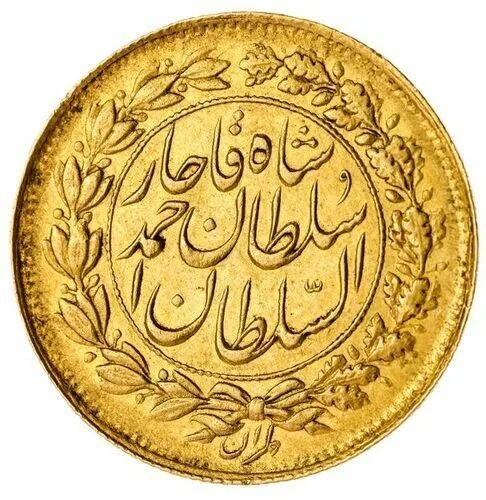
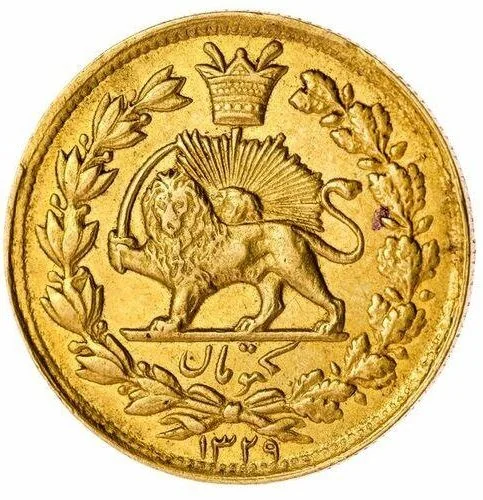
10000 dinars – Iran
Add to wishlist
Standard circulation coins
Series: Legend
Iran
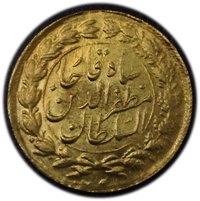
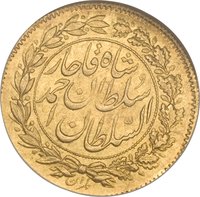
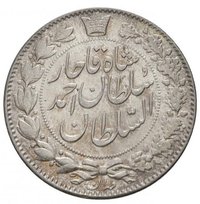
Obverse
Inscription:
السّلطان سلطان احمد شاه قاجار
طهران
طهران
Translation:
The Sultan Sultan Ahmad Shah Qajar
Tehran
Tehran
Script: Persian (nastaliq)
Language: Arabic
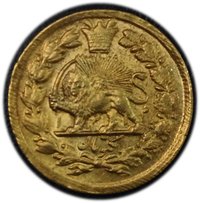
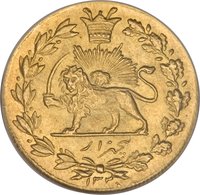
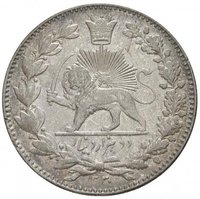
Reverse
Edge
Milled
Mints
| Name | Mark |
|---|---|
| Tehran | طهران |
Mintings
| Year | Mint Mark | Mintage | Quality | Collection |
|---|---|---|---|---|
| — | — | — | ||
| 1911 | — | — | ||
| 1912 | — | — |
Historical background
In 1911, Iran’s currency situation was one of profound disorder and fragmentation, a direct legacy of the 19th century and the Qajar dynasty's declining authority. The monetary system was not unified; instead, it operated on a bimetallic standard with a chaotic mix of domestic and foreign coins in circulation. The primary silver coin was the kran, but its weight and purity varied regionally. Alongside these, gold tomans, copper shahis, and most disruptively, a flood of foreign coins—especially Russian rubles and British rupees—circulated freely, their value fluctuating with political influence and international silver prices. The state treasury was chronically empty due to concessions to foreign powers and royal extravagance, leading to severe debasement of the coinage as a short-term revenue measure, which further eroded public trust.
This financial crisis was exacerbated by major political events. The Constitutional Revolution (1905-1911) had created a fragile new government in Tehran that sought to modernize the state but faced immense internal and external pressures. In 1911, the conflict between the constitutionalists and the deposed Mohammad Ali Shah, backed by Russian forces, reached a critical point. Russia’s military intervention in the north effectively partitioned the country, and its banks, particularly the Russian Loan and Discount Bank, issued substantial amounts of paper rubles that circulated as forced currency, undermining Iran’s monetary sovereignty. The government's attempt to establish a national bank had previously failed, leaving no central institution to control the currency or issue stable notes.
Consequently, by the end of 1911, Iran lacked a unified national currency, had no central bank, and its monetary system was effectively Balkanized between Russian and British spheres of influence. The widespread debasement of coinage led to rampant inflation, crippling trade and causing significant hardship for the population. This chaotic currency situation symbolized the broader collapse of Qajar state authority and the severe limitations of the constitutional government, highlighting how Iran’s financial system had become a key battleground for imperial rivalry and a major obstacle to national sovereignty and economic stability.
This financial crisis was exacerbated by major political events. The Constitutional Revolution (1905-1911) had created a fragile new government in Tehran that sought to modernize the state but faced immense internal and external pressures. In 1911, the conflict between the constitutionalists and the deposed Mohammad Ali Shah, backed by Russian forces, reached a critical point. Russia’s military intervention in the north effectively partitioned the country, and its banks, particularly the Russian Loan and Discount Bank, issued substantial amounts of paper rubles that circulated as forced currency, undermining Iran’s monetary sovereignty. The government's attempt to establish a national bank had previously failed, leaving no central institution to control the currency or issue stable notes.
Consequently, by the end of 1911, Iran lacked a unified national currency, had no central bank, and its monetary system was effectively Balkanized between Russian and British spheres of influence. The widespread debasement of coinage led to rampant inflation, crippling trade and causing significant hardship for the population. This chaotic currency situation symbolized the broader collapse of Qajar state authority and the severe limitations of the constitutional government, highlighting how Iran’s financial system had become a key battleground for imperial rivalry and a major obstacle to national sovereignty and economic stability.
Series: Legend
✨ Legendary