

10 Francs – French Polynesia
France
Context
Year: 1967
Country: France 
Issuer: French Polynesia
Period:
(1957—2003)
Currency:
(since 1945)
Demonetization: 30 November 2022
Total mintage: 1,000,000
Material
References
KM: #Click to copy to clipboard5
Numista: #3746
Value
Exchange value: 10 XPF
Inflation-adjusted value: 101.14 XPF
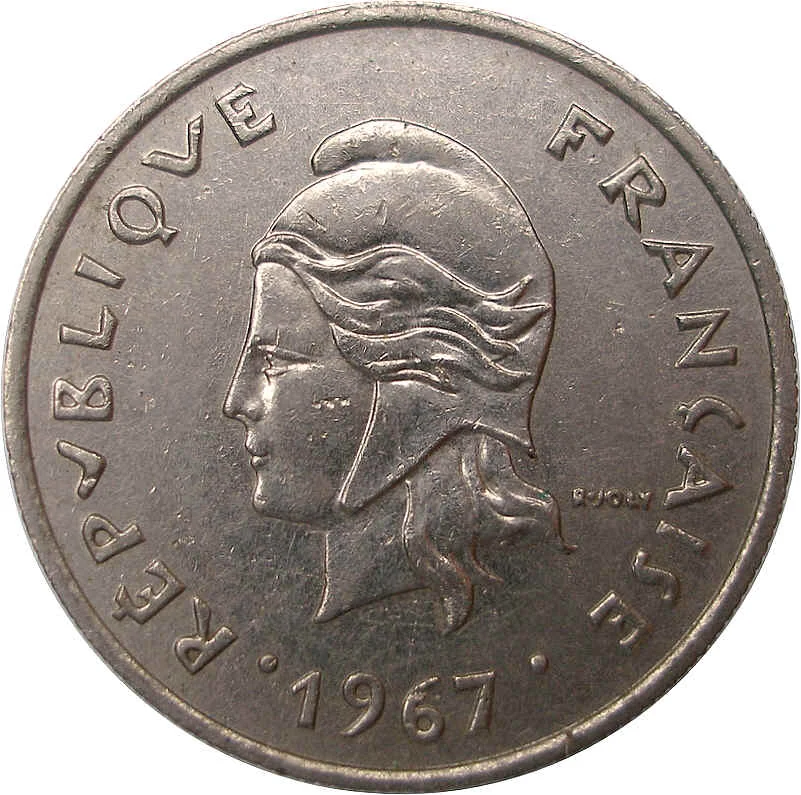
Obverse
Description:
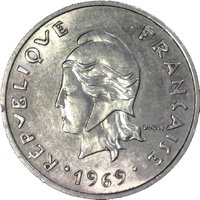
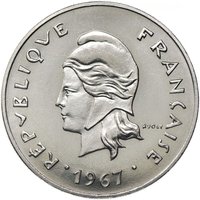
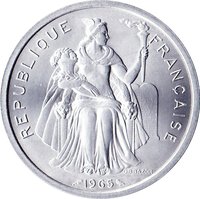
Marianne left, date below, legend around.
Inscription:
RÉPUBLIQUE FRANÇAISE
R. JOLY
1967
R. JOLY
1967
Translation:
FRENCH REPUBLIC
R. JOLY
1967
R. JOLY
1967
Script: Latin
Language: French
Engraver: Raymond Joly
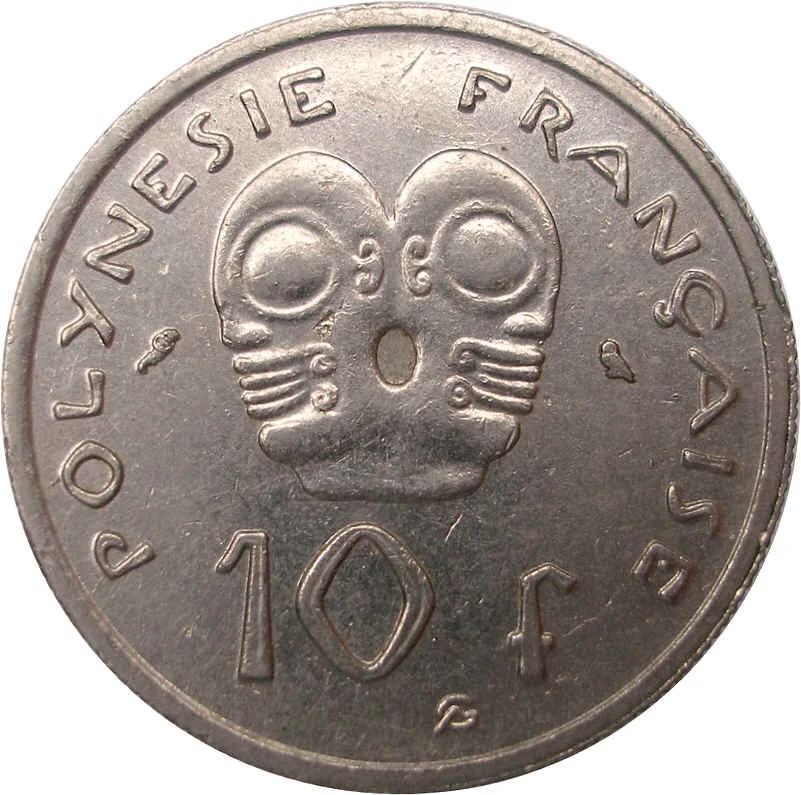
Reverse
Description:
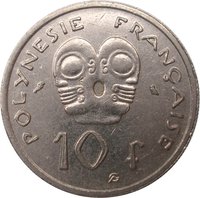
Tribal mask over value.
Inscription:
POLYNÉSIE FRANÇAISE
10 F
10 F
Translation:
French Polynesia
10 Francs
10 Francs
Script: Latin
Language: French
Engraver: Aleth Guzman-Nageotte
Edge
Milled
Mints
| Name | Mark |
|---|---|
| Monnaie de Paris | — |
Mintings
| Year | Mint Mark | Mintage | Quality | Collection |
|---|---|---|---|---|
| 1967 | — | 1,000,000 |
Historical background
In 1967, French Polynesia's currency situation was defined by its status as an overseas territory of France, utilizing the CFP franc (Franc des Colonies Françaises du Pacifique). Established in 1945, the CFP franc was created to insulate France's Pacific and later African territories from the high inflation and devaluations affecting the metropolitan French franc. By the 1960s, its value was pegged not directly to the French franc, but to a new international benchmark: the French treasury guaranteed its convertibility and fixed its exchange rate to the French franc at 0.055 French francs per 1 CFP franc. This stable peg provided economic predictability and facilitated trade and subsidy flows from Paris.
This monetary arrangement was deeply intertwined with France's strategic interests in the region, particularly the establishment of the Centre d'Expérimentation du Pacifique (CEP)—France's nuclear testing facility—on the atolls of Moruroa and Fangataufa in 1963. The massive influx of French military personnel, investment, and infrastructure spending associated with the CEP created an economic boom in Tahiti, centered around the capital, Papeete. The fixed CFP franc facilitated this financial transfer and helped manage the sudden injection of capital, but it also tied the local economy's health directly to French political and military priorities rather than purely regional market forces.
Consequently, while the currency itself was stable, the broader "currency situation" reflected a period of profound economic and social transformation. The CEP-driven boom accelerated urbanization and a shift from a subsistence-based economy to a cash-centric one, with the CFP franc as its vehicle. This dependence on French monetary policy and spending underscored the territory's colonial economic integration, a point of growing political discussion as nascent movements for greater autonomy began to consider economic sovereignty, including monetary policy, as a future aspiration. Thus, in 1967, the CFP franc symbolized both stability and dependence within a colony undergoing rapid and disruptive change.
This monetary arrangement was deeply intertwined with France's strategic interests in the region, particularly the establishment of the Centre d'Expérimentation du Pacifique (CEP)—France's nuclear testing facility—on the atolls of Moruroa and Fangataufa in 1963. The massive influx of French military personnel, investment, and infrastructure spending associated with the CEP created an economic boom in Tahiti, centered around the capital, Papeete. The fixed CFP franc facilitated this financial transfer and helped manage the sudden injection of capital, but it also tied the local economy's health directly to French political and military priorities rather than purely regional market forces.
Consequently, while the currency itself was stable, the broader "currency situation" reflected a period of profound economic and social transformation. The CEP-driven boom accelerated urbanization and a shift from a subsistence-based economy to a cash-centric one, with the CFP franc as its vehicle. This dependence on French monetary policy and spending underscored the territory's colonial economic integration, a point of growing political discussion as nascent movements for greater autonomy began to consider economic sovereignty, including monetary policy, as a future aspiration. Thus, in 1967, the CFP franc symbolized both stability and dependence within a colony undergoing rapid and disruptive change.
🌱 Very Common