

1 franc – French Polynesia
Add to wishlist
France
Context
Year: 1965
Country: France
Issuer: French Polynesia
Period:
(1957—2003)
Currency:
(since 1945)
Demonetization: 30 November 2022
Total mintage: 4,300,000
Material
References
KM: #
Numista: #3743
Value
Exchange value: 1 XPF
Inflation-adjusted value: 10.66 XPF
Obverse
Description:
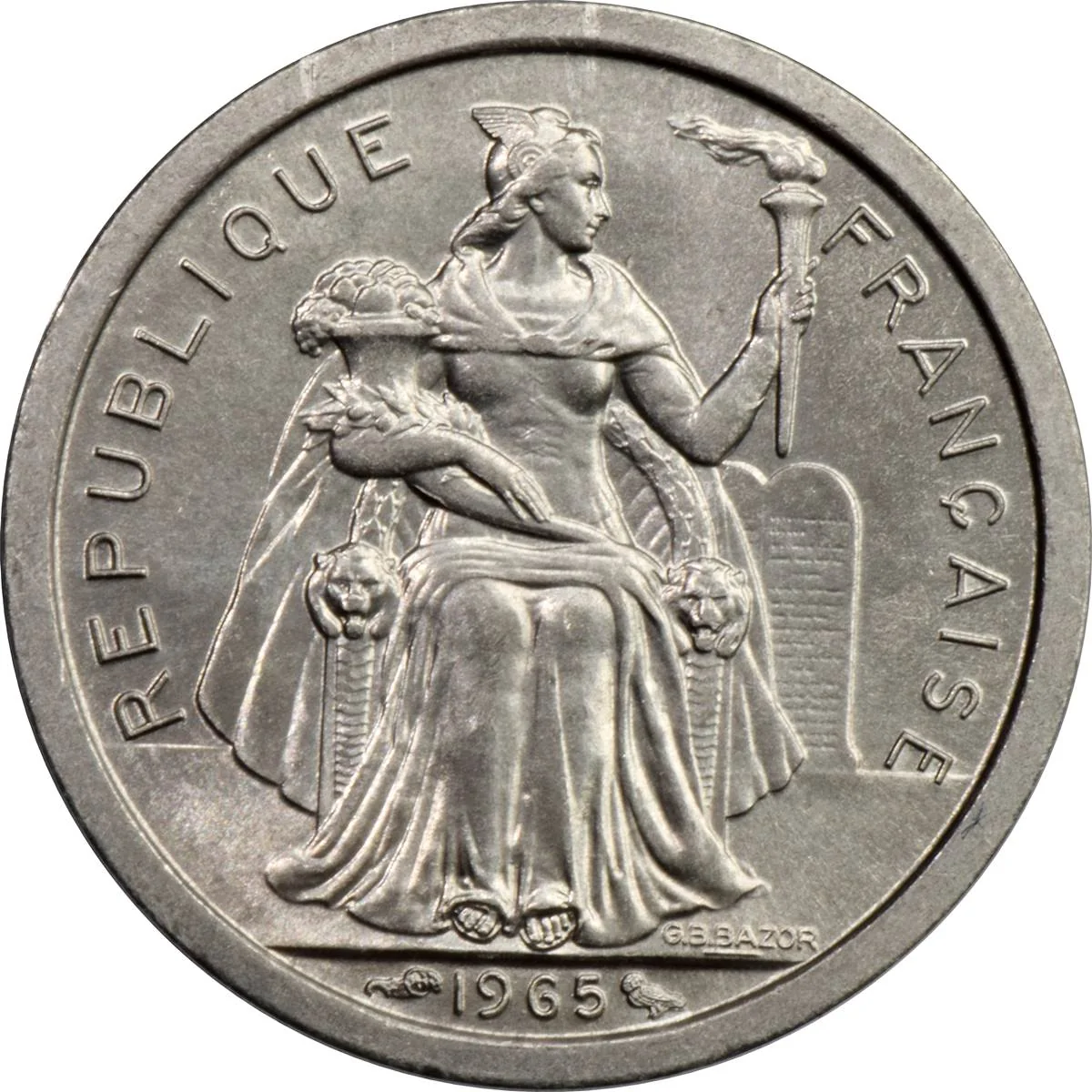
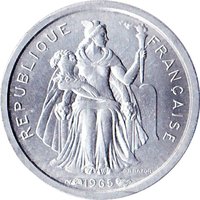
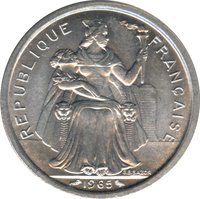
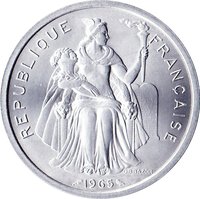
Liberty seated left on throne, holding a lit torch in her left hand and a cornucopia of fruit in her right arm.
Inscription:
REPUBLIQUE FRANÇAISE
G.B.BAZOR
1965
G.B.BAZOR
1965
Translation:
FRENCH REPUBLIC
G.B.BAZOR
1965
G.B.BAZOR
1965
Script: Latin
Language: French
Engraver: Lucien Georges Bazor
Reverse
Description:
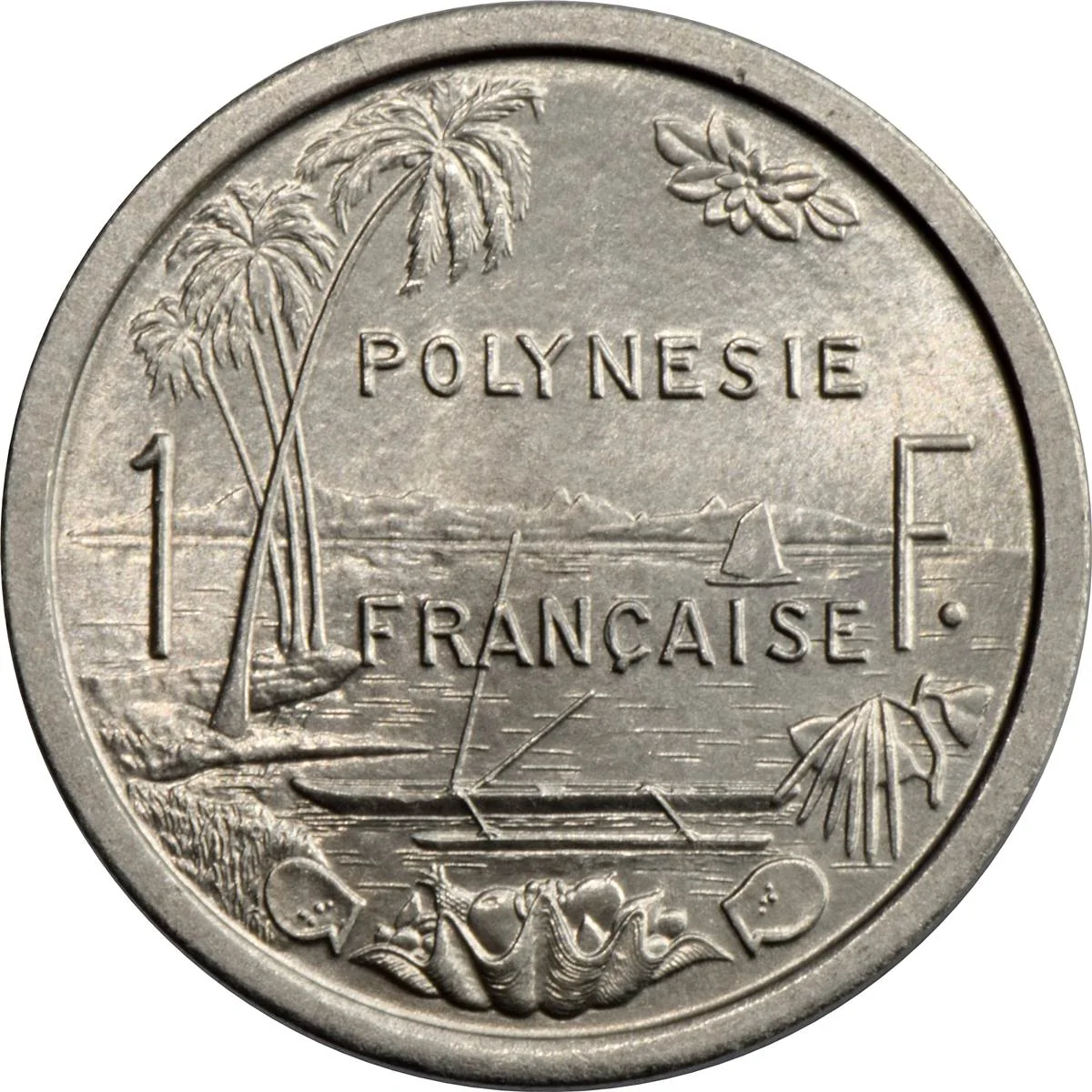
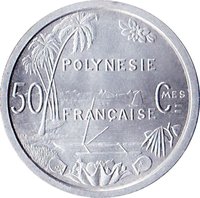
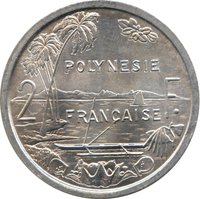
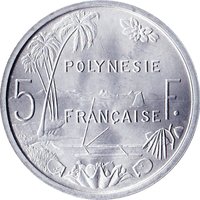
Palm trees left, sailboat on sea, distant mountains. Outrigger boat and fruit in foreground.
Inscription:
POLYNESIE
1F.
FRANÇAISE
1F.
FRANÇAISE
Translation:
French Polynesia
1 Franc
1 Franc
Script: Latin
Language: French
Engraver: Lucien Georges Bazor
Edge
Plain
Categories
| Symbol> Allegory |
| Plant> Tree |
| Symbol> Cornucopia |
| Transportation> Watercraft |
Mints
| Name | Mark |
|---|---|
| Monnaie de Paris | — |
Mintings
| Year | Mint Mark | Mintage | Quality | Collection |
|---|---|---|---|---|
| 1965 | — | 4,300,000 |
Historical background
In 1965, French Polynesia remained under the monetary authority of France, utilizing the CFP franc (Change Franc Pacifique) as its official currency. This system, established in 1945, was designed to provide monetary stability to France's Pacific territories by pegging the CFP franc to the French franc at a fixed rate. For French Polynesia, then undergoing significant economic and social transformation due to the establishment of the Centre d'Expérimentation du Pacifique (CEP)—France's nuclear testing program—this fixed link to the metropolitan currency was crucial. It ensured predictable financial conditions for the massive influx of French military personnel, infrastructure investment, and associated commercial activity.
The currency's value was guaranteed by the French Treasury, meaning the CFP franc had no independent monetary policy. Its exchange rate was set and maintained by Paris, insulating the territory from foreign exchange volatility but also leaving it entirely dependent on France's economic management. This period saw the CFP franc's peg adjusted from its original 1945 value to a new fixed rate of 100 CFP francs = 5.50 French francs in 1960, following France's own currency reform that introduced the "nouveau franc." This peg remained firmly in place throughout 1965.
Economically, the CFP franc system facilitated the booming, but distorted, economy driven by the nuclear tests. It simplified financial transactions for the state and military contractors, but also contributed to a high cost of living for local residents, as imported goods were expensive and the economy became increasingly oriented towards servicing the CEP. While providing stability, the currency regime was a clear symbol of French Polynesia's integrated colonial status, with no local control over monetary issuance or policy, a situation that would persist for decades.
The currency's value was guaranteed by the French Treasury, meaning the CFP franc had no independent monetary policy. Its exchange rate was set and maintained by Paris, insulating the territory from foreign exchange volatility but also leaving it entirely dependent on France's economic management. This period saw the CFP franc's peg adjusted from its original 1945 value to a new fixed rate of 100 CFP francs = 5.50 French francs in 1960, following France's own currency reform that introduced the "nouveau franc." This peg remained firmly in place throughout 1965.
Economically, the CFP franc system facilitated the booming, but distorted, economy driven by the nuclear tests. It simplified financial transactions for the state and military contractors, but also contributed to a high cost of living for local residents, as imported goods were expensive and the economy became increasingly oriented towards servicing the CEP. While providing stability, the currency regime was a clear symbol of French Polynesia's integrated colonial status, with no local control over monetary issuance or policy, a situation that would persist for decades.
🌱 Very Common