

1 Markka – Finland
Finland
Context
Years: 1969–1993
Issuer: Finland 
Period:
(since 1919)
Currency:
(1963—2001)
Demonetization: 31 December 1997
Total mintage: 420,968,999
Material
References
KM: #Click to copy to clipboard49a
Numista: #3737
Value
Exchange value: 1 FIM
Inflation-adjusted value: 10.79 FIM
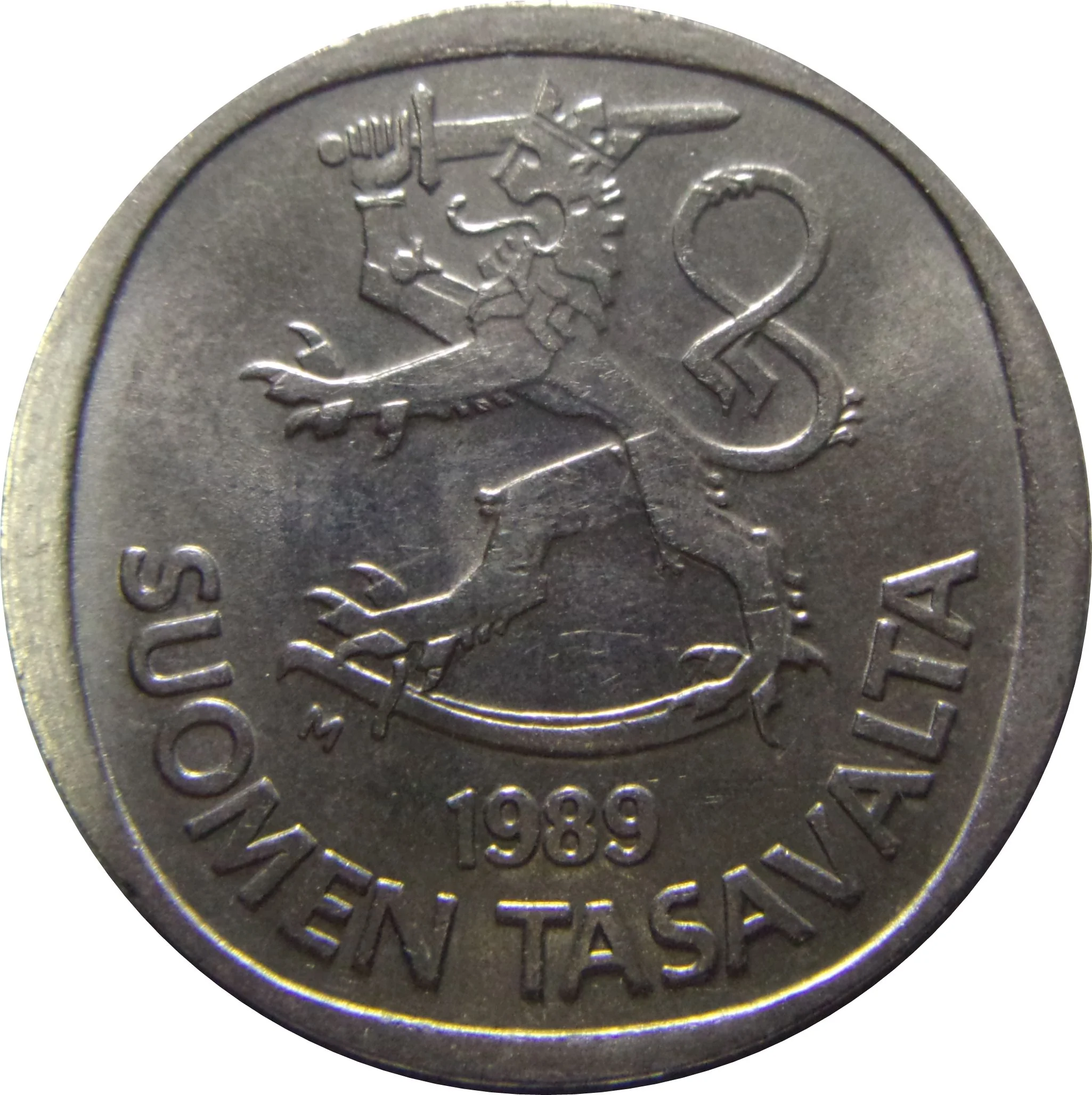
Obverse
Description:
Heraldic emblem
Inscription:
M
1989
SUOMEN TASAVALTA
1989
SUOMEN TASAVALTA
Translation:
M
1989
REPUBLIC OF FINLAND
1989
REPUBLIC OF FINLAND
Script: Latin
Language: Finnish
Engraver: Olof Eriksson
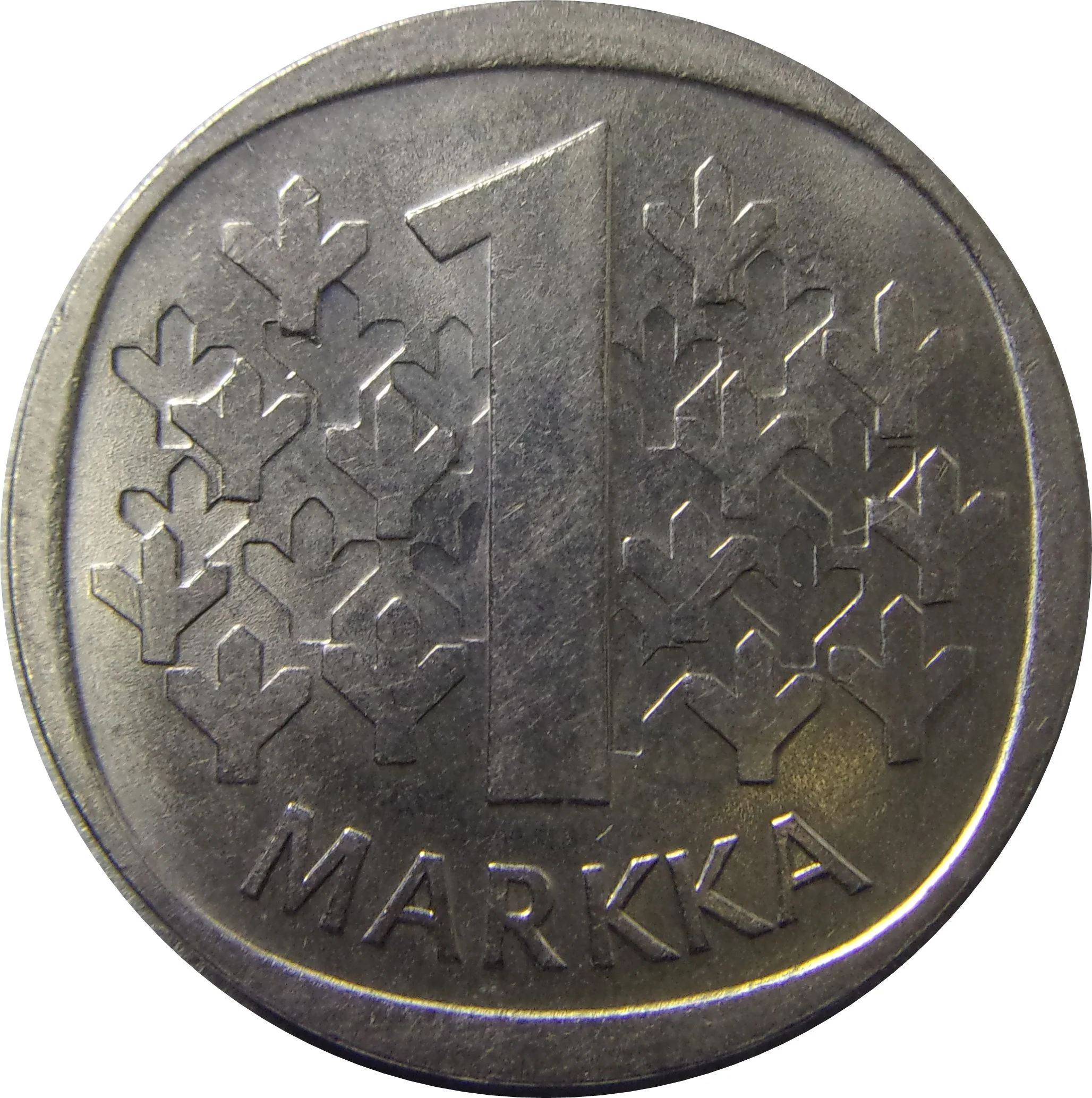
Reverse
Description:
Stylized trees foreground.
Inscription:
1
MARKKA
MARKKA
Script: Latin
Engraver: Heikki Häiväoja
Edge
Inscripted
Legend:
*** SUOMI FINLAND *** SUOMI FINLAND
Categories
| Animal> Feline |
| Symbols> Coat of Arms |
| Object> Cold weapons |
Mints
| Name | Mark |
|---|---|
| Mint of Finland | — |
Mintings
| Year | Mint Mark | Mintage | Quality | Collection |
|---|---|---|---|---|
| 1969 | — | 1,308,000 | ||
| 1970 | — | 12,255,000 | ||
| 1971 | — | 19,676,000 | ||
| 1972 | — | 19,885,000 | ||
| 1973 | — | 17,060,000 | ||
| 1974 | — | 18,065,000 | ||
| 1975 | — | 11,523,000 | ||
| 1976 | — | 12,048,000 | ||
| 1977 | — | 10,077,000 | ||
| 1978 | — | 10,022,000 | ||
| 1979 | — | 11,311,000 | ||
| 1980 | — | 19,306,000 | ||
| 1981 | — | 32,003,000 | ||
| 1982 | — | 30,001,000 | ||
| 1983 | — | 8,074,999 | ||
| 1984 | — | 15,000,000 | ||
| 1985 | — | 19,001,000 | ||
| 1986 | — | 10,000,000 | ||
| 1987 | — | 9,303,000 | ||
| 1988 | — | 27,535,000 | ||
| 1989 | — | 37,520,000 | ||
| 1990 | — | 50,305,000 | ||
| 1991 | — | 15,026,000 | ||
| 1992 | — | 3,628,000 | ||
| 1993 | — | 1,036,000 |
Historical background
In 1969, Finland operated under a fixed exchange rate system as part of the Bretton Woods framework, pegging the Finnish markka (FIM) to the US dollar. This system provided stability for international trade, which was crucial for Finland's export-dependent economy, heavily reliant on industries like forestry and metalworking. However, maintaining this peg required strict monetary discipline and significant foreign exchange reserves, limiting the government's ability to use independent monetary policy to stimulate the domestic economy.
Domestically, the period was characterized by strong economic growth and rising inflation, partly fueled by wage increases secured through centralized agreements between powerful trade unions and employers' organizations. This created underlying pressure on the markka's fixed parity, as rising domestic costs threatened export competitiveness. Furthermore, the global Bretton Woods system itself was showing signs of strain, with increasing speculation against major currencies, casting a shadow of uncertainty over all participating currencies, including the markka.
Consequently, 1969 represented a calm before a significant storm. While the currency situation was stable on the surface, the fixed exchange rate was becoming increasingly difficult to sustain in the face of domestic inflationary pressures and looming international monetary instability. This precarious balance would soon be disrupted, leading Finland to devalue the markka in 1967 and again in 1967, and ultimately to a series of devaluations and the abandonment of the dollar peg in the early 1970s as the Bretton Woods system collapsed.
Domestically, the period was characterized by strong economic growth and rising inflation, partly fueled by wage increases secured through centralized agreements between powerful trade unions and employers' organizations. This created underlying pressure on the markka's fixed parity, as rising domestic costs threatened export competitiveness. Furthermore, the global Bretton Woods system itself was showing signs of strain, with increasing speculation against major currencies, casting a shadow of uncertainty over all participating currencies, including the markka.
Consequently, 1969 represented a calm before a significant storm. While the currency situation was stable on the surface, the fixed exchange rate was becoming increasingly difficult to sustain in the face of domestic inflationary pressures and looming international monetary instability. This precarious balance would soon be disrupted, leading Finland to devalue the markka in 1967 and again in 1967, and ultimately to a series of devaluations and the abandonment of the dollar peg in the early 1970s as the Bretton Woods system collapsed.
🌱 Very Common