

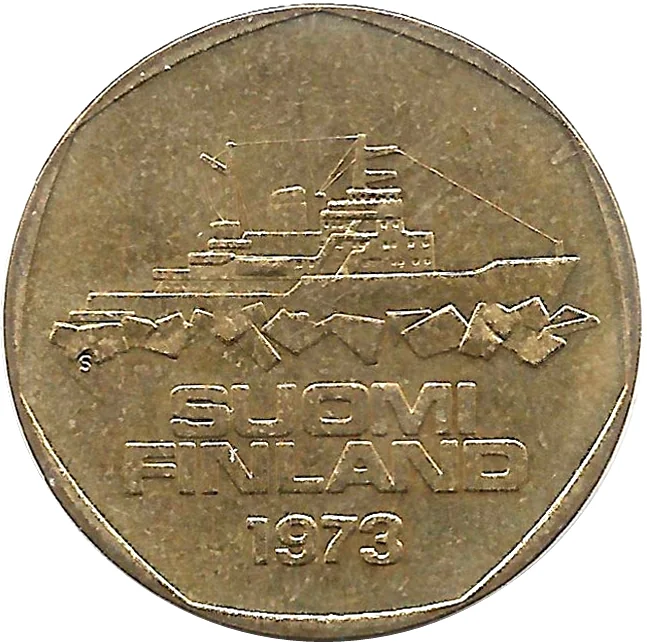
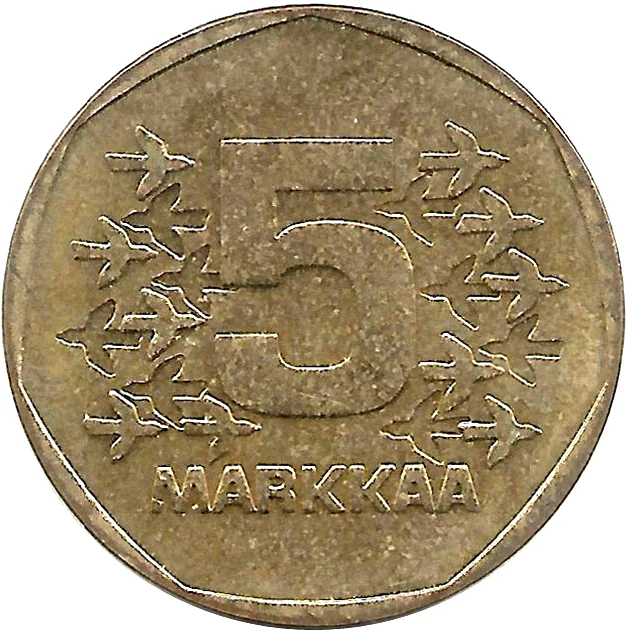
Obverse
Description:
Icebreaker "Varma," date below.
Inscription:
SUOMI
FINLAND
1973
FINLAND
1973
Script: Latin
Engraver: Heikki Häiväoja
Reverse
Description:
Stylized bird flock, denomination centered.
Inscription:
5
MARKKAA
MARKKAA
Script: Latin
Engraver: Heikki Häiväoja
Edge
Inscribed in hollow.
Legend:
REPUBLIKEN FINLAND SUOMEN TASAVALTA
Categories
| Transportation> Watercraft |
Mints
| Name | Mark |
|---|---|
| Mint of Finland | — |
Mintings
| Year | Mint Mark | Mintage | Quality | Collection |
|---|---|---|---|---|
| 1972 | — | 400,000 | ||
| 1973 | — | 2,188,000 | ||
| 1974 | — | 300,000 | ||
| 1975 | — | 300,000 | ||
| 1976 | — | 400,000 | ||
| 1977 | — | 300,000 | ||
| 1978 | — | 300,000 |
Historical background
In 1972, Finland's currency situation was defined by its position within the Bretton Woods system of fixed exchange rates, but under significant strain. The Finnish markka (FIM) was pegged to a basket of currencies, heavily weighted toward the US dollar. This system aimed to provide stability for Finland's export-dependent economy, which relied heavily on trade with both Western markets and the Soviet Union. However, the early 1970s were a period of global monetary turmoil, triggered by the collapse of the Bretton Woods system in 1971 when the US suspended the dollar's convertibility to gold, leading to widespread currency fluctuations and revaluations.
Domestically, Finland faced inflationary pressures and a deteriorating current account balance. A major devaluation of 8.5% had already occurred in 1967 to restore competitiveness, but by 1972, economic overheating from rapid wage growth and strong domestic demand was again putting downward pressure on the markka. To defend the fixed peg, the Bank of Finland was compelled to intervene frequently in foreign exchange markets, depleting reserves and imposing restrictions on capital movements. This period was characterized by a constant struggle to balance the need for a stable exchange rate with the realities of domestic inflation and global instability.
Consequently, 1972 was a transitional year, setting the stage for a significant policy shift. The rigid fixed exchange rate regime was becoming increasingly unsustainable. The pressures of this year contributed to the decision, just a year later in 1973, to formally abandon the strict peg. Finland moved to a crawling peg system, allowing the markka to depreciate in a controlled manner against its currency basket. This change aimed to better reconcile external competitiveness with internal economic conditions, marking the end of the Bretton Woods era for Finland and the beginning of a more flexible exchange rate policy.
Domestically, Finland faced inflationary pressures and a deteriorating current account balance. A major devaluation of 8.5% had already occurred in 1967 to restore competitiveness, but by 1972, economic overheating from rapid wage growth and strong domestic demand was again putting downward pressure on the markka. To defend the fixed peg, the Bank of Finland was compelled to intervene frequently in foreign exchange markets, depleting reserves and imposing restrictions on capital movements. This period was characterized by a constant struggle to balance the need for a stable exchange rate with the realities of domestic inflation and global instability.
Consequently, 1972 was a transitional year, setting the stage for a significant policy shift. The rigid fixed exchange rate regime was becoming increasingly unsustainable. The pressures of this year contributed to the decision, just a year later in 1973, to formally abandon the strict peg. Finland moved to a crawling peg system, allowing the markka to depreciate in a controlled manner against its currency basket. This change aimed to better reconcile external competitiveness with internal economic conditions, marking the end of the Bretton Woods era for Finland and the beginning of a more flexible exchange rate policy.
🌱 Common