


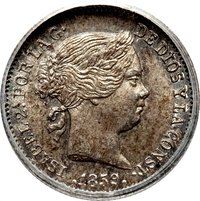
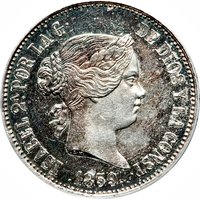
Obverse
Description:
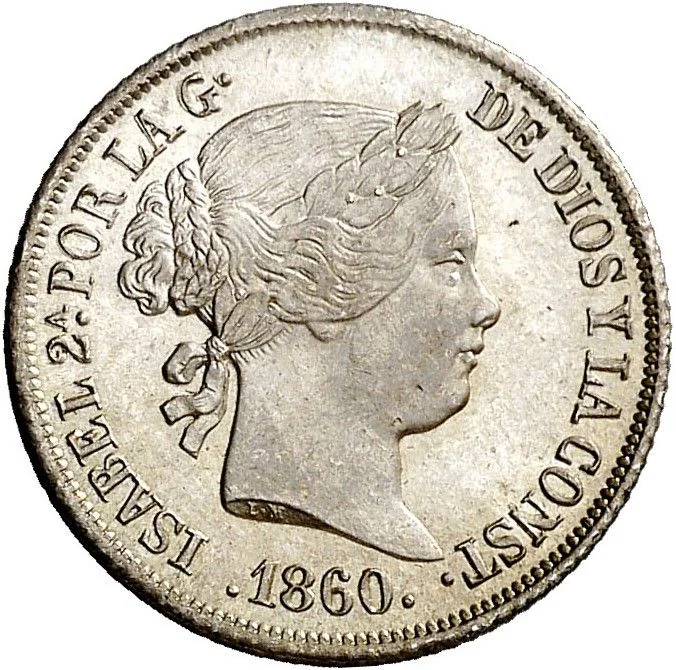
Queen Isabella II facing right.
Inscription:
ISABEL 2A. POR LA G· DE DIOS Y LA CONST·
.1860.
.1860.
Translation:
ISABELLA 2ND. BY THE GRACE OF GOD AND THE CONSTITUTION.
.1860.
.1860.
Script: Latin
Language: Spanish
Engraver: Luis Marchionni y Hombrón
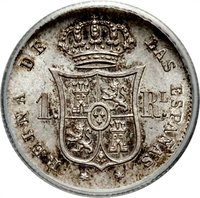
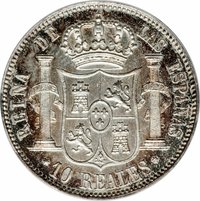
Reverse
Description:
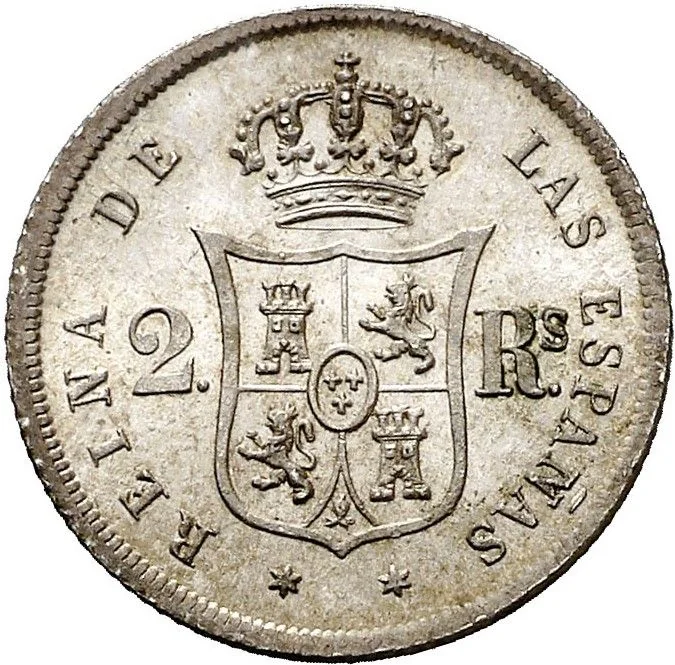
Royal arms of Spain.
Inscription:
* REINA DE LAS ESPAÑAS *
2. RS.
2. RS.
Translation:
Queen of the Spains
Script: Latin
Language: Spanish
Engraver: Luis Marchionni y Hombrón
Edge
Reeded
Categories
| Symbols> Coat of Arms |
Mints
| Name | Mark |
|---|---|
| Barcelona Mint / La Seca | — |
| Royal Mint of Madrid | — |
| Royal Mint of Seville | — |
Mintings
| Year | Mint Mark | Mintage | Quality | Collection |
|---|---|---|---|---|
| 1857 | — | — | ||
| 1858 | — | — | ||
| 1859 | — | — | ||
| 1860 | — | — | ||
| 1861 | — | — | ||
| 1862 | — | — | ||
| 1863 | — | — | ||
| 1864 | — | — |
Historical background
In 1857, Spain's currency system was a complex and unstable patchwork, a legacy of its turbulent early 19th century. The country lacked a unified national coinage; instead, a multitude of old regional and monarchical coins—including the real, the escudo, and the peseta (then a unit of account equal to 4 reales)—circulated simultaneously. This monetary fragmentation was exacerbated by severe budget deficits, heavy public debt from the Carlist Wars, and a reliance on foreign loans, which undermined confidence in the state's financial health. The result was a system prone to confusion, hindering domestic commerce and integration into the wider European economy.
The immediate trigger for the crisis of 1857 was a sharp credit contraction originating in international markets, which exposed the weaknesses of the Spanish banking system. Speculative bubbles, particularly in railway investments financed by unstable credit, burst as foreign capital fled. This led to a cascade of bank failures and a severe liquidity crisis. With the banking sector in distress, the already fragile currency situation worsened, as trust in paper banknotes evaporated and a scramble for scarce precious metal coins ensued, effectively causing a metallic currency shortage.
This turmoil provided the final impetus for a long-needed reform. In 1857, the government of the Liberal Union under Leopoldo O'Donnell took decisive action. The Banking Law of 1857 and the accompanying Currency Reform were enacted to impose order. The reforms centralized the right of note issuance, strengthening the Bank of San Fernando (soon to be the Bank of Spain), and most importantly, they officially adopted the peseta as the sole monetary unit, paving the way for a decimal-based national coinage. Thus, the crisis of 1857 became the crucible that forged the modern Spanish monetary system, setting the legal foundation for the peseta's full introduction a decade later in 1868.
The immediate trigger for the crisis of 1857 was a sharp credit contraction originating in international markets, which exposed the weaknesses of the Spanish banking system. Speculative bubbles, particularly in railway investments financed by unstable credit, burst as foreign capital fled. This led to a cascade of bank failures and a severe liquidity crisis. With the banking sector in distress, the already fragile currency situation worsened, as trust in paper banknotes evaporated and a scramble for scarce precious metal coins ensued, effectively causing a metallic currency shortage.
This turmoil provided the final impetus for a long-needed reform. In 1857, the government of the Liberal Union under Leopoldo O'Donnell took decisive action. The Banking Law of 1857 and the accompanying Currency Reform were enacted to impose order. The reforms centralized the right of note issuance, strengthening the Bank of San Fernando (soon to be the Bank of Spain), and most importantly, they officially adopted the peseta as the sole monetary unit, paving the way for a decimal-based national coinage. Thus, the crisis of 1857 became the crucible that forged the modern Spanish monetary system, setting the legal foundation for the peseta's full introduction a decade later in 1868.
🌟 Limited