

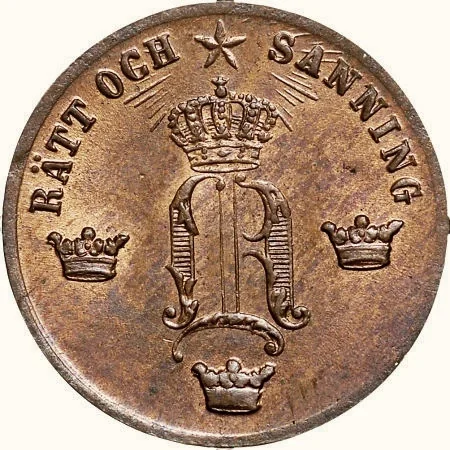
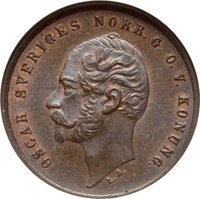
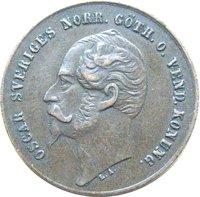
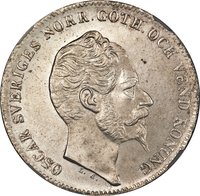
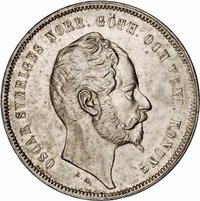
Obverse
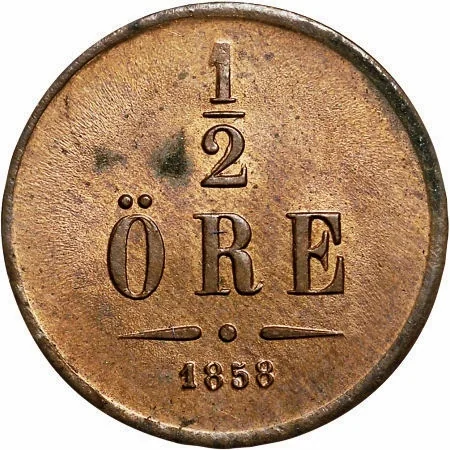
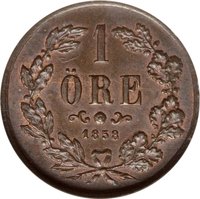
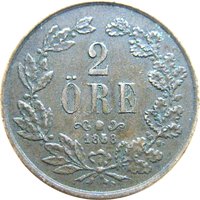
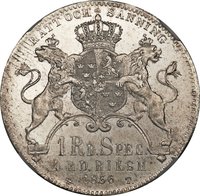
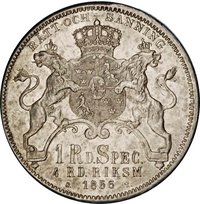
Reverse
Edge
Plain
Mints
| Name | Mark |
|---|---|
| Kungliga Myntet | — |
Mintings
| Year | Mint Mark | Mintage | Quality | Collection |
|---|---|---|---|---|
| 1856 | — | 26,240 | ||
| 1857 | — | 1,338,500 | ||
| 1858 | — | 1,848,514 |
Historical background
In 1856, Sweden operated under a complex and restrictive monetary system inherited from the 18th century. The primary unit was the Riksdaler Riksmynt, but the economy still grappled with the legacy of the earlier Riksdaler Specie, creating a confusing dual standard. Crucially, the Riksbank held a legal monopoly on issuing banknotes, but these notes were not legal tender. This meant creditors were not legally obligated to accept them, and they circulated at a fluctuating discount against silver coin, undermining public confidence in paper money and hindering efficient commerce.
The period was one of transition and debate, heavily influenced by the 1844 Scandinavian Monetary Union with Denmark. This agreement established a common silver standard based on the riksdaler/krone, aiming to facilitate trade by creating fixed exchange rates between the two nations' currencies. However, in practice, Sweden's internal monetary instability and the persistent distrust of paper notes limited the union's immediate effectiveness. Economic thinkers and policymakers were actively discussing the need for modernization, with a growing consensus that moving toward a reliable, uniform currency was essential for industrial growth and financial stability.
Therefore, the currency situation in 1856 was characterized by tension between an outdated, cumbersome system and the pressing demands of a modernizing economy. The silver standard formally prevailed, but the unreliable paper currency created practical inefficiencies. This unstable environment set the stage for the significant reforms that would follow in the 1870s, including the adoption of the gold standard and the creation of the fully-fledged Scandinavian Monetary Union with Norway and Denmark, which finally provided Sweden with a stable and trusted modern currency.
The period was one of transition and debate, heavily influenced by the 1844 Scandinavian Monetary Union with Denmark. This agreement established a common silver standard based on the riksdaler/krone, aiming to facilitate trade by creating fixed exchange rates between the two nations' currencies. However, in practice, Sweden's internal monetary instability and the persistent distrust of paper notes limited the union's immediate effectiveness. Economic thinkers and policymakers were actively discussing the need for modernization, with a growing consensus that moving toward a reliable, uniform currency was essential for industrial growth and financial stability.
Therefore, the currency situation in 1856 was characterized by tension between an outdated, cumbersome system and the pressing demands of a modernizing economy. The silver standard formally prevailed, but the unreliable paper currency created practical inefficiencies. This unstable environment set the stage for the significant reforms that would follow in the 1870s, including the adoption of the gold standard and the creation of the fully-fledged Scandinavian Monetary Union with Norway and Denmark, which finally provided Sweden with a stable and trusted modern currency.
Series: 1856 Sweden circulation coins
🌱 Fairly Common