

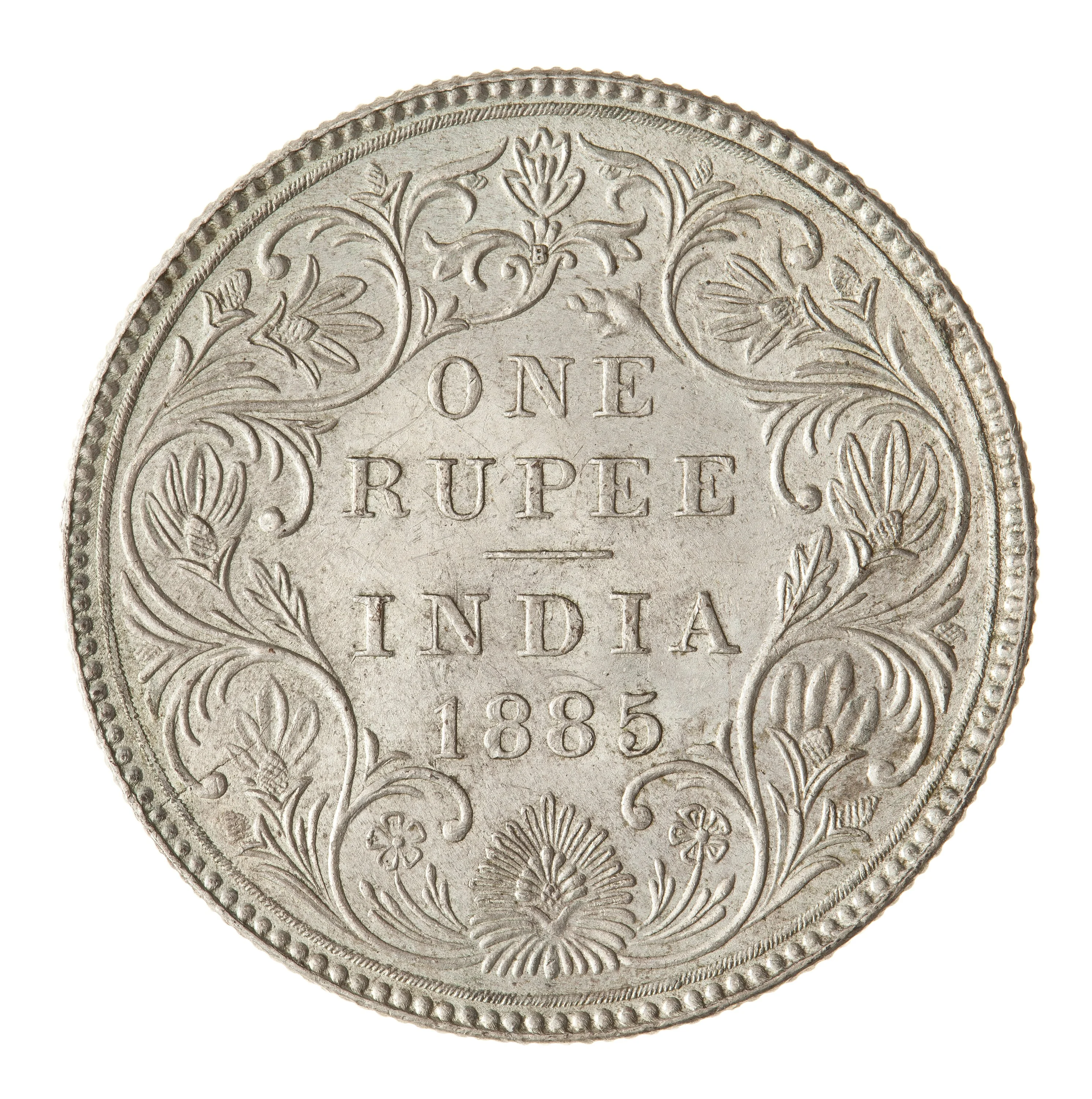
1 Rupee – India - British
India
Context
Years: 1877–1901
Country: India 
Issuer: India - British
Ruler: Victoria
Currency:
(1770—1947)
Demonetized: Yes
Total mintage: 885,366,742
Material
References
KM: #Click to copy to clipboard492
Numista: #3719
Value
Bullion value: $31.07
Obverse
Description:
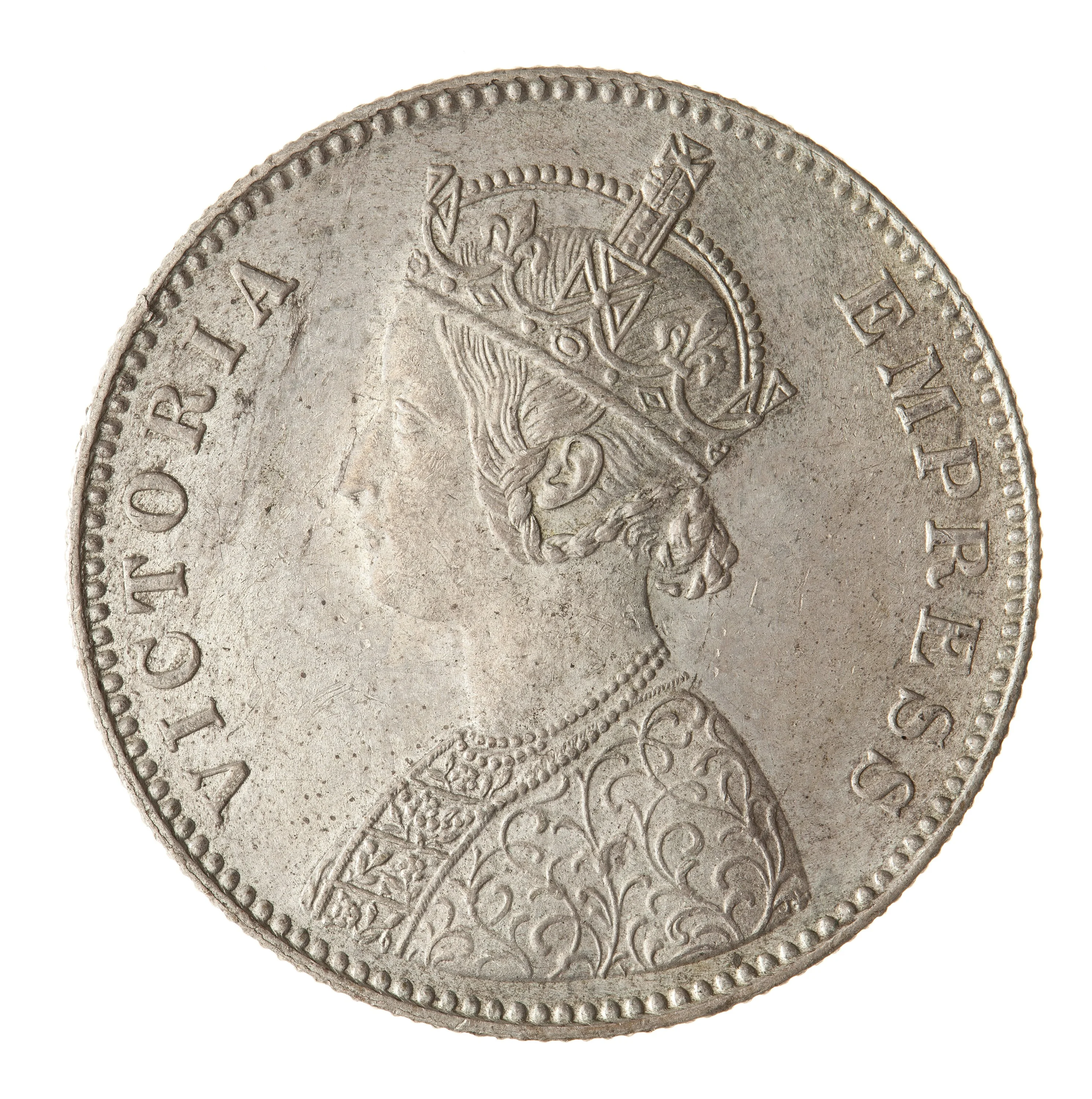
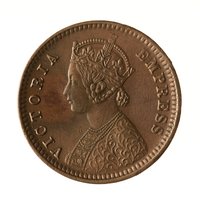
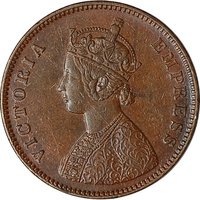
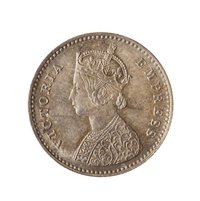
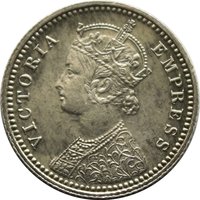
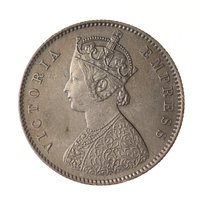
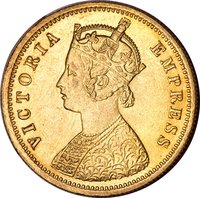
Empress Victoria's crowned portrait with updated "Empress" lettering.
Inscription:
VICTORIA EMPRESS
Script: Latin
Engraver: William Wyon
Reverse
Edge
Reeded
Mints
| Name | Mark |
|---|---|
| Mumbai / Bombay | B |
| Kolkata / Calcutta / Murshidabad | C |
Mintings
| Year | Mint Mark | Mintage | Quality | Collection |
|---|---|---|---|---|
| 1877 | B | — | BU | |
| 1877 | C | 39,251,692 | BU | |
| 1878 | B | 63,927,196 | BU | |
| 1878 | C | 32,657,837 | BU | |
| 1879 | — | — | BU | |
| 1879 | B | — | BU | |
| 1879 | C | 15,928,325 | BU | |
| 1880 | B | 53,785,624 | BU | |
| 1880 | C | 18,399,894 | BU | |
| 1881 | C | 2,435,719 | BU | |
| 1881 | B | 3,161,858 | BU | |
| 1882 | B | — | BU | |
| 1882 | C | 15,090,289 | BU | |
| 1883 | B | 18,022,789 | BU | |
| 1883 | C | 5,123,372 | BU | |
| 1884 | C | 11,641,757 | BU | |
| 1884 | B | — | BU | |
| 1885 | — | — | Proof | |
| 1885 | B | — | ||
| 1885 | B | — | BU | |
| 1885 | C | 34,152,203 | BU | |
| 1886 | B | 41,146,457 | BU | |
| 1886 | C | 10,878,075 | BU | |
| 1887 | B | — | BU | |
| 1887 | C | — | BU | |
| 1888 | B | — | BU | |
| 1888 | C | 7,568,000 | BU | |
| 1889 | C | 9,368,310 | BU | |
| 1889 | B | — | BU | |
| 1890 | B incuse | — | ||
| 1890 | B | 92,900,000 | BU | |
| 1890 | C | 24,741,865 | BU | |
| 1891 | B | 49,500,000 | BU | |
| 1891 | C | 14,669,903 | BU | |
| 1892 | B | — | BU | |
| 1892 | C | 32,455,120 | BU | |
| 1893 | B | 69,590,000 | BU | |
| 1893 | C | 9,140,310 | BU | |
| 1894 | C | — | Proof | |
| 1897 | B | 1,054,593 | BU | |
| 1897 | C | 470,184 | BU | |
| 1898 | B | 6,268,437 | BU | |
| 1898 | C | 1,250,976 | BU | |
| 1899 | B | — | Proof | |
| 1900 | C | 5,290,591 | BU | |
| 1900 | B | 65,236,908 | BU | |
| 1901 | B | 130,258,458 | BU | |
| 1901 | C | — | BU |
Historical background
In 1877, the currency situation in British India was a complex and transitional system, dominated by the silver rupee but facing significant international pressure. The Indian rupee was a silver-based currency, and its value was fixed against gold at a rate of 1 rupee to 1 shilling 4 pence (or 15 rupees to 1 British gold sovereign). This rate, however, was a government accounting fiction for the "Council Bill" system used to transfer funds to London; the rupee's actual market value was determined by the fluctuating global price of silver. This period followed the great recoinage of the 1830s and 40s, which had established a uniform silver standard across British territories, but the system was now being strained by external forces.
The core instability stemmed from the global phenomenon of the "fall of the rupee," driven by the discovery of vast new silver deposits, particularly in the United States, which caused the metal's price to plummet on the international market. As the rupee's intrinsic silver value fell, its fixed exchange rate with the gold-based pound sterling became increasingly overvalued. This created a severe fiscal crisis for the Government of India, as it had to make substantial "Home Charges" payments (for debt, pensions, and imports) in gold to London. Effectively, it cost more and more depreciated silver rupees to buy the same amount of gold, leading to budget deficits and fears of depleting the Indian treasury.
Consequently, 1877 found the colonial administration actively debating a move towards a gold standard. A major currency commission had been appointed in 1876 (the Mansfield Commission) to address the crisis, and its work was ongoing. The government was caught between the need for monetary stability with Britain and the disruptive impact of suddenly demonetizing silver in a vast, cash-based agrarian economy. Thus, the currency situation was one of acute strain, with the silver standard visibly failing, a gold standard being seriously contemplated, but no definitive resolution yet in place, setting the stage for the closure of Indian mints to free silver coinage in 1893.
The core instability stemmed from the global phenomenon of the "fall of the rupee," driven by the discovery of vast new silver deposits, particularly in the United States, which caused the metal's price to plummet on the international market. As the rupee's intrinsic silver value fell, its fixed exchange rate with the gold-based pound sterling became increasingly overvalued. This created a severe fiscal crisis for the Government of India, as it had to make substantial "Home Charges" payments (for debt, pensions, and imports) in gold to London. Effectively, it cost more and more depreciated silver rupees to buy the same amount of gold, leading to budget deficits and fears of depleting the Indian treasury.
Consequently, 1877 found the colonial administration actively debating a move towards a gold standard. A major currency commission had been appointed in 1876 (the Mansfield Commission) to address the crisis, and its work was ongoing. The government was caught between the need for monetary stability with Britain and the disruptive impact of suddenly demonetizing silver in a vast, cash-based agrarian economy. Thus, the currency situation was one of acute strain, with the silver standard visibly failing, a gold standard being seriously contemplated, but no definitive resolution yet in place, setting the stage for the closure of Indian mints to free silver coinage in 1893.
🌱 Very Common