

5000 Cruzeiros (Tiradentes' death) – Brazil
Circulating commemorative coins
Commemoration: 200th anniversary of Tiradentes' death
Brazil
Context
Year: 1992
Issuer: Brazil 
Period:
(since 1967)
Currency:
(1990—1993)
Demonetization: 15 September 1994
Total mintage: 10,000,000
Material
Diameter: 31 mm
Weight: 9.95 g
Thickness: 1.9 mm
Shape: Round
Composition: Stainless steel
Technique: Milled
Alignment: Coin alignment
flip
References
KM: #Click to copy to clipboard625
Numista: #14155
Value
Exchange value: 5000 BRE
Inflation-adjusted value: 234690148.10 BRE
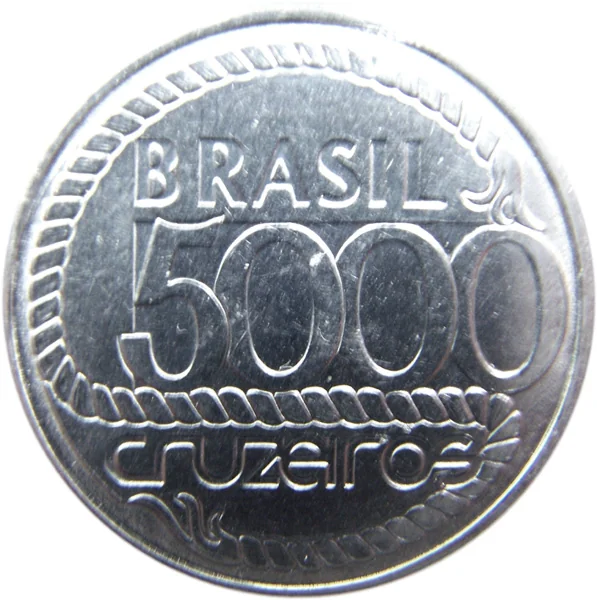
Obverse
Description:
Rope denomination.
Inscription:
BRASIL
5000
CRUZEIROS
5000
CRUZEIROS
Translation:
BRAZIL
5000
CRUZEIROS
5000
CRUZEIROS
Script: Latin
Language: Portuguese
Designer and engraver: Kátia Dias
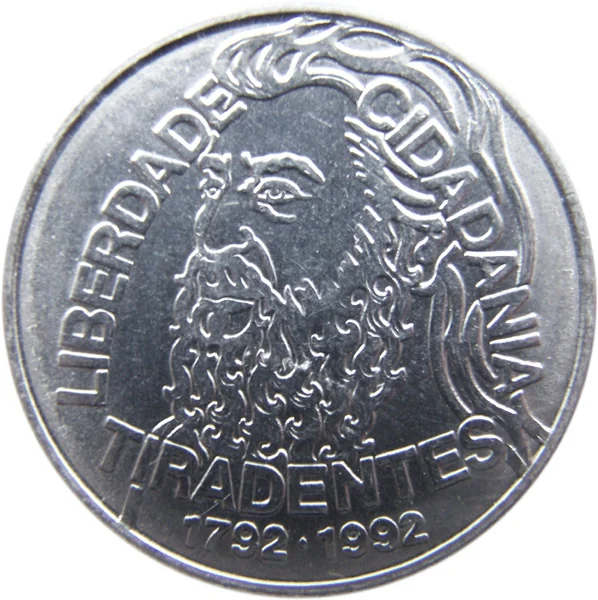
Reverse
Description:
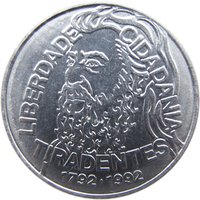
Tiradentes bust left, dates below.
Inscription:
LIBERDADE
CIDADANIA
TIRADENTES
1792-1992
CIDADANIA
TIRADENTES
1792-1992
Translation:
Liberty
Citizenship
Tiradentes
1792-1992
Citizenship
Tiradentes
1792-1992
Script: Latin
Language: Portuguese
Designer and engraver: Kátia Dias
Edge
Plain
Categories
| Event> Death anniversary |
Mints
| Name | Mark |
|---|---|
| Casa da Moeda do Brasil | — |
Mintings
| Year | Mint Mark | Mintage | Quality | Collection |
|---|---|---|---|---|
| 1992 | — | 10,000,000 |
Historical background
In 1992, Brazil was in the throes of a profound monetary crisis, marking the chaotic final chapter of the Cruzado Plan era. The period was characterized by hyperinflation, which reached an astonishing annual rate of 1,157%, effectively eroding wages and savings on a daily basis. The currency itself was in a state of bewildering flux; the government had introduced the "cruzado novo" (NCz$) in 1989 to replace the original cruzado, but this unit had already lost its function as a reliable store of value. Economic policy was a desperate cycle of price freezes, wage adjustments, and failed stabilization plans, leading to a widespread loss of confidence in the currency and frequent indexation of prices to past inflation.
This monetary instability was both a cause and a symptom of deeper political and economic turmoil. The year 1992 was dominated by the impeachment proceedings against President Fernando Collor de Mello, who had taken office in 1990 with a radical shock plan that included a temporary asset freeze. His administration, mired in corruption scandals, became paralyzed, preventing any coherent fiscal response to the inflation crisis. With the political system in crisis, the central bank lacked the credibility to implement effective monetary control, and public debt was monetized to cover massive fiscal deficits, directly fueling the inflationary fire.
Consequently, daily economic life for Brazilians was dominated by a frantic struggle to keep pace with prices. Businesses adjusted prices multiple times a day, and consumers rushed to spend cash the moment they received it before it lost further value. The currency situation had degenerated to such an extent that the very concept of a stable unit of account had broken down, setting the stage for the radical solution that would follow: the 1994 Plano Real. This future plan would learn from the failures of 1992, understanding that defeating hyperinflation required not just a new currency name, but profound institutional change anchored in fiscal discipline and a credible exchange-rate anchor.
This monetary instability was both a cause and a symptom of deeper political and economic turmoil. The year 1992 was dominated by the impeachment proceedings against President Fernando Collor de Mello, who had taken office in 1990 with a radical shock plan that included a temporary asset freeze. His administration, mired in corruption scandals, became paralyzed, preventing any coherent fiscal response to the inflation crisis. With the political system in crisis, the central bank lacked the credibility to implement effective monetary control, and public debt was monetized to cover massive fiscal deficits, directly fueling the inflationary fire.
Consequently, daily economic life for Brazilians was dominated by a frantic struggle to keep pace with prices. Businesses adjusted prices multiple times a day, and consumers rushed to spend cash the moment they received it before it lost further value. The currency situation had degenerated to such an extent that the very concept of a stable unit of account had broken down, setting the stage for the radical solution that would follow: the 1994 Plano Real. This future plan would learn from the failures of 1992, understanding that defeating hyperinflation required not just a new currency name, but profound institutional change anchored in fiscal discipline and a credible exchange-rate anchor.

🌱 Very Common