

⅕ crown – Gibraltar
Add to wishlist
United Kingdom
Context
Year: 1997
Country: United Kingdom
Issuer: Gibraltar
Ruler: Elizabeth II
Currency:
(since 1967)
Total mintage: 1,000
Material
References
KM: #
Numista: #368824
Value
Bullion value: $416.26
Obverse
Description:
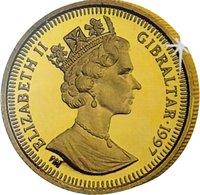
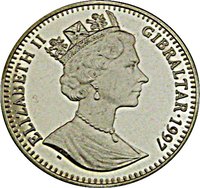
Bust of Elizabeth II facing right.
Inscription:
ELIZABETH II GIBRALTAR · 1997
RDM
PM
RDM
PM
Script: Latin
Engraver: Raphael David Maklouf
Reverse
Edge
Reeded
Mints
| Name | Mark |
|---|---|
| Pobjoy Mint | (PM) |
Mintings
| Year | Mint Mark | Mintage | Quality | Collection |
|---|---|---|---|---|
| 1997 | — | 1,000 | Proof |
Historical background
In 1997, Gibraltar’s currency situation was defined by its unique political status as a British Overseas Territory and its deep economic integration with neighbouring Spain. The legal tender was the Gibraltar pound (GIP), issued by the Government of Gibraltar and pegged at par with the British pound sterling (GBP). Sterling notes and coins also circulated freely alongside local issues, creating a de facto dual-currency system where the Gibraltar pound was not accepted in the wider United Kingdom but the British pound was fully accepted in Gibraltar.
This period was one of stability for the currency peg, but it existed within a complex geopolitical context. Gibraltar’s economy was, and remains, heavily reliant on tourism, financial services, and port operations, with a significant daily influx of workers from Spain. This cross-border flow made the Spanish peseta a widely used de facto second currency for everyday transactions, especially in retail and hospitality sectors catering to visitors. The pending launch of the euro in 1999 therefore loomed as a major future consideration, raising questions about how the territory would adapt to a major trading partner adopting a new currency.
Ultimately, the currency arrangements of 1997 reflected Gibraltar’s hybrid identity: politically and monetarily aligned with Britain, yet economically intertwined with the European mainland. The stability of the sterling peg provided monetary credibility, while the pragmatic acceptance of the peseta facilitated cross-border trade. This setup would soon face a significant test with the introduction of the euro, prompting Gibraltar to later formally allow the euro alongside its sterling-based system to accommodate its economic realities.
This period was one of stability for the currency peg, but it existed within a complex geopolitical context. Gibraltar’s economy was, and remains, heavily reliant on tourism, financial services, and port operations, with a significant daily influx of workers from Spain. This cross-border flow made the Spanish peseta a widely used de facto second currency for everyday transactions, especially in retail and hospitality sectors catering to visitors. The pending launch of the euro in 1999 therefore loomed as a major future consideration, raising questions about how the territory would adapt to a major trading partner adopting a new currency.
Ultimately, the currency arrangements of 1997 reflected Gibraltar’s hybrid identity: politically and monetarily aligned with Britain, yet economically intertwined with the European mainland. The stability of the sterling peg provided monetary credibility, while the pragmatic acceptance of the peseta facilitated cross-border trade. This setup would soon face a significant test with the introduction of the euro, prompting Gibraltar to later formally allow the euro alongside its sterling-based system to accommodate its economic realities.
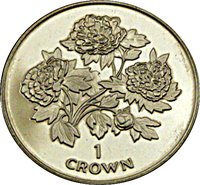
Series: Flower Collection

✨ Legendary