

Obverse
Description:
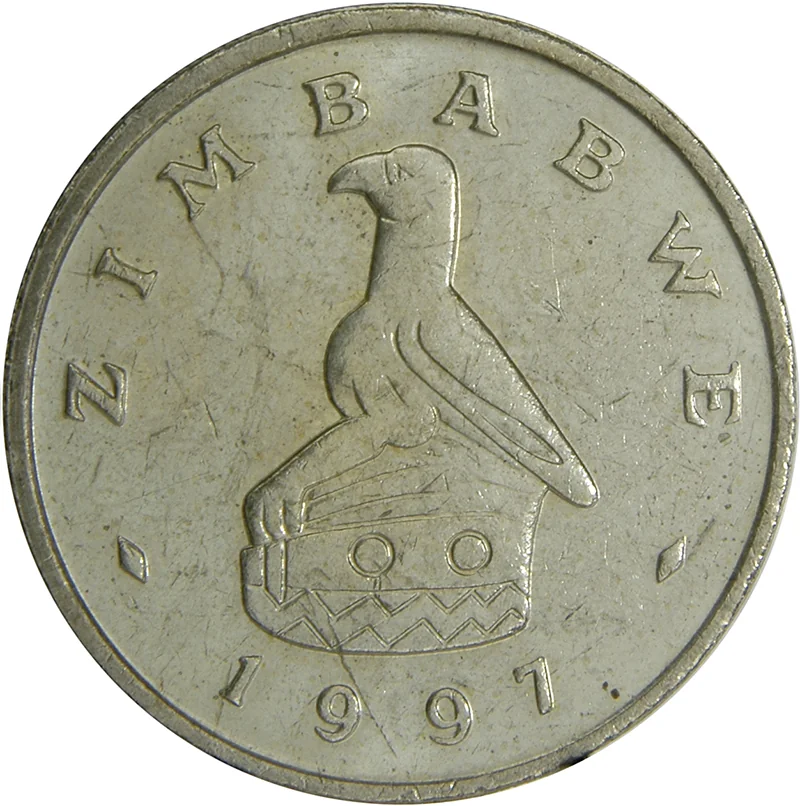
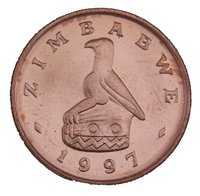
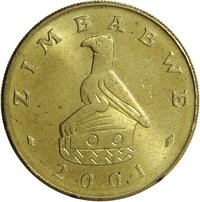
The famous Zimbabwe Bird, a protective sculpture from the 12th-14th century capital of the Monomotapa Empire, carved by the Shona people's ancestors.
Inscription:
ZIMBABWE
1997
1997
Script: Latin
Engraver: Barry Stanton
Reverse
Description:
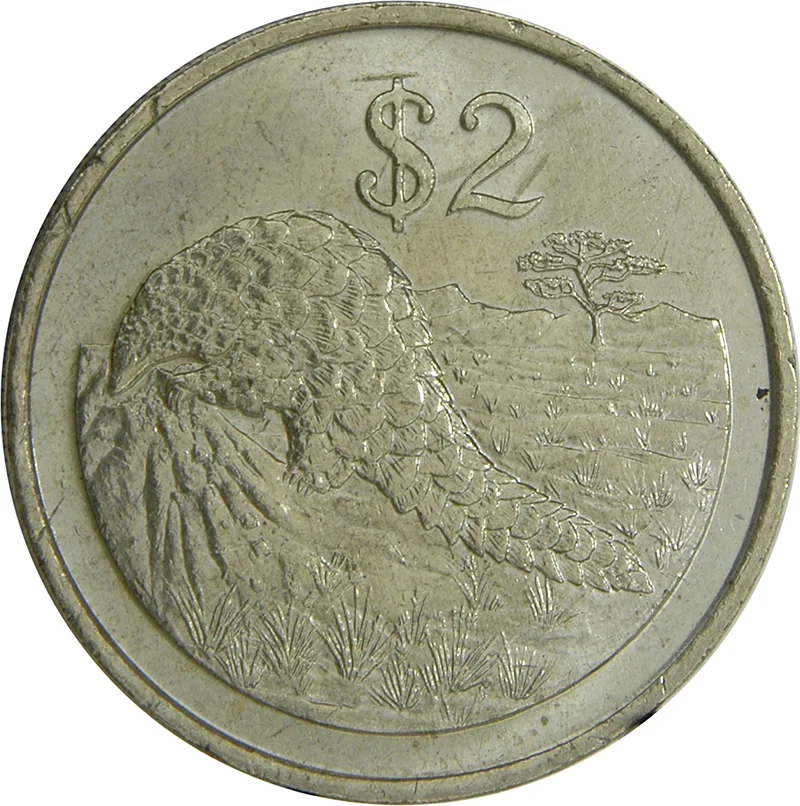
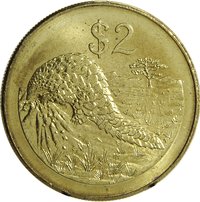
Pangolins, or scaly anteaters, are toothless insectivorous mammals with elongated, scale-covered bodies. They inhabit tropical regions of Africa and Southeast Asia.
Inscription:
$2
Script: Latin
Edge
Reeded
Mints
| Name | Mark |
|---|---|
| Royal Mint | — |
Mintings
| Year | Mint Mark | Mintage | Quality | Collection |
|---|---|---|---|---|
| 1997 | — | — |
Historical background
In 1997, Zimbabwe's long-standing economic stability began to unravel, marking the start of a profound currency crisis. The year was a critical turning point, triggered by two major financial decisions. First, the government abruptly announced it would pay unbudgeted gratuities to war veterans, a massive fiscal outlay equivalent to 3% of GDP that was financed by printing money. Second, the costly and ill-planned military intervention in the Democratic Republic of the Congo further drained foreign reserves. These actions shattered market confidence, leading to a sudden crash of the Zimbabwean dollar, which lost over 70% of its value against the US dollar in a single day on November 14, 1997—an event known as "Black Friday."
This currency collapse exposed deeper structural weaknesses. Underpinning the crisis were chronic fiscal deficits, a decline in agricultural and manufacturing productivity following the first controversial steps of land reform announcements, and a growing external debt burden. The rapid devaluation imported inflation, as the cost of crucial imported goods like fuel, machinery, and medicine soared. The government's response, refusing to curb spending and instead relying on the central bank to finance the deficit, set a dangerous precedent for monetization that would become a destructive habit.
Consequently, 1997 served as the painful genesis of hyperinflation in Zimbabwe. The loss of currency credibility initiated a vicious cycle where printing money to solve fiscal shortfalls led to higher prices, further devaluation, and even more money printing. While full-blown hyperinflation would erupt a decade later, the events of 1997 decisively broke the trust in the Zimbabwean dollar, setting the national economy on a path of severe and prolonged monetary instability from which it has never fully recovered.
This currency collapse exposed deeper structural weaknesses. Underpinning the crisis were chronic fiscal deficits, a decline in agricultural and manufacturing productivity following the first controversial steps of land reform announcements, and a growing external debt burden. The rapid devaluation imported inflation, as the cost of crucial imported goods like fuel, machinery, and medicine soared. The government's response, refusing to curb spending and instead relying on the central bank to finance the deficit, set a dangerous precedent for monetization that would become a destructive habit.
Consequently, 1997 served as the painful genesis of hyperinflation in Zimbabwe. The loss of currency credibility initiated a vicious cycle where printing money to solve fiscal shortfalls led to higher prices, further devaluation, and even more money printing. While full-blown hyperinflation would erupt a decade later, the events of 1997 decisively broke the trust in the Zimbabwean dollar, setting the national economy on a path of severe and prolonged monetary instability from which it has never fully recovered.
🌱 Very Common