

10 Rubles – Russian Federation
Russia
Context
Year: 2018
Country: Russia 
Issuer: Russian Federation
Period:
(since 1991)
Currency:
(since 1998)
Total mintage: 5,000,000
Material
Diameter: 27 mm
Weight: 7.9 g
Thickness: 2.1 mm
Shape: Round
Standard: Silver quarter ounce
Techniques: Latent image, Milled
Alignment: Medal alignment
flip
References
Value
Exchange value: 10 RUB
Inflation-adjusted value: 18.91 RUB
Obverse
Description:
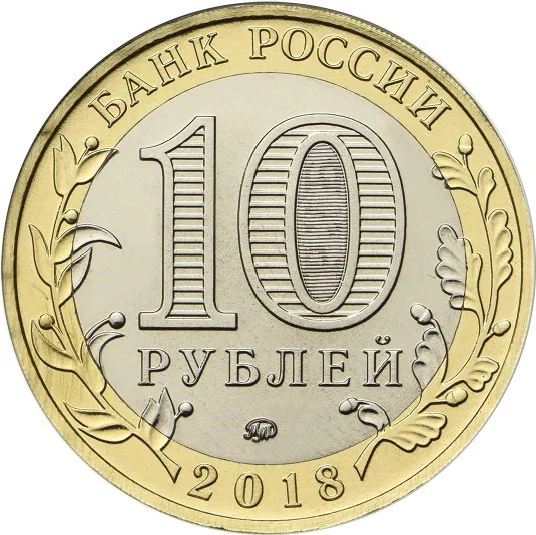
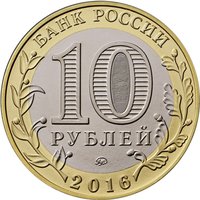
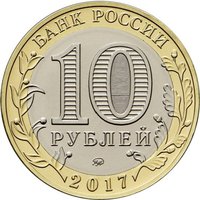
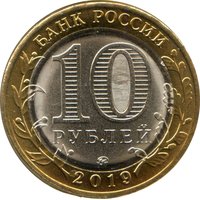
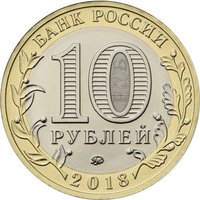
The central disc features "10 РУБЛЕЙ" with a holographic "10" and "РУБ" inside the zero, and the mint mark below. The ring bears "БАНК РОССИИ" at the top, "2018" at the bottom, and stylized plant twigs extending onto the disc.
Inscription:
БАНК РОССИИ
10
РУБЛЕЙ
ММД
2018
10
РУБЛЕЙ
ММД
2018
Translation:
BANK OF RUSSIA
10
RUBLES
MMD
2018
10
RUBLES
MMD
2018
Script: Cyrillic
Language: Russian
Designer and engraver: Alexander Vasilyevich Baklanov
Reverse
Description:
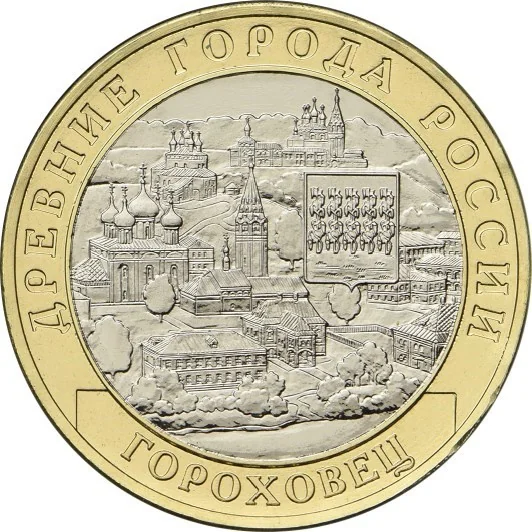
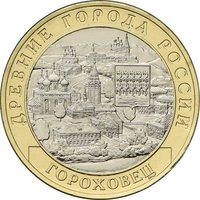
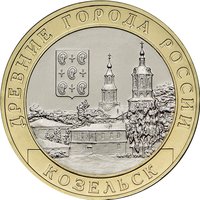
Town panorama with Gorokhovets's coat of arms. Inscription: "ДРЕВНИЕ ГОРОДА РОССИИ" above, "ГОРОХОВЕЦ" below.
Inscription:
ДРЕВНИЕ ГОРОДА РОССИИ
ГОРОХОВЕЦ
ГОРОХОВЕЦ
Translation:
ANCIENT CITIES OF RUSSIA
GOROKHOVETS
GOROKHOVETS
Script: Cyrillic
Language: Russian
Designer and engraver: Fedor Sergeevich Andronov
Edge
300 corrugations and the inscription recurring twice and divided by asterisks
Legend:
ДЕСЯТЬ РУБЛЕЙ * ДЕСЯТЬ РУБЛЕЙ *
Translation:
TEN RUBLES * TEN RUBLES *
Language: Russian
Categories
| Symbols> Coat of Arms |
| Building> Religious building |
| Geography> Town |
Mints
| Name | Mark |
|---|---|
| Moscow Mint | (ММД) |
Mintings
| Year | Mint Mark | Mintage | Quality | Collection |
|---|---|---|---|---|
| 2018 | ММД | 5,000,000 |
Historical background
In 2018, the Russian ruble faced significant pressure, becoming one of the worst-performing currencies globally that year. The primary drivers were a combination of new U.S. sanctions and falling oil prices. In April, the U.S. imposed severe sanctions on several Russian oligarchs, their companies, and key government officials, causing immediate capital flight and a loss of investor confidence. This financial shock was compounded by a decline in the price of Brent crude, a crucial benchmark for Russia's oil-dependent economy, which fell from over $86 per barrel in October to near $50 by year's end. These twin shocks exposed the Russian economy's ongoing vulnerability to external geopolitical and commodity market forces.
The Central Bank of the Russian Federation (CBR) responded with a strategy focused on controlling inflation and maintaining financial stability, rather than defending a specific exchange rate. It allowed the ruble to float freely, acting as a "shock absorber" for the economy. Throughout the year, the CBR gradually increased its key interest rate, culminating in a hike to 7.75% in December, aimed at curbing inflation risks and making ruble assets more attractive to stem capital outflow. This approach, while leading to a significantly weaker currency, helped preserve foreign exchange reserves and prevented a full-blown financial crisis.
By the close of 2018, the ruble had depreciated by approximately 17% against the U.S. dollar compared to the start of the year. The situation underscored the lasting impact of the sanctions regime first imposed in 2014 and highlighted the structural challenges of an economy heavily reliant on hydrocarbon exports. Despite the volatility, the government's budget, calibrated to lower oil prices, and the CBR's orthodox monetary policy provided a degree of resilience, preventing the kind of panic seen during the 2014-2015 crisis, though at the cost of reduced purchasing power for the Russian population.
The Central Bank of the Russian Federation (CBR) responded with a strategy focused on controlling inflation and maintaining financial stability, rather than defending a specific exchange rate. It allowed the ruble to float freely, acting as a "shock absorber" for the economy. Throughout the year, the CBR gradually increased its key interest rate, culminating in a hike to 7.75% in December, aimed at curbing inflation risks and making ruble assets more attractive to stem capital outflow. This approach, while leading to a significantly weaker currency, helped preserve foreign exchange reserves and prevented a full-blown financial crisis.
By the close of 2018, the ruble had depreciated by approximately 17% against the U.S. dollar compared to the start of the year. The situation underscored the lasting impact of the sanctions regime first imposed in 2014 and highlighted the structural challenges of an economy heavily reliant on hydrocarbon exports. Despite the volatility, the government's budget, calibrated to lower oil prices, and the CBR's orthodox monetary policy provided a degree of resilience, preventing the kind of panic seen during the 2014-2015 crisis, though at the cost of reduced purchasing power for the Russian population.
Series: Ancient Towns of Russia
🌱 Common