

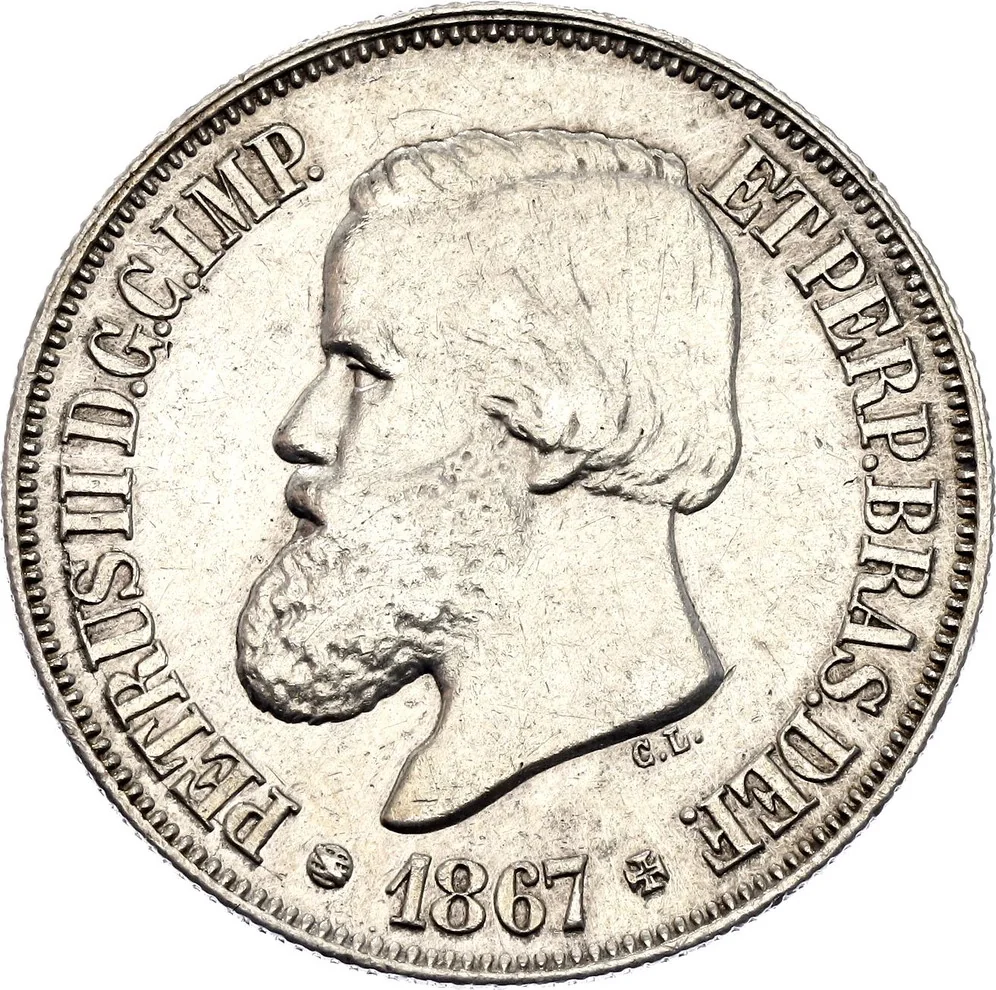
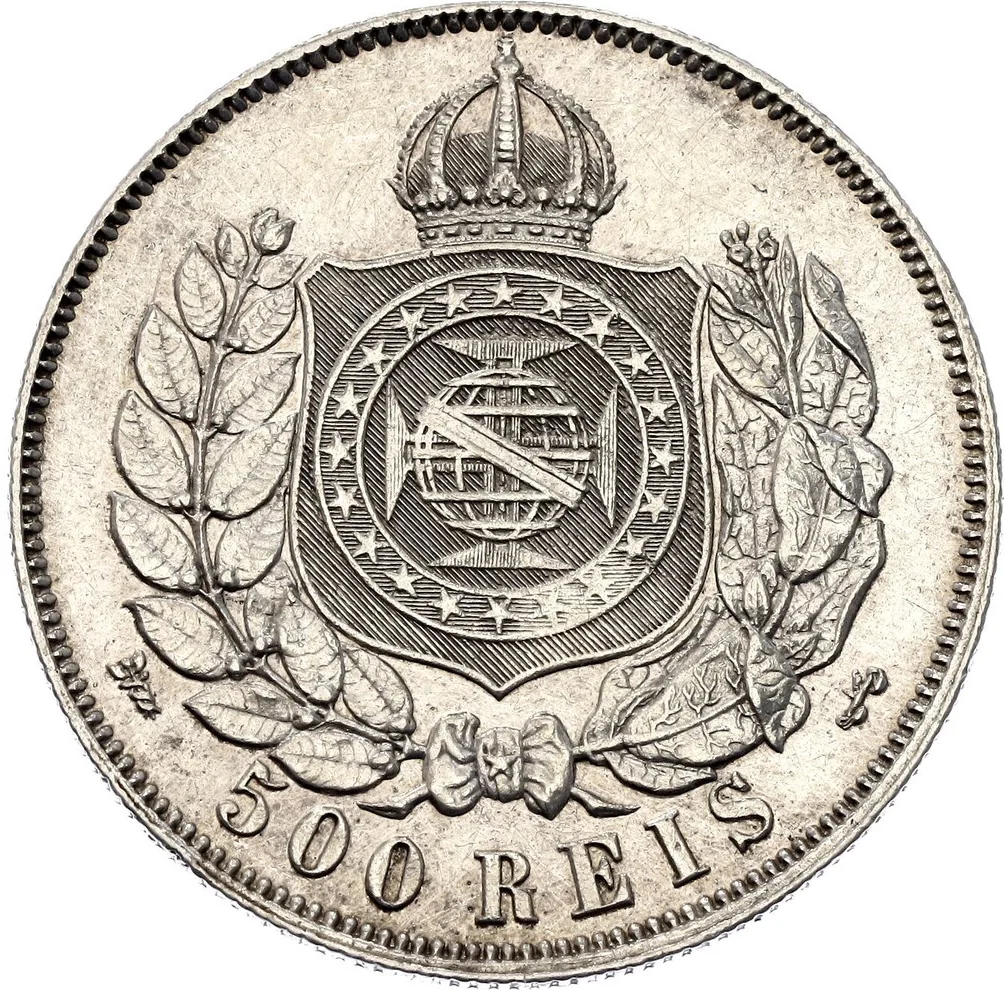
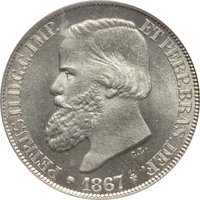
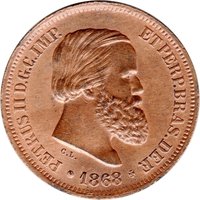
Obverse
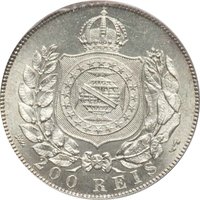
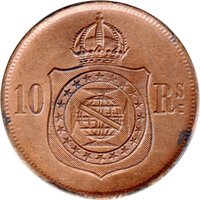
Reverse
Description:
Below the imperial arms.
Inscription:
500 RÉIS
Translation:
Five Hundred Réis.
Script: Latin
Language: Portuguese
Engraver: C. Lüster
Edge
Reeded
Mints
| Name | Mark |
|---|---|
| Casa da Moeda do Brasil | — |
Mintings
| Year | Mint Mark | Mintage | Quality | Collection |
|---|---|---|---|---|
| 1867 | — | — | ||
| 1868 | — | — |
Historical background
In 1867, Brazil operated under a complex and strained monetary system, a legacy of the Portuguese colonial era. The official currency was the réis (plural réis), a low-value unit where transactions were often denoted in mil-réis (1,000 réis). However, the system was not one of uniform, state-issued coinage. Instead, it was characterized by a severe shortage of small-denomination coins for everyday commerce, leading to widespread use of privately issued copper and bronze tokens by businesses, municipalities, and even railroads. Alongside these, a confusing array of worn foreign coins, particularly from neighboring Spanish American republics, circulated at fluctuating values, creating a chaotic and inefficient medium of exchange.
This monetary fragmentation occurred within a broader context of fiscal pressure. Brazil was engaged in the costly Paraguayan War (1864-1870), which placed enormous demands on the imperial treasury. To finance the conflict, the government of Dom Pedro II had resorted to issuing paper money, beginning in 1859 and accelerating during the war. By 1867, these treasury notes (papel-moeda) were in increasing circulation, but they were not yet legal tender and often traded at a discount to their face value in gold or silver. This created a dual system where metallic currency (when available) and paper money coexisted uneasily.
Consequently, the currency situation in 1867 was one of transition and tension. The empire was slowly moving toward a more unified, paper-based system out of wartime necessity, but this was eroding public confidence. The chronic lack of reliable specie for small transactions hampered the daily economy, while the expanding volume of inconvertible paper money sowed the seeds for future inflation. Thus, the monetary landscape was a patchwork of private tokens, foreign coin, and government paper, all underpinned by the distant promise of gold-backed mil-réis, reflecting both the immediate strains of war and the long-term challenges of building a modern national economy.
This monetary fragmentation occurred within a broader context of fiscal pressure. Brazil was engaged in the costly Paraguayan War (1864-1870), which placed enormous demands on the imperial treasury. To finance the conflict, the government of Dom Pedro II had resorted to issuing paper money, beginning in 1859 and accelerating during the war. By 1867, these treasury notes (papel-moeda) were in increasing circulation, but they were not yet legal tender and often traded at a discount to their face value in gold or silver. This created a dual system where metallic currency (when available) and paper money coexisted uneasily.
Consequently, the currency situation in 1867 was one of transition and tension. The empire was slowly moving toward a more unified, paper-based system out of wartime necessity, but this was eroding public confidence. The chronic lack of reliable specie for small transactions hampered the daily economy, while the expanding volume of inconvertible paper money sowed the seeds for future inflation. Thus, the monetary landscape was a patchwork of private tokens, foreign coin, and government paper, all underpinned by the distant promise of gold-backed mil-réis, reflecting both the immediate strains of war and the long-term challenges of building a modern national economy.
🌱 Fairly Common