

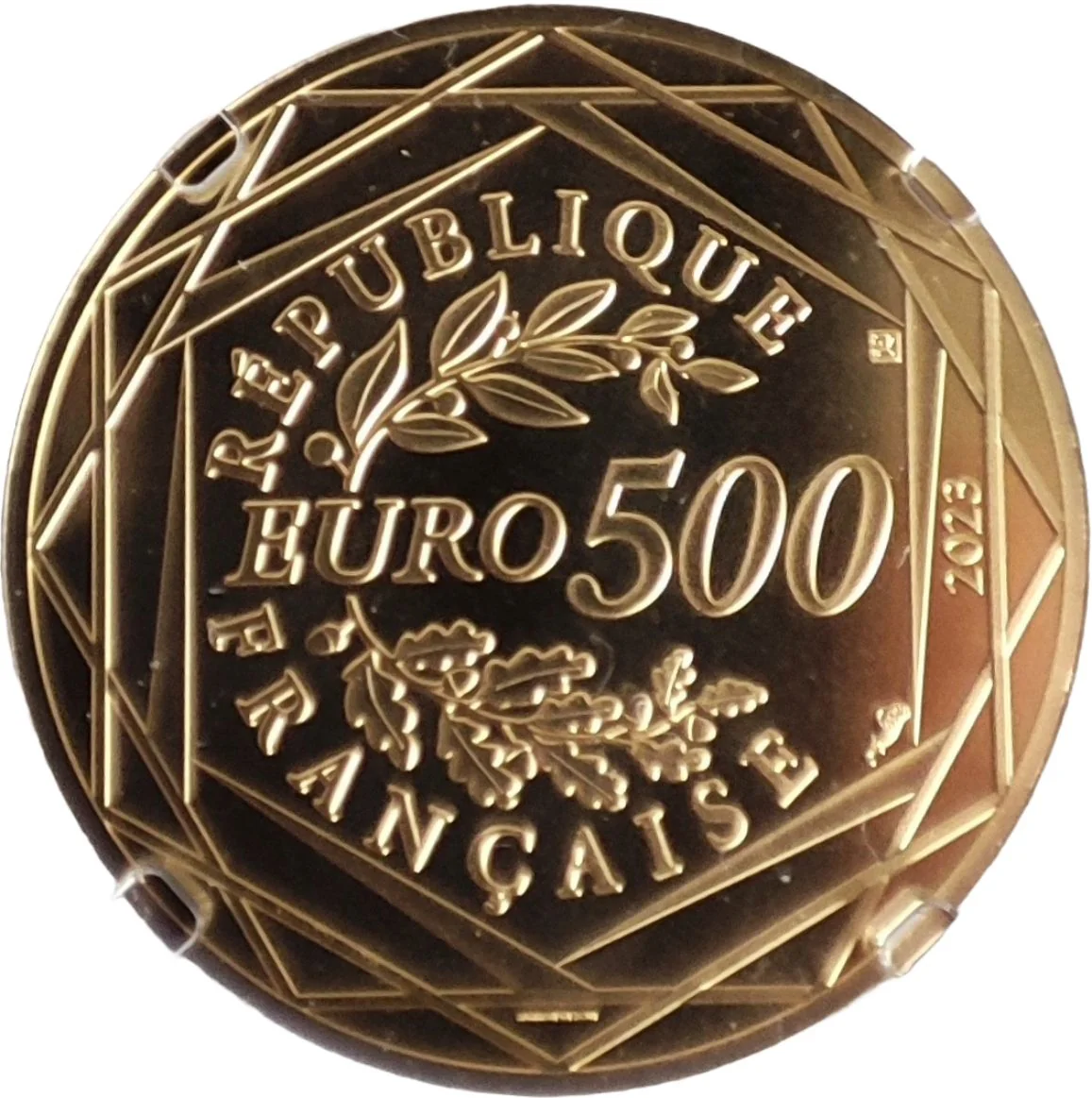

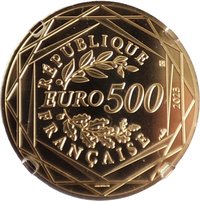

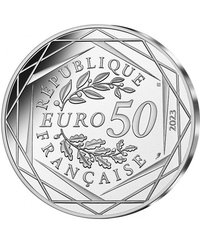
Obverse
Description:
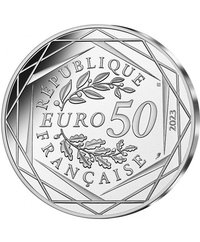
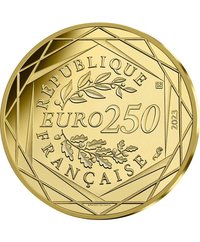
"500 EURO" flanked by laurel and oak branches, encircled by "RÉPUBLIQUE FRANÇAISE" and three hexagons.
Inscription:
RÉPUBLIQUE FRANÇAISE
EURO 500
2023
MONNAIE DE PARIS
EURO 500
2023
MONNAIE DE PARIS
Translation:
FRENCH REPUBLIC
EURO 500
2023
MONNAIE DE PARIS
EURO 500
2023
MONNAIE DE PARIS
Script: Latin
Language: French
Engraver: Joaquin Jimenez
Reverse
Edge
Plain
Categories
| Sport> Summer Olympic Games |
| Symbol> Allegory |
| Symbol> Wreath |
| Symbol> Phrygian cap |
Mints
| Name | Mark |
|---|---|
| Monnaie de Paris | — |
Mintings
| Year | Mint Mark | Mintage | Quality | Collection |
|---|---|---|---|---|
| 2023 | — | 5,000 | BU |
Historical background
In 2023, France, as a member of the Eurozone, operated under the euro (€), a currency managed by the European Central Bank (ECB). The primary monetary policy context was defined by the ECB's aggressive campaign to combat high inflation, a legacy of the post-pandemic supply chain disruptions and the energy crisis exacerbated by the war in Ukraine. Throughout the year, the ECB implemented a series of significant interest rate hikes, which aimed to cool demand and bring inflation down from its peak. This tightening cycle directly influenced borrowing costs for French businesses and households, slowing economic activity and raising concerns about potential recessionary pressures.
Domestically, the French government faced the delicate challenge of supporting purchasing power while adhering to EU fiscal rules. High inflation, though easing from its 2022 peak, remained a central political and economic concern, eroding household budgets. In response, the government deployed targeted measures such as energy price caps, food inflation checks, and indexed increases to pensions and welfare benefits. These fiscal interventions aimed to cushion the social impact but also contributed to a high public debt burden, which remained above 110% of GDP, leading to ongoing scrutiny from European institutions and credit rating agencies.
Looking outward, the euro's exchange rate fluctuated against major currencies like the US dollar, influenced by the differential between ECB and Federal Reserve policies. A relatively weaker euro helped French exporters but increased the cost of energy and other imported goods. Overall, the 2023 currency situation in France was characterized by this tension between the ECB's restrictive monetary policy to ensure price stability and the government's expansionary fiscal measures to protect its citizens, all within the framework of shared European sovereignty over the currency.
Domestically, the French government faced the delicate challenge of supporting purchasing power while adhering to EU fiscal rules. High inflation, though easing from its 2022 peak, remained a central political and economic concern, eroding household budgets. In response, the government deployed targeted measures such as energy price caps, food inflation checks, and indexed increases to pensions and welfare benefits. These fiscal interventions aimed to cushion the social impact but also contributed to a high public debt burden, which remained above 110% of GDP, leading to ongoing scrutiny from European institutions and credit rating agencies.
Looking outward, the euro's exchange rate fluctuated against major currencies like the US dollar, influenced by the differential between ECB and Federal Reserve policies. A relatively weaker euro helped French exporters but increased the cost of energy and other imported goods. Overall, the 2023 currency situation in France was characterized by this tension between the ECB's restrictive monetary policy to ensure price stability and the government's expansionary fiscal measures to protect its citizens, all within the framework of shared European sovereignty over the currency.
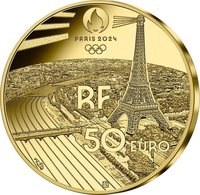
Series: 2024 Summer Olympic Games, Paris







💎 Extremely Rare