

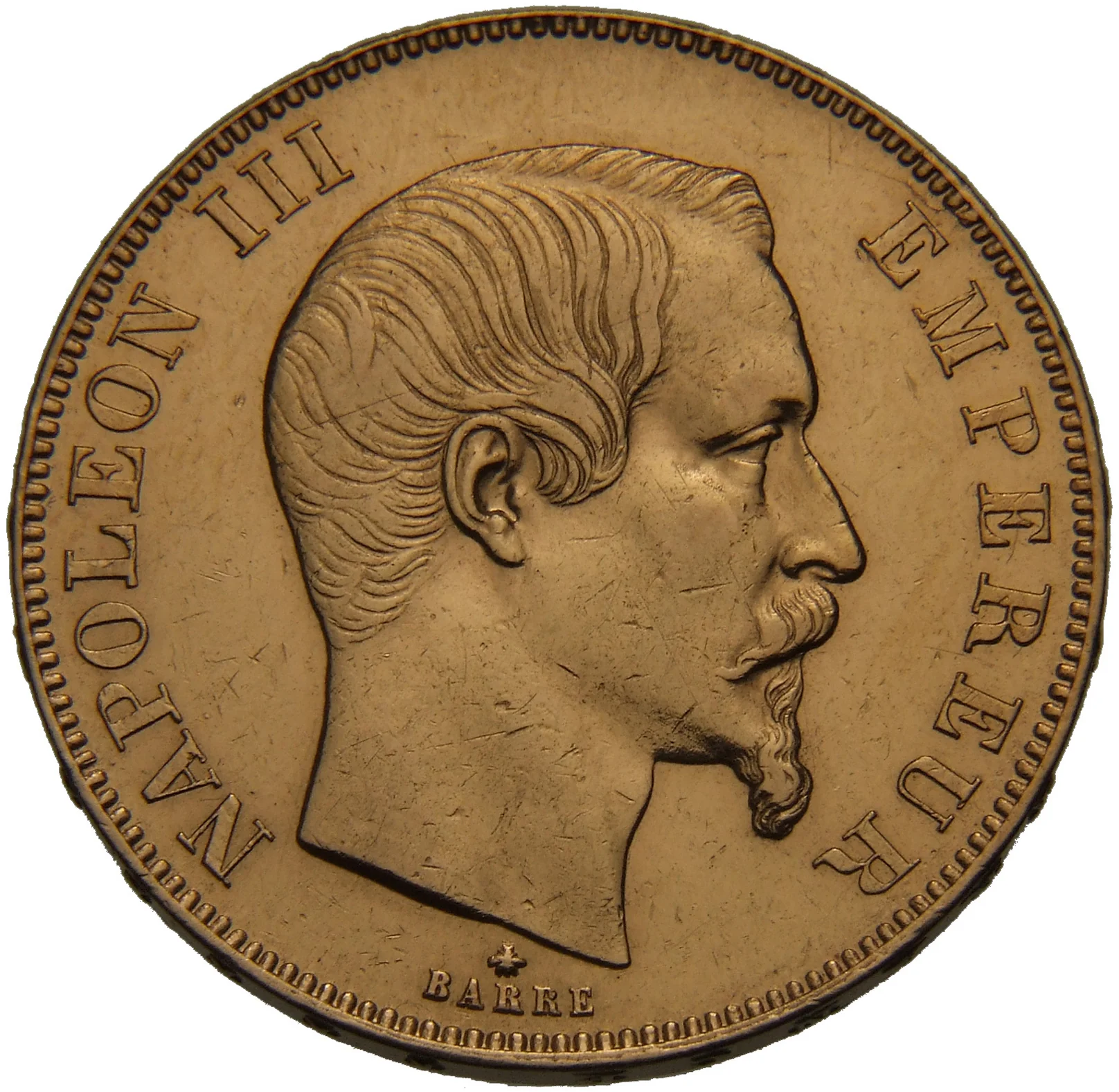
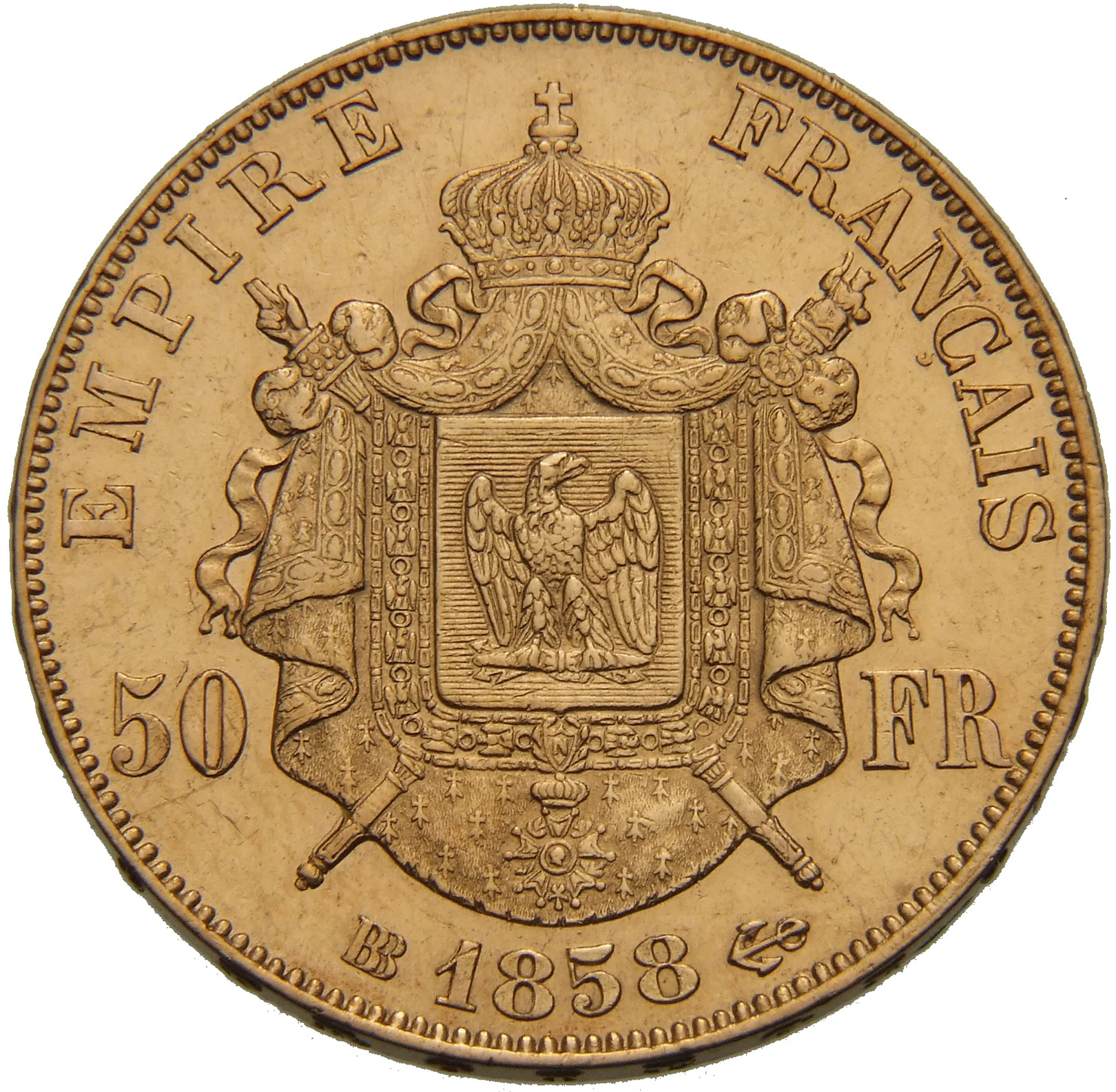
50 Francs – France
France
Context
Years: 1855–1860
Issuer: France 
Ruler: Napoleon III
Currency:
(1795—1959)
Demonetization: 25 June 1928
Total mintage: 796,765
Material
References
KM: #Click to copy to clipboard785
Numista: #10256
Value
Bullion value: $2420.47
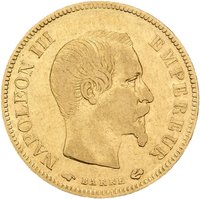
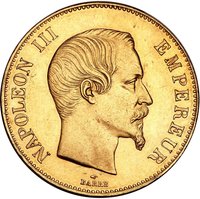
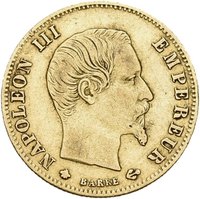
Obverse
Inscription:
NAPOLEON III EMPEREUR
Translation:
NAPOLEON III EMPEROR
Script: Latin
Language: French
Engraver: Jacques-Jean Barre
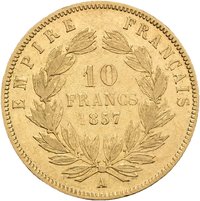
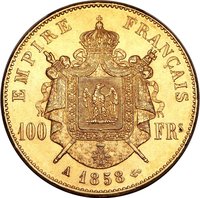
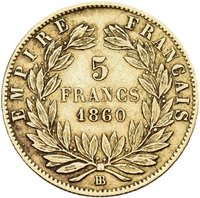
Reverse
Edge
© Arno22
Categories
| Person> Monarch |
| Symbols> Coat of Arms |
Mints
| Name | Mark |
|---|---|
| Monnaie de Paris | A |
| Strasbourg | BB |
Mintings
Historical background
In 1855, France operated under a bimetallic monetary system, established by the Franc Germinal law of 1803. This system fixed the values of both gold and silver coins in relation to the franc, with a legal ratio of 15.5 kilograms of silver to 1 kilogram of gold. The franc itself was a stable and trusted currency, with coins like the 20-franc gold napoléon and the 5-franc silver écu serving as the pillars of everyday commerce and international trade. This stability was a point of national pride and a key factor in France's economic growth during the mid-19th century.
However, this bimetallic system was under growing international strain. The discovery of vast gold deposits in California (1848) and Australia (1851) began to alter the global market ratio between gold and silver, making the French mint ratio increasingly outdated. In practice, this often led to the phenomenon described by Gresham's Law, where "bad money drives out good": undervalued coins (silver at the French mint) were hoarded or exported, while overvalued coins (gold) flooded into circulation. This put pressure on the Bank of France's reserves and complicated financial transactions.
Despite these underlying pressures, the year 1855 itself was one of conspicuous economic confidence, underscored by the Exposition Universelle in Paris. This world's fair showcased French industrial and financial prowess, attracting international investors and reinforcing the franc's prestige. Consequently, while economists and bankers were aware of the systemic vulnerabilities, the immediate currency situation appeared robust. The Second Empire, under Napoleon III, would not be forced to confront the full instability of bimetallism until the 1860s, when it led France to help establish the Latin Monetary Union in an attempt to create a multinational zone of currency stability.
However, this bimetallic system was under growing international strain. The discovery of vast gold deposits in California (1848) and Australia (1851) began to alter the global market ratio between gold and silver, making the French mint ratio increasingly outdated. In practice, this often led to the phenomenon described by Gresham's Law, where "bad money drives out good": undervalued coins (silver at the French mint) were hoarded or exported, while overvalued coins (gold) flooded into circulation. This put pressure on the Bank of France's reserves and complicated financial transactions.
Despite these underlying pressures, the year 1855 itself was one of conspicuous economic confidence, underscored by the Exposition Universelle in Paris. This world's fair showcased French industrial and financial prowess, attracting international investors and reinforcing the franc's prestige. Consequently, while economists and bankers were aware of the systemic vulnerabilities, the immediate currency situation appeared robust. The Second Empire, under Napoleon III, would not be forced to confront the full instability of bimetallism until the 1860s, when it led France to help establish the Latin Monetary Union in an attempt to create a multinational zone of currency stability.
Series: 1855 France circulation coins
🌟 Uncommon