

2 euro – Estonia
Add to wishlist
Estonia
Context
Year: 2023
Issuer: Estonia
Issuing organization: Bank of Estonia
Period:
(since 1991)
Currency:
(since 2011)
Total mintage: 1,000,000
Material
References
KM: #
Numista: #364450
Value
Exchange value: 2 EUR
Inflation-adjusted value: 2.30 EUR
Obverse
Description:
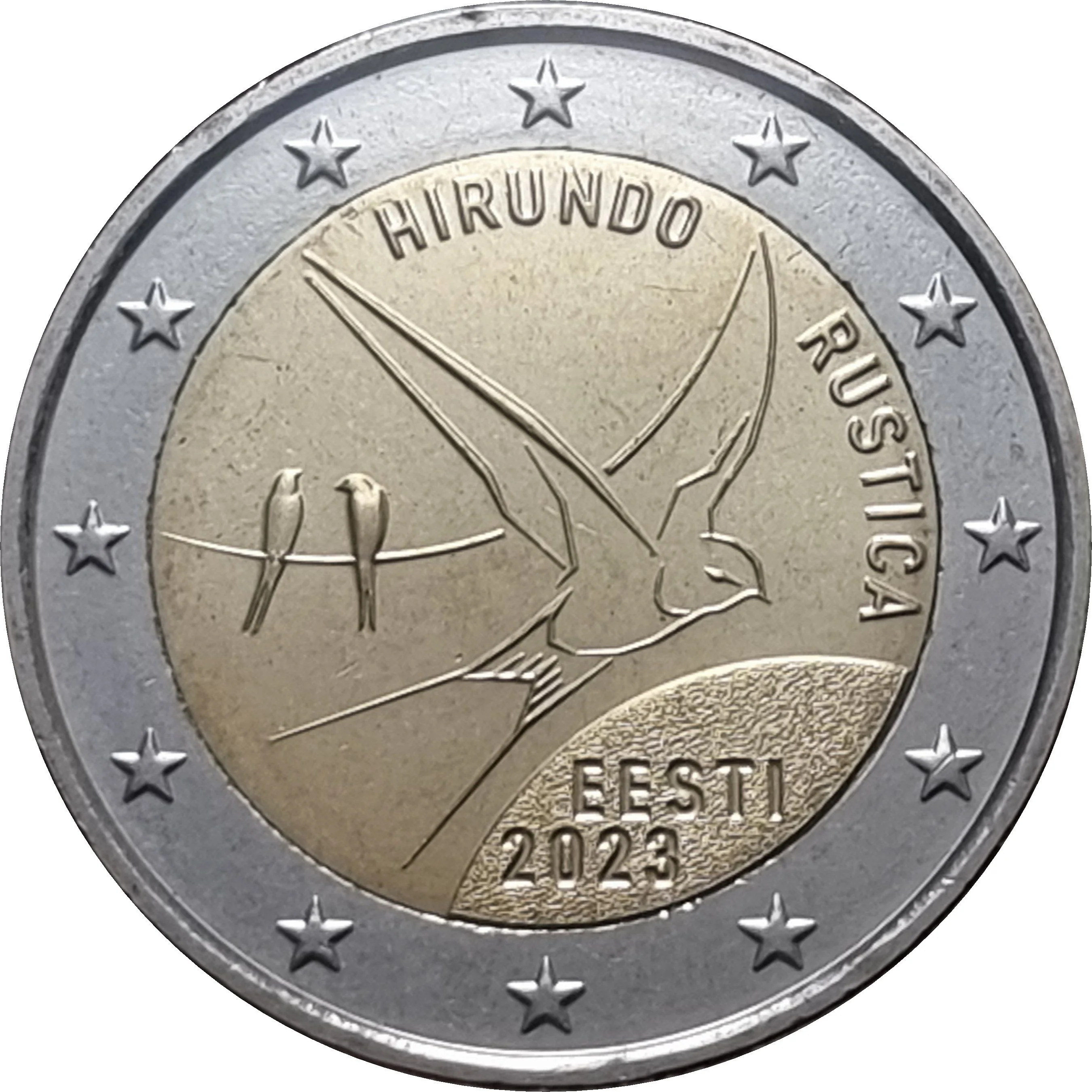
A barn swallow in flight with two perched on a wire. Country name arcs at bottom right, Latin name at the inner ring's top. Twelve European stars in the outer ring.
Inscription:
HIRUNDO RUSTICA
EESTI
2023
EESTI
2023
Translation:
HIRUNDO RUSTICA
ESTONIA
2023
ESTONIA
2023
Script: Latin
Designer: Kaupo Kangro
Reverse
Edge
Reeded, with country name upright and inverted
Legend:
EESTI O EESTI O
Translation:
O Estonia, O Estonia
Language: Estonian
Mints
| Name | Mark |
|---|---|
| Mint of Finland | — |
Mintings
| Year | Mint Mark | Mintage | Quality | Collection |
|---|---|---|---|---|
| 2023 | — | 988,000 | ||
| 2023 | — | 12,000 | BU |
Historical background
In 2023, Estonia remained a full and integrated member of the Eurozone, having adopted the euro as its sole official currency in 2011. The country's monetary policy was therefore set by the European Central Bank (ECB), which was engaged in a sustained effort to combat high inflation across the Eurozone. Throughout the year, Estonia experienced the direct impact of the ECB's consecutive interest rate hikes, which aimed to cool the economy and bring down price pressures. This shared currency framework provided stability and eliminated exchange rate risk within the bloc, but also meant Estonia had no independent monetary tools to address its specific economic conditions.
Domestically, the primary currency-related challenge was persistently high inflation, which, though easing from its 2022 peak, remained among the highest in the Eurozone. This was driven by strong wage growth, high energy prices, and underlying structural factors in the Baltic economies. The national conversation around currency therefore focused less on the euro itself and more on its consequences: the cost-of-living crisis, the competitiveness of Estonian exports, and the economic slowdown induced by the ECB's tight monetary policy. The government relied on fiscal policy measures to mitigate the effects on vulnerable households.
Looking forward, the digital euro project remained a topic of strategic discussion within Estonian financial and tech circles, aligning with the country's strong digital identity. However, 2023 did not see any significant moves toward alternative currencies or changes to the euro framework. The consensus in Estonia continued to favor euro membership as a cornerstone of economic security and European integration, despite the short-term pain of inflation and higher borrowing costs. The currency situation was thus characterized by stable institutional integration coupled with significant economic pressures shared across the monetary union.
Domestically, the primary currency-related challenge was persistently high inflation, which, though easing from its 2022 peak, remained among the highest in the Eurozone. This was driven by strong wage growth, high energy prices, and underlying structural factors in the Baltic economies. The national conversation around currency therefore focused less on the euro itself and more on its consequences: the cost-of-living crisis, the competitiveness of Estonian exports, and the economic slowdown induced by the ECB's tight monetary policy. The government relied on fiscal policy measures to mitigate the effects on vulnerable households.
Looking forward, the digital euro project remained a topic of strategic discussion within Estonian financial and tech circles, aligning with the country's strong digital identity. However, 2023 did not see any significant moves toward alternative currencies or changes to the euro framework. The consensus in Estonia continued to favor euro membership as a cornerstone of economic security and European integration, despite the short-term pain of inflation and higher borrowing costs. The currency situation was thus characterized by stable institutional integration coupled with significant economic pressures shared across the monetary union.
Series: Estonia 2 euro commemoratives
🌱 Common