

25 pesetas – Spain
Add to wishlist
Spain
Context
Year: 2001
Issuer: Spain
Ruler: Juan Carlos I
Currency:
(1868—2001)
Demonetization: 28 February 2002
Total mintage: 150,000
Material
Diameter: 19.5 mm
Weight: 5.55 g
Silver Weight:: 5.13 g
Thickness: 1.8 mm
Shape: Round with a round hole
Composition: 92.5% Silver
Magnetic: No
Technique: Milled
References
Numista: #36420
Value
Exchange value: 25 ESP
Bullion value: $12.80
Inflation-adjusted value: 43.80 ESP
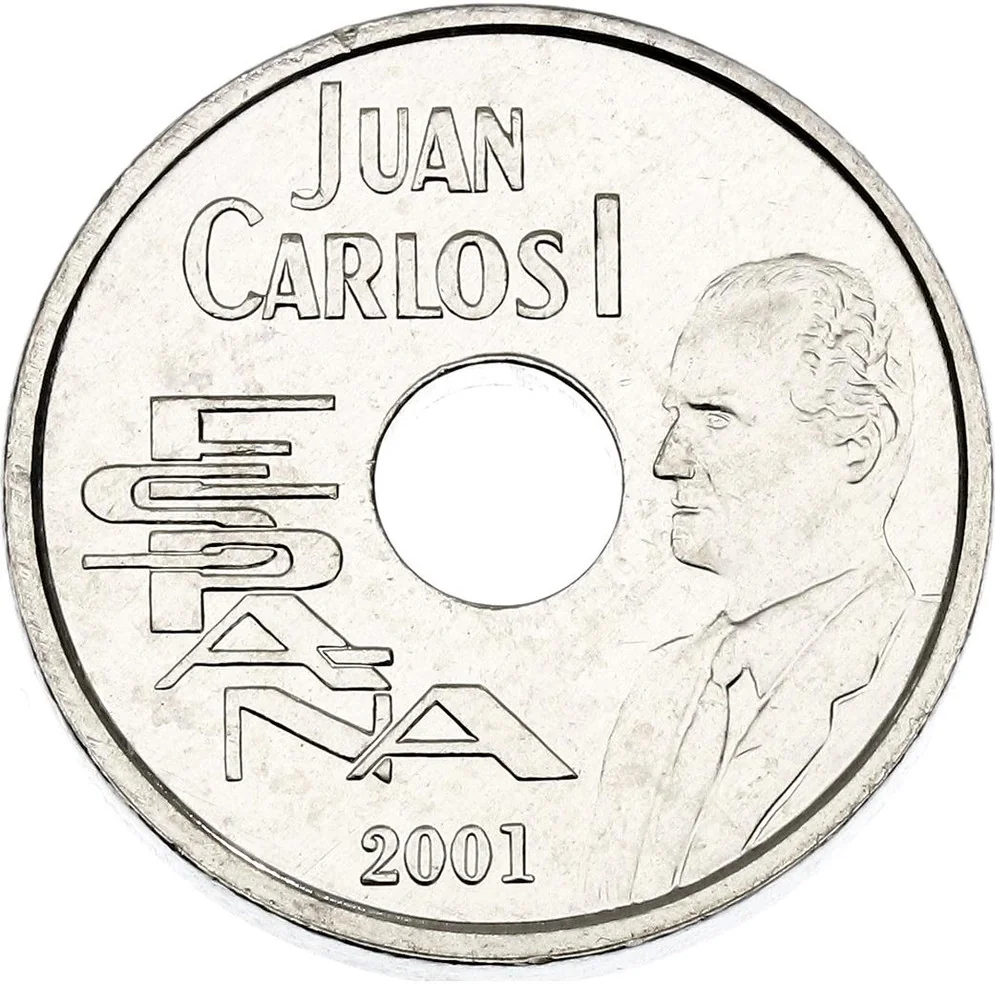
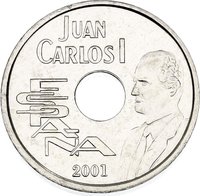
Obverse
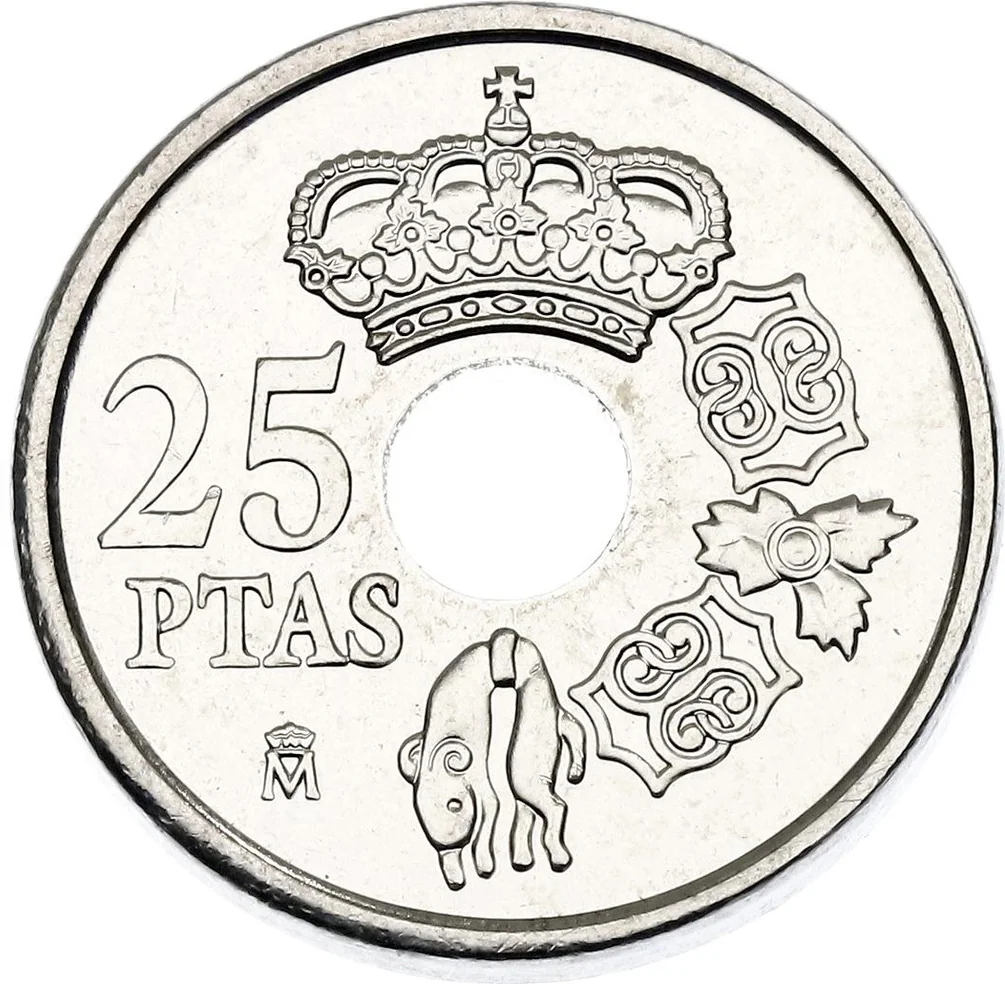
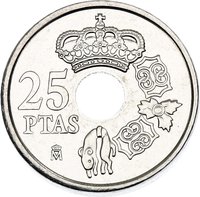
Reverse
Description:
Royal crown above, collar of the Order of the Golden Fleece to the right.
Inscription:
25 PTAS
M
M
Script: Latin
Edge
Plain
Mints
| Name | Mark |
|---|---|
| Royal Mint of Madrid | (M) |
Mintings
| Year | Mint Mark | Mintage | Quality | Collection |
|---|---|---|---|---|
| 2001 | M | 150,000 |
Historical background
In 2001, Spain's currency situation was defined by its full and active participation in the final, irreversible stage of the European single currency project. The peseta, which had been Spain's national currency for over a century, was in its final years of circulation as legal tender. Since January 1, 1999, the euro had existed as a virtual currency for electronic payments and financial markets, with the peseta locked at a fixed conversion rate of 166.386 pesetas to one euro. This period was one of dual display, where prices were shown in both currencies to acclimatize the public, but all financial and accounting systems operated on the fixed euro standard.
The year was a critical preparatory phase for the physical cash changeover scheduled for January 1, 2002. The Spanish government, the Bank of Spain, and financial institutions were engaged in a massive logistical operation. This included the production and secure distribution of euro banknotes and coins, the adaptation of millions of vending machines and cash registers, and extensive public information campaigns to familiarize citizens with the new currency's appearance and security features. Economically, the fixed conversion rate provided stability, fully integrating Spain into the Eurozone's monetary policy set by the European Central Bank, which aimed to maintain price stability across the bloc.
Thus, the 2001 currency situation was characterized not by crisis or fluctuation, but by managed transition and anticipation. There was no independent monetary policy, as Spain had ceded control over interest rates and money supply to the ECB. The focus was entirely on ensuring a smooth and efficient shift to euro cash, marking the culmination of Spain's deeper integration into the European project, which promised to reduce transaction costs, eliminate exchange rate risk within the Eurozone, and bolster trade and investment. The peseta's fate was sealed, representing a profound economic and symbolic shift in the nation's modern history.
The year was a critical preparatory phase for the physical cash changeover scheduled for January 1, 2002. The Spanish government, the Bank of Spain, and financial institutions were engaged in a massive logistical operation. This included the production and secure distribution of euro banknotes and coins, the adaptation of millions of vending machines and cash registers, and extensive public information campaigns to familiarize citizens with the new currency's appearance and security features. Economically, the fixed conversion rate provided stability, fully integrating Spain into the Eurozone's monetary policy set by the European Central Bank, which aimed to maintain price stability across the bloc.
Thus, the 2001 currency situation was characterized not by crisis or fluctuation, but by managed transition and anticipation. There was no independent monetary policy, as Spain had ceded control over interest rates and money supply to the ECB. The focus was entirely on ensuring a smooth and efficient shift to euro cash, marking the culmination of Spain's deeper integration into the European project, which promised to reduce transaction costs, eliminate exchange rate risk within the Eurozone, and bolster trade and investment. The peseta's fate was sealed, representing a profound economic and symbolic shift in the nation's modern history.
Series: Last issue of pesetas
⭐ Rare