

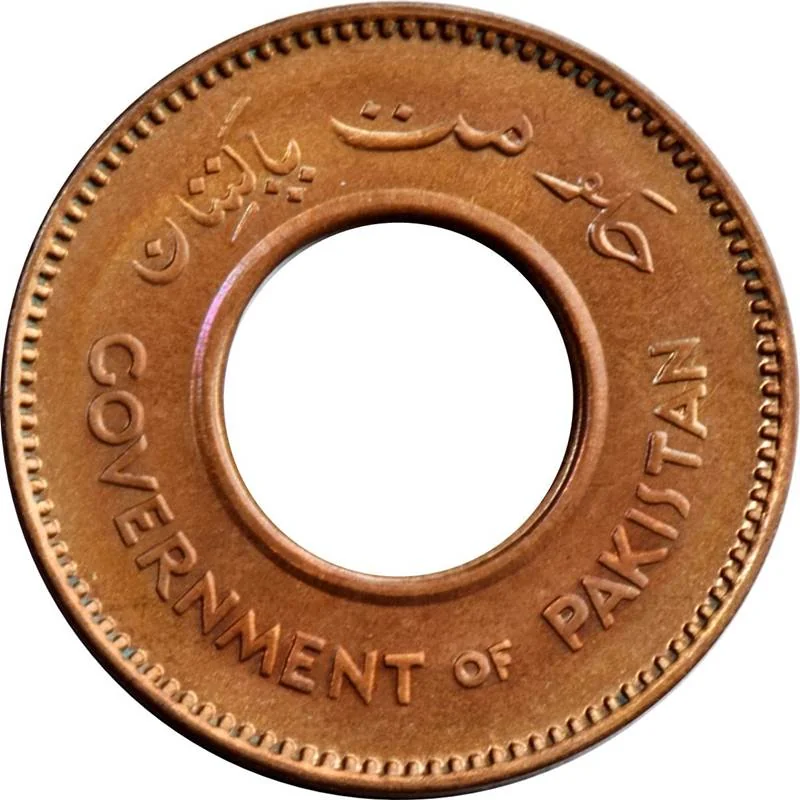
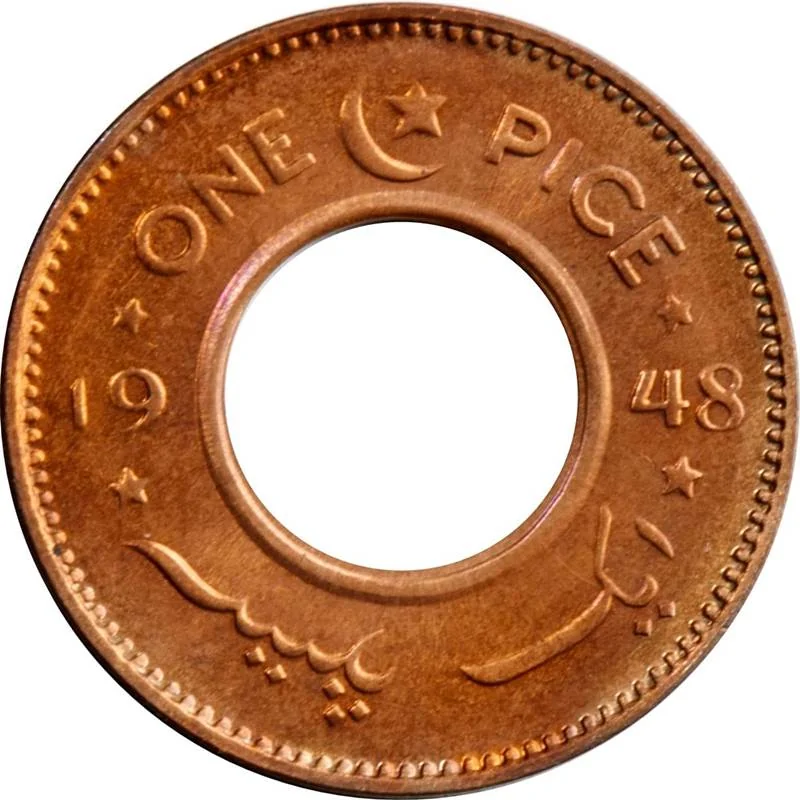
1 paisa – Pakistan
Add to wishlist
Pakistan
Context
Years: 1948–1952
Issuer: Pakistan
Period:
(1947—1956)
Ruler: Elizabeth II
Currency:
(1948—1960)
Demonetized: Yes
Total mintage: 81,475,000
Material
Diameter: 21.3 mm
Weight: 2 g
Thickness: 1.07 mm
Shape: Round with a round hole
Composition: Bronze
Magnetic: No
Technique: Milled
Alignment: Medal alignment
flip
References
KM: #
Numista: #14095
Value
Exchange value: 1⁄64 PKR
Obverse
Reverse
Edge
Plain
Mints
| Name | Mark |
|---|---|
| Lahore | — |
Mintings
| Year | Mint Mark | Mintage | Quality | Collection |
|---|---|---|---|---|
| 1948 | — | — | ||
| 1948 | — | 5,000 | Proof | |
| 1949 | — | 25,740,000 | ||
| 1949 | — | — | Proof | |
| 1951 | — | 14,050,000 | ||
| 1952 | — | 41,680,000 |
Historical background
Following the partition of India in 1947, Pakistan inherited a complex and precarious currency situation. At independence, both nations continued using the Indian rupee, with currency notes stamped "Government of Pakistan" as a temporary measure. This created immediate vulnerabilities, as Pakistan lacked control over its money supply and its reserves were held by the Reserve Bank of India. A critical dispute arose over the division of the pre-partition cash balances, with India initially withholding Pakistan's share of £75 million, strangling the new state's ability to finance essential imports and government functions. This financial withholding escalated into a major political crisis in early 1948.
Recognizing the urgent need for monetary sovereignty, the Pakistani government took decisive action. The State Bank of Pakistan was established on July 1, 1948, and given sole authority for issuing currency. On October 1, 1948, the Pakistani rupee was formally introduced, replacing the stamped Indian notes. The new currency was initially pegged at par with the Indian rupee to minimize economic disruption in a region still deeply interconnected through trade and migration.
Thus, by the end of 1948, Pakistan had successfully navigated its initial currency crisis. It had secured its financial share from India after protracted negotiations, established its own central bank, and launched a distinct national currency. This foundational move was crucial for asserting economic independence, enabling the state to manage its own fiscal and monetary policy, and building the institutional framework for a sovereign economy. However, the challenges of building foreign exchange reserves and managing a nascent financial system in a predominantly agrarian economy lay ahead.
Recognizing the urgent need for monetary sovereignty, the Pakistani government took decisive action. The State Bank of Pakistan was established on July 1, 1948, and given sole authority for issuing currency. On October 1, 1948, the Pakistani rupee was formally introduced, replacing the stamped Indian notes. The new currency was initially pegged at par with the Indian rupee to minimize economic disruption in a region still deeply interconnected through trade and migration.
Thus, by the end of 1948, Pakistan had successfully navigated its initial currency crisis. It had secured its financial share from India after protracted negotiations, established its own central bank, and launched a distinct national currency. This foundational move was crucial for asserting economic independence, enabling the state to manage its own fiscal and monetary policy, and building the institutional framework for a sovereign economy. However, the challenges of building foreign exchange reserves and managing a nascent financial system in a predominantly agrarian economy lay ahead.
Series: 1948 Pakistan circulation coins
🌱 Common