

Obverse
Description:
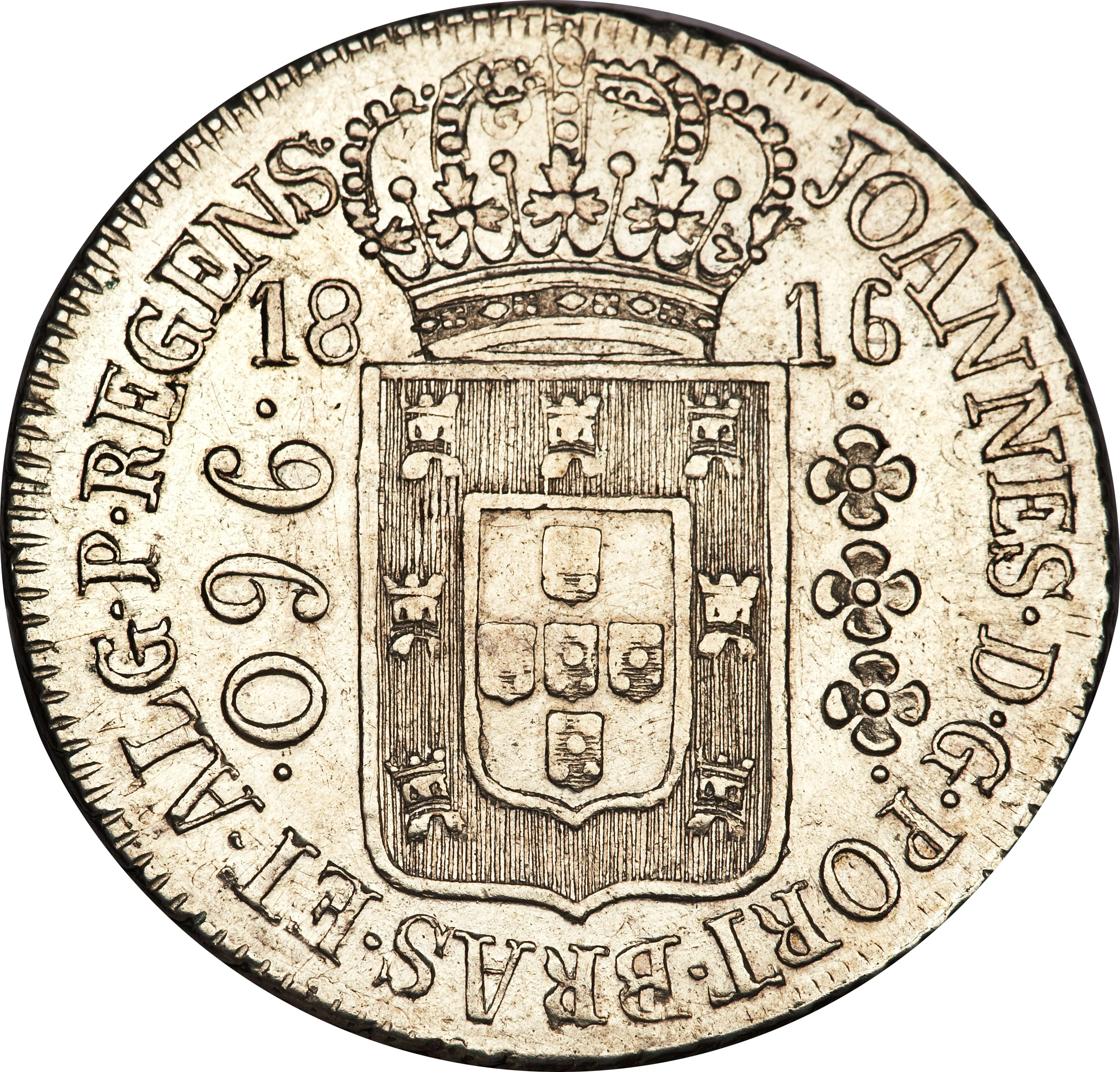
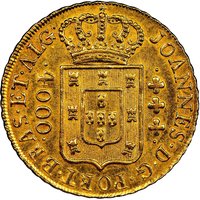
Arms with a crown.
Inscription:
JOANNES·D·G·PORT·BRAS·ET·ALG·P·REGENS·
18 16
·960·
18 16
·960·
Translation:
John, by the Grace of God, Prince Regent of Portugal, Brazil, and the Algarves.
18 16
·960·
18 16
·960·
Script: Latin
Languages: Latin, Portuguese
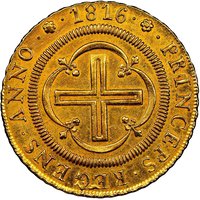
Reverse
Edge
Puff pastry
Mintings
| Year | Mint Mark | Mintage | Quality | Collection |
|---|---|---|---|---|
| 1816 | R | — |
Historical background
In 1816, Brazil's currency situation was characterized by a complex and often chaotic monetary landscape, a direct legacy of its colonial past and the recent upheavals caused by the Napoleonic Wars and the arrival of the Portuguese court in 1808. The circulating medium was a confusing mix of metallic coins, including Portuguese réis (the official unit of account), Spanish-American pesos, and coins from other European empires. Crucially, there was a severe and chronic shortage of official, full-weight Portuguese coinage, which led to widespread circulation of worn, clipped, and counterfeit coins. This scarcity was exacerbated by Brazil's persistent trade deficit with Portugal and restrictions on minting, creating a dysfunctional system where the nominal value of coins often far exceeded their intrinsic metal value.
The primary response to this shortage was the proliferation of paper money, first issued by the Banco do Brasil following its founding in 1808. These banknotes, intended as a practical solution, were initially well-received and facilitated commerce in Rio de Janeiro. However, by 1816, the over-issuance of paper money to finance government expenditures—particularly those of the royal court and military campaigns—had already begun to erode public confidence. The paper mil-réis started to trade at a discount against metallic coinage, marking the early stages of a depreciation that would plague the Brazilian economy for decades. This created a two-tiered system where hard currency was hoarded for important transactions or foreign trade.
Thus, in 1816, Brazil stood at a monetary crossroads. Officially part of the United Kingdom of Portugal, Brazil and the Algarves since 1815, the country was grappling with the financial demands of a nascent royal state while lacking a unified, trustworthy currency. The system was a fragile patchwork of undervalued metal and increasingly suspect paper, straining under the weight of royal spending and a growing economy. This instability foreshadowed the severe inflationary crises and currency devaluations that would follow after independence in 1822, with roots firmly planted in the monetary challenges of the late colonial and early royal period.
The primary response to this shortage was the proliferation of paper money, first issued by the Banco do Brasil following its founding in 1808. These banknotes, intended as a practical solution, were initially well-received and facilitated commerce in Rio de Janeiro. However, by 1816, the over-issuance of paper money to finance government expenditures—particularly those of the royal court and military campaigns—had already begun to erode public confidence. The paper mil-réis started to trade at a discount against metallic coinage, marking the early stages of a depreciation that would plague the Brazilian economy for decades. This created a two-tiered system where hard currency was hoarded for important transactions or foreign trade.
Thus, in 1816, Brazil stood at a monetary crossroads. Officially part of the United Kingdom of Portugal, Brazil and the Algarves since 1815, the country was grappling with the financial demands of a nascent royal state while lacking a unified, trustworthy currency. The system was a fragile patchwork of undervalued metal and increasingly suspect paper, straining under the weight of royal spending and a growing economy. This instability foreshadowed the severe inflationary crises and currency devaluations that would follow after independence in 1822, with roots firmly planted in the monetary challenges of the late colonial and early royal period.
💎 Very Rare