

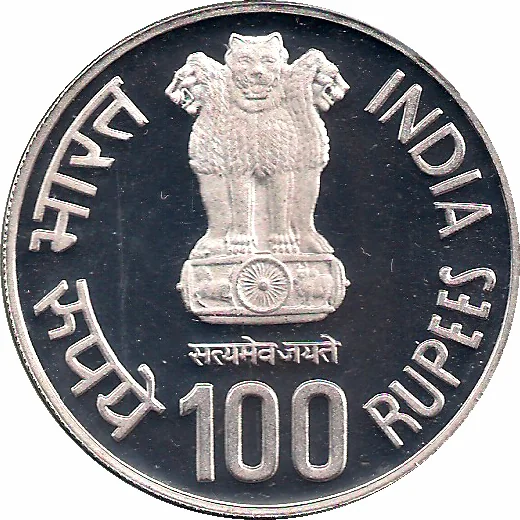
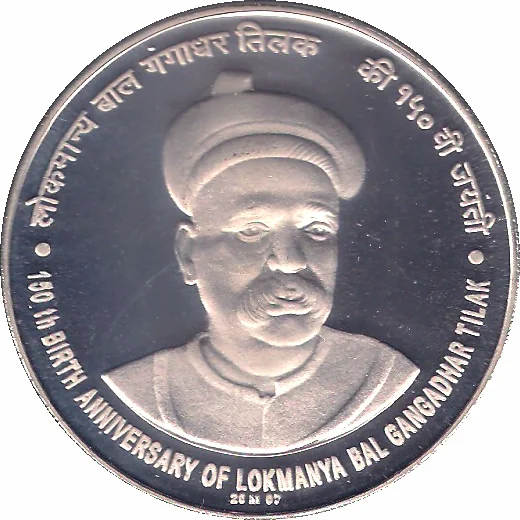
100 Rupees (Lokmanya Bal Gangadhar Tilak) – India
Non-circulating coins
Commemoration: Lokmanya Bal Gangadhar Tilak - 150th Birth Anniversary
India

Material
References
KM: #Click to copy to clipboard366
Numista: #36221
Value
Exchange value: 100 INR = $1.10
Bullion value: $49.73
Inflation-adjusted value: 340.65 INR
Obverse
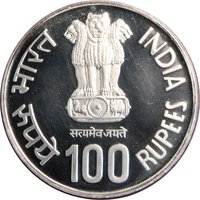
Reverse
Edge
Reeded
Categories
| Event> Birth anniversary |
Mints
| Name | Mark |
|---|---|
| Mumbai / Bombay | ♦ |
| Mumbai / Bombay | M |
Historical background
In 2007, India's currency situation was characterized by robust economic growth and significant pressure on the Indian Rupee (INR) to appreciate. The economy was expanding at a rate of over 9%, attracting substantial foreign capital inflows, both as Foreign Direct Investment (FDI) and portfolio investments in a booming stock market. This surge in dollar inflows created an imbalance, increasing the supply of foreign currency and driving up demand for the rupee. Consequently, the Reserve Bank of India (RBI) faced a complex challenge: an appreciating rupee threatened to make Indian exports less competitive in the global market, a major concern for a key sector like information technology.
To manage this volatility and stem the rupee's rise, the RBI actively intervened in the foreign exchange market by purchasing dollars and building up its foreign exchange reserves, which soared to nearly $300 billion by year's end. This intervention was part of a "managed float" regime. However, these dollar purchases injected large amounts of rupee liquidity into the banking system, risking inflation. To sterilize this effect and control money supply, the RBI simultaneously engaged in Open Market Operations (OMOs), selling government bonds to absorb the excess liquidity. This delicate balancing act defined much of the year's monetary policy.
Despite these interventions, the rupee ended 2007 significantly stronger, appreciating by approximately 12% against the US dollar. This appreciation was a double-edged sword; while it reduced the cost of imports like oil, it squeezed profit margins for exporters. The situation underscored the tensions of a rapidly globalizing economy. Furthermore, the latter part of 2007 brought early shadows of the impending global financial crisis, which would, by 2008, dramatically reverse capital flows and plunge the rupee into a phase of depreciation and volatility, ending a period of sustained strength.
To manage this volatility and stem the rupee's rise, the RBI actively intervened in the foreign exchange market by purchasing dollars and building up its foreign exchange reserves, which soared to nearly $300 billion by year's end. This intervention was part of a "managed float" regime. However, these dollar purchases injected large amounts of rupee liquidity into the banking system, risking inflation. To sterilize this effect and control money supply, the RBI simultaneously engaged in Open Market Operations (OMOs), selling government bonds to absorb the excess liquidity. This delicate balancing act defined much of the year's monetary policy.
Despite these interventions, the rupee ended 2007 significantly stronger, appreciating by approximately 12% against the US dollar. This appreciation was a double-edged sword; while it reduced the cost of imports like oil, it squeezed profit margins for exporters. The situation underscored the tensions of a rapidly globalizing economy. Furthermore, the latter part of 2007 brought early shadows of the impending global financial crisis, which would, by 2008, dramatically reverse capital flows and plunge the rupee into a phase of depreciation and volatility, ending a period of sustained strength.

⭐ Rare