

4000 réis – Brazil
Add to wishlist
Brazil
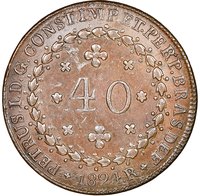
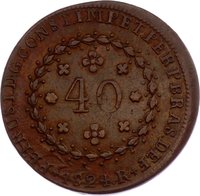
Obverse
Description:
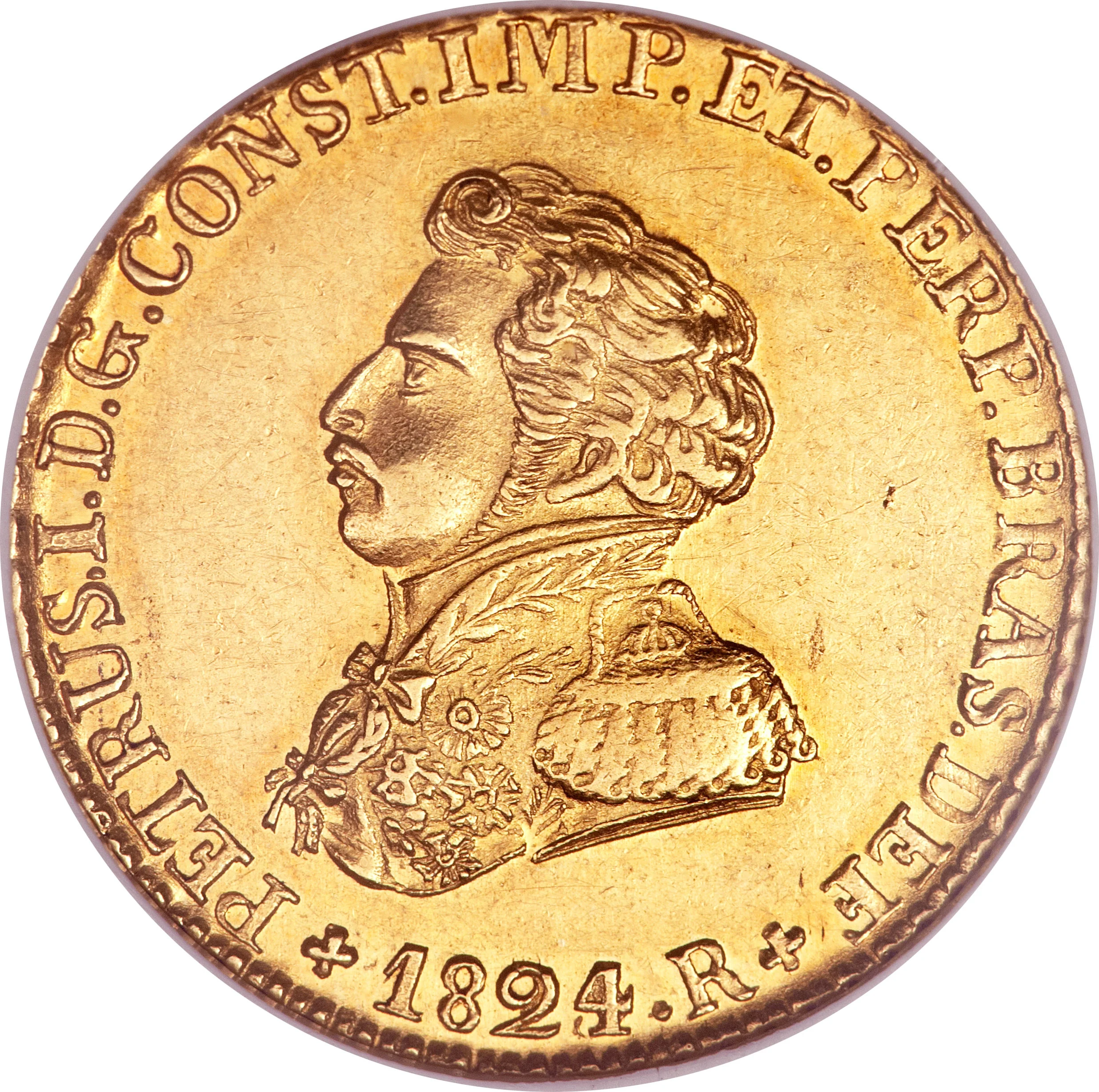
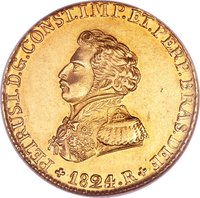
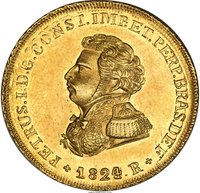
Uniformed bust left, date and mint mark beneath.
Inscription:
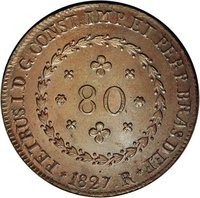
PETRUS.I.D.G.CONST.IMP.ET.PERP.BRAS.DEF
1824.R
1824.R
Script: Latin
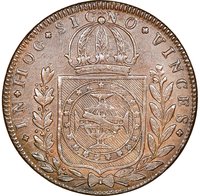
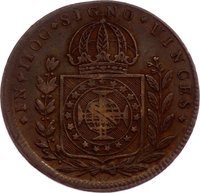
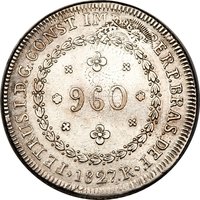
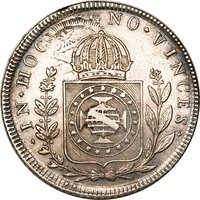
Reverse
Edge
Mints
| Name | Mark |
|---|---|
| Bahia | B |
| Casa da Moeda do Brasil | R |
Mintings
Historical background
In 1823, Brazil found itself in a precarious monetary situation, a direct legacy of its colonial past and the turbulent process of independence declared in 1822. The circulating medium was a chaotic mix of Portuguese coins, such as réis (the unit of account), alongside a vast array of debased and counterfeit coins from various nations. Most critically, the economy was saturated with papel-moeda (paper money), first issued by the Portuguese Crown in 1808 and then recklessly over-issued by the Banco do Brasil to finance government deficits, particularly the costs of the independence movement and the ongoing war in the north. This led to a severe loss of confidence and a dramatic depreciation of paper currency against gold and silver.
The new imperial government under Emperor Pedro I faced an immediate fiscal crisis. With metallic coins being hoarded and the paper currency losing value, the state struggled to collect taxes in a stable medium and fund its operations. The disparity between the face value of the paper money and its real, market value created widespread economic distortion, harming trade and public credit. This environment of monetary instability directly threatened the legitimacy and functionality of the fledgling empire, making currency reform not just an economic necessity but a political imperative for survival.
Consequently, 1823 became a year of decisive action. The Constituent Assembly, tasked with drafting the empire's first constitution, also grappled with the currency problem. The solution was the Lei Monetária (Monetary Law) of October 1823, which established a new, unified national currency: the mil-réis. This law aimed to simplify the system by making the mil-réis the standard unit, while also beginning the complex process of withdrawing the discredited paper money from circulation and attempting to restore a metallic standard. Thus, 1823 marked the critical juncture where Brazil began its difficult transition from a colonial monetary patchwork toward a unified, national currency system under the Imperial government.
The new imperial government under Emperor Pedro I faced an immediate fiscal crisis. With metallic coins being hoarded and the paper currency losing value, the state struggled to collect taxes in a stable medium and fund its operations. The disparity between the face value of the paper money and its real, market value created widespread economic distortion, harming trade and public credit. This environment of monetary instability directly threatened the legitimacy and functionality of the fledgling empire, making currency reform not just an economic necessity but a political imperative for survival.
Consequently, 1823 became a year of decisive action. The Constituent Assembly, tasked with drafting the empire's first constitution, also grappled with the currency problem. The solution was the Lei Monetária (Monetary Law) of October 1823, which established a new, unified national currency: the mil-réis. This law aimed to simplify the system by making the mil-réis the standard unit, while also beginning the complex process of withdrawing the discredited paper money from circulation and attempting to restore a metallic standard. Thus, 1823 marked the critical juncture where Brazil began its difficult transition from a colonial monetary patchwork toward a unified, national currency system under the Imperial government.
Series: 1823 Brazil circulation coins
💎 Extremely Rare