

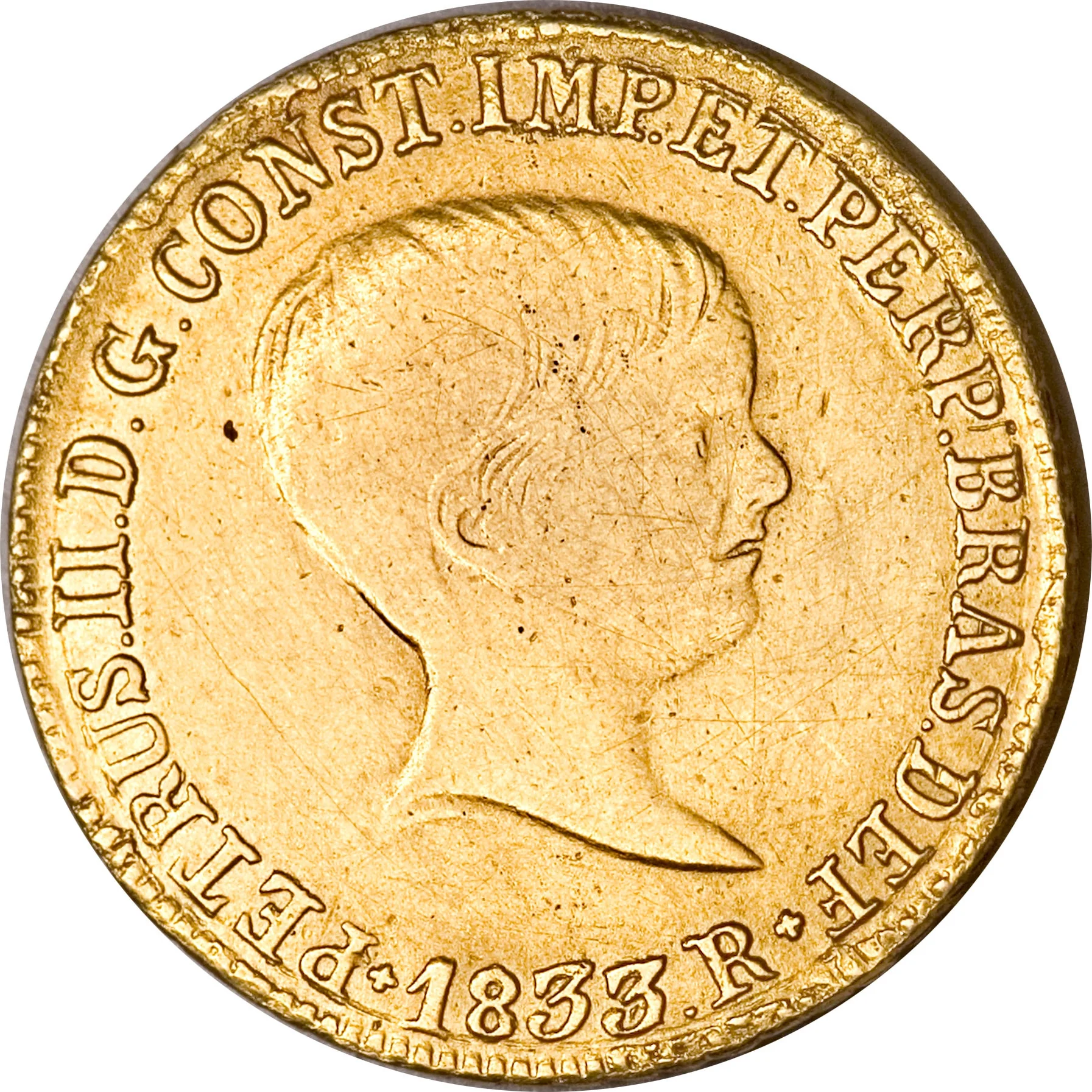
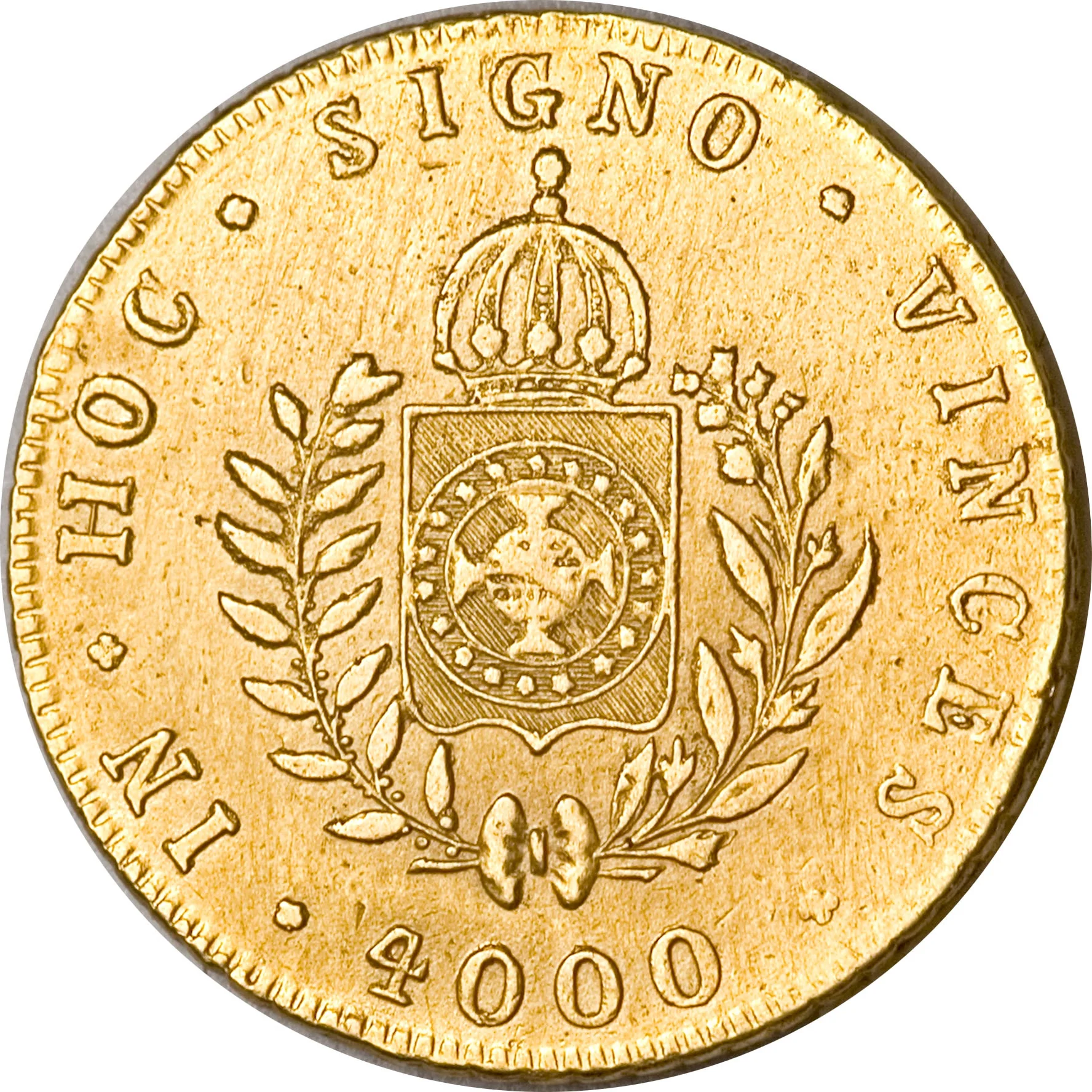

Obverse
Description:
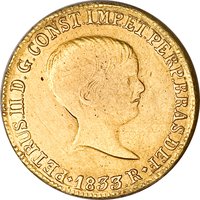
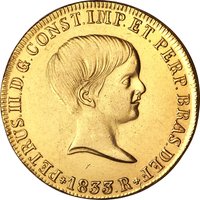
Young Pedro II with date and lettering encircling his portrait.
Inscription:
PETRUS.II.D.G.CONST.IMP.ET.PERP.BRAS.DEF
1833.R
1833.R
Script: Latin
Reverse
Edge
Mintings
| Year | Mint Mark | Mintage | Quality | Collection |
|---|---|---|---|---|
| 1832 | — | — | ||
| 1832 | R | 64 | ||
| 1833 | R | 257 |
Historical background
In 1832, Brazil's currency situation was chaotic and inflationary, a direct legacy of the political and economic turbulence following independence from Portugal in 1822. The government, first under Emperor Pedro I and then the Regency (as Pedro I abdicated in 1831), financed large deficits primarily by issuing more paper money. The primary circulating currency was the mil-réis, but its value was severely undermined by the over-issuance of copper coins (vilões and patacões) and, more critically, paper bilhetes de tesouro (treasury notes) from the Banco do Brasil. These notes were not properly backed by specie, leading to a dramatic loss of public confidence and a sharp divergence between the value of paper and gold.
This period was characterized by a severe currency crisis, with rampant inflation and widespread currency forgery exacerbating the problem. The value of paper money fluctuated wildly and depreciated significantly against gold and silver, creating a complex system of multiple exchange rates. This environment hampered domestic trade, discouraged foreign investment, and placed a heavy burden on the population, particularly salaried workers and those on fixed incomes whose purchasing power eroded rapidly. The economic instability mirrored the political fragility of the Regency period, as the young nation struggled to establish credible institutions.
Authorities recognized the crisis, but effective solutions remained elusive in 1832. The Banco do Brasil, deeply entangled with government debt, had its note-issuing privileges suspended in 1829, but the notes already in circulation continued to depreciate. Debates raged between "metalists," who advocated for a return to a hard currency standard, and those who saw controlled paper money as necessary for economic development. While the worst of the inflation would peak later in the 1830s, the currency chaos of 1832 laid bare the fundamental challenge of establishing monetary sovereignty and fiscal discipline in the nascent Brazilian Empire.
This period was characterized by a severe currency crisis, with rampant inflation and widespread currency forgery exacerbating the problem. The value of paper money fluctuated wildly and depreciated significantly against gold and silver, creating a complex system of multiple exchange rates. This environment hampered domestic trade, discouraged foreign investment, and placed a heavy burden on the population, particularly salaried workers and those on fixed incomes whose purchasing power eroded rapidly. The economic instability mirrored the political fragility of the Regency period, as the young nation struggled to establish credible institutions.
Authorities recognized the crisis, but effective solutions remained elusive in 1832. The Banco do Brasil, deeply entangled with government debt, had its note-issuing privileges suspended in 1829, but the notes already in circulation continued to depreciate. Debates raged between "metalists," who advocated for a return to a hard currency standard, and those who saw controlled paper money as necessary for economic development. While the worst of the inflation would peak later in the 1830s, the currency chaos of 1832 laid bare the fundamental challenge of establishing monetary sovereignty and fiscal discipline in the nascent Brazilian Empire.
Series: 1832 Brazil circulation coins
✨ Legendary