

10000 Réis – Brazil
Brazil
Context

Material
References
KM: #Click to copy to clipboard457
Numista: #36170
Value
Bullion value: $2193.36
Obverse
Description:
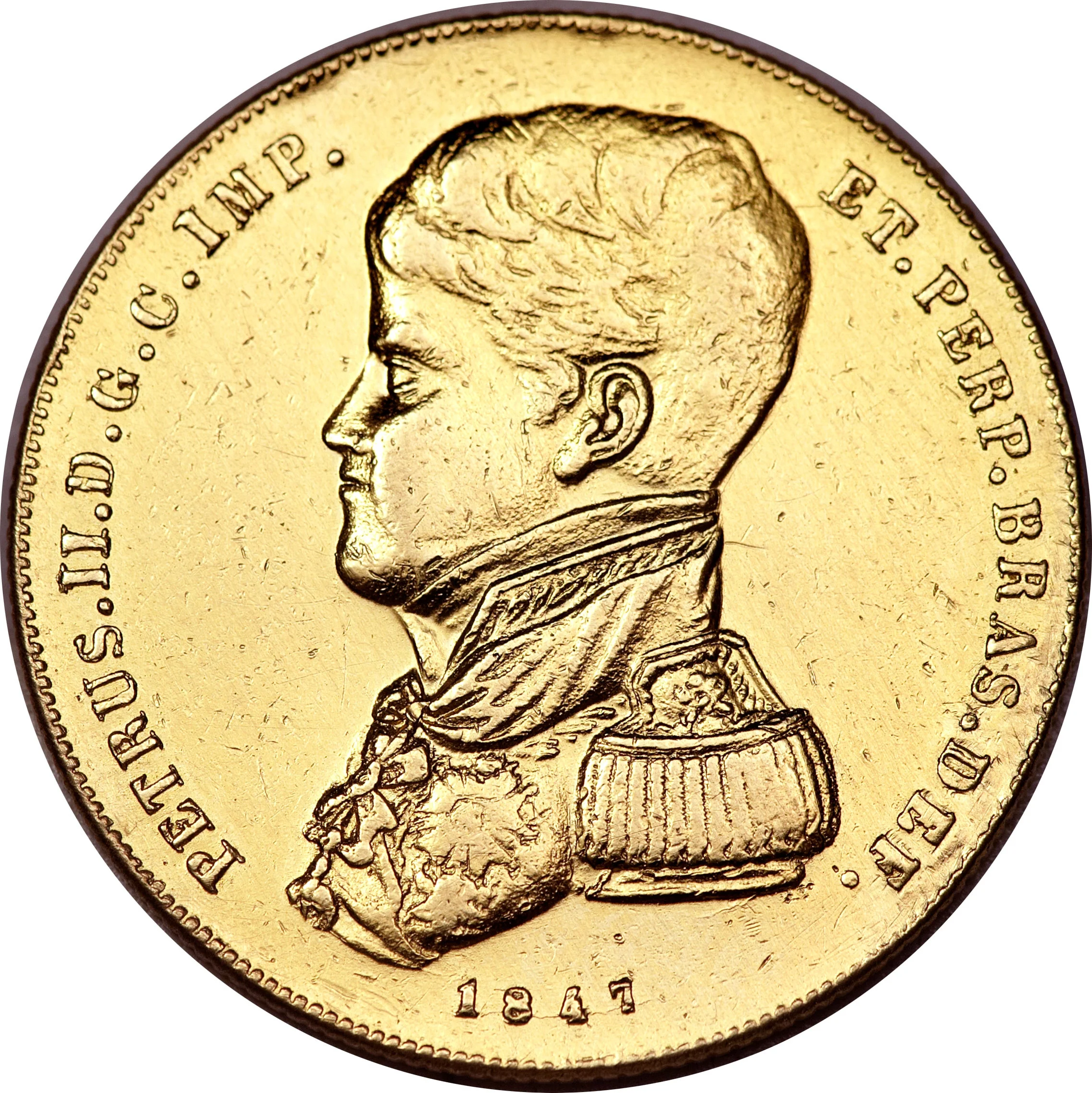
Uniformed bust facing left.
Inscription:
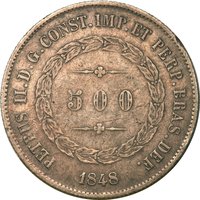
PETRUS.II.D.G.C.IMP. ET.PERP.BRAS.DEF.
1847
1847
Script: Latin
Reverse
Edge
Mintings
| Year | Mint Mark | Mintage | Quality | Collection |
|---|---|---|---|---|
| 1841 | — | 345 | ||
| 1842 | — | 1,146 | ||
| 1843 | — | 544 | ||
| 1844 | — | 1,989 | ||
| 1845 | — | 3,834 | ||
| 1847 | — | 25,791 | ||
| 1848 | — | 4,567 |
Historical background
In 1841, Brazil's currency situation was characterized by significant instability and complexity, a legacy of its colonial past and the financial strains of early independence. The nation operated under a bimetallic system nominally based on gold and silver, but the reality was a chaotic circulation of various foreign coins, particularly British pounds, Portuguese réis, and Spanish-American pesos, alongside debased domestic coinage. The standard unit was the réis (plural réis), with values often expressed in milréis (1,000 réis). However, the lack of a strong, unified national coinage and widespread counterfeiting undermined public trust and complicated commerce.
This monetary disarray was exacerbated by the issuance of paper money. Following the costly war with Argentina over the Cisplatine Province (which led to the independence of Uruguay) and ongoing internal conflicts, the government increasingly relied on the printing press to finance its deficits. These treasury notes, often not fully backed by specie, fueled inflation and led to a widening gap between the face value of paper money and its actual worth in gold or silver. The result was a system where the value of money could vary significantly from one province to another, hindering economic integration and growth.
Recognizing the crisis, the Brazilian government had begun taking steps toward reform. The pivotal Lei Álvares Machado of 1846 was still a few years away, but in 1841, authorities were grappling with the urgent need to retire depreciated paper notes and restore metallic currency. The period thus represents a tense transitional phase, where the pressures of building a modern state and a national economy were acutely felt through the unreliable and fragmented medium of exchange, setting the stage for the more systematic monetary reforms of the following decade.
This monetary disarray was exacerbated by the issuance of paper money. Following the costly war with Argentina over the Cisplatine Province (which led to the independence of Uruguay) and ongoing internal conflicts, the government increasingly relied on the printing press to finance its deficits. These treasury notes, often not fully backed by specie, fueled inflation and led to a widening gap between the face value of paper money and its actual worth in gold or silver. The result was a system where the value of money could vary significantly from one province to another, hindering economic integration and growth.
Recognizing the crisis, the Brazilian government had begun taking steps toward reform. The pivotal Lei Álvares Machado of 1846 was still a few years away, but in 1841, authorities were grappling with the urgent need to retire depreciated paper notes and restore metallic currency. The period thus represents a tense transitional phase, where the pressures of building a modern state and a national economy were acutely felt through the unreliable and fragmented medium of exchange, setting the stage for the more systematic monetary reforms of the following decade.
✨ Legendary