

20000 Réis – Brazil
Brazil
Context

Material
References
KM: #Click to copy to clipboard461
Numista: #36146
Value
Bullion value: $2742.94
Obverse
Description:
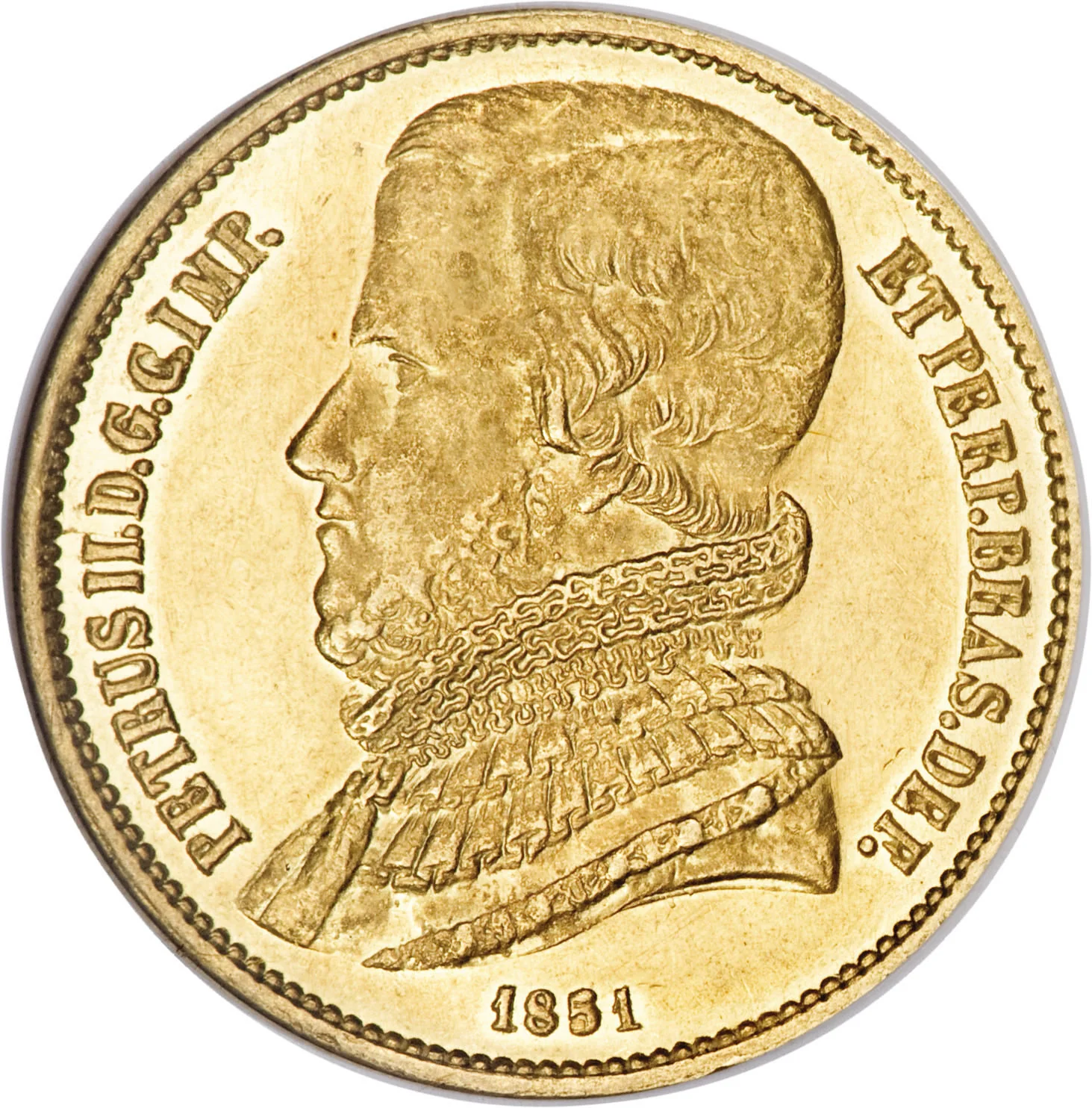
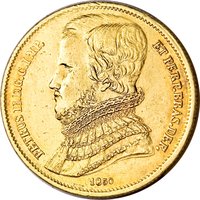
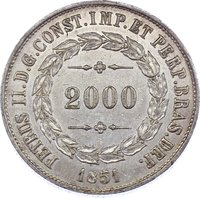
Pedro II left bust, 1851 date above, flanked by Latin inscriptions.
Inscription:
PETRUS II.D.G.C.IMP. ET PERP.BRAS.DEF.
1851
1851
Translation:
Peter II, by the Grace of God, Constitutional Emperor and Perpetual Defender of Brazil.
1851
1851
Script: Latin
Language: Latin
Engraver: Carlos Custódio Azevedo
Reverse
Description:
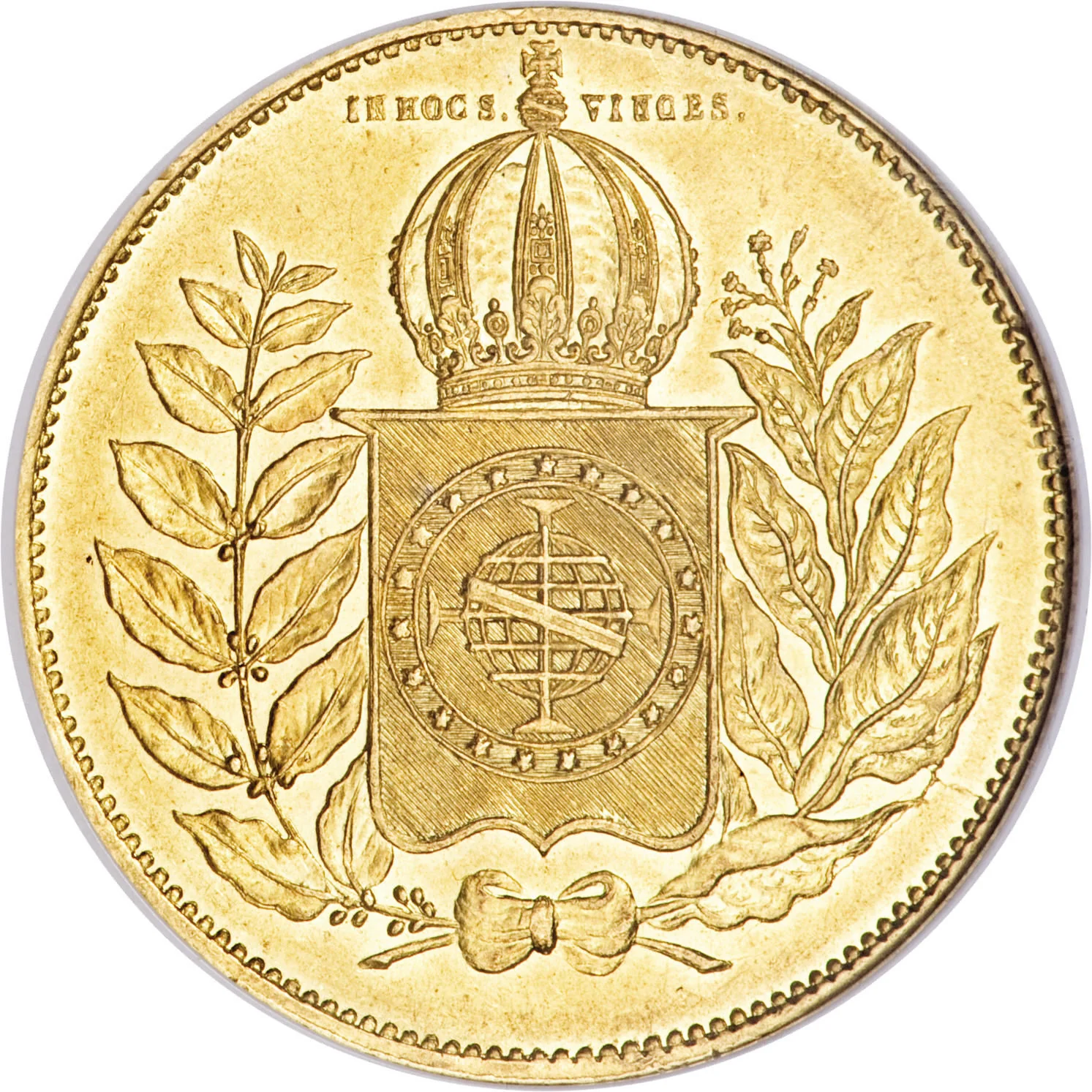
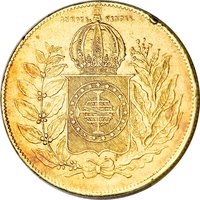
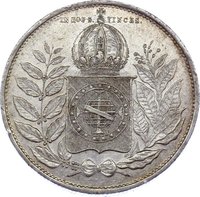
Empire of Brazil coat of arms with the motto "IN HOC S. VINCES."
Inscription:
IN HOC S. VINCES.
Translation:
In this sign you will conquer.
Script: Latin
Language: Latin
Engraver: Carlos Custódio Azevedo
Edge
Reeded
Categories
| Symbols> Coat of Arms |
Mintings
| Year | Mint Mark | Mintage | Quality | Collection |
|---|---|---|---|---|
| 1849 | — | 6,464 | ||
| 1850 | — | 42,256 | ||
| 1851 | — | 302,553 |
Historical background
In 1849, Brazil's currency situation was characterized by significant instability and fragmentation, a legacy of the colonial era and the political turmoil following independence in 1822. The monetary system was a complex and chaotic mix of copper, silver, and gold coins, both domestic and foreign, circulating at fluctuating values. The most notable unit was the mil-réis, a real-based unit of account, but the physical currency in circulation included worn Portuguese coins, counterfeits, and various foreign currencies, particularly British sovereigns. This lack of a uniform, state-controlled currency hampered commerce and economic planning, as exchange rates between coins and regions were highly variable.
The primary response to this crisis was the Law of August 8, 1846, which came into full effect in the years leading up to 1849. This law aimed to reform the system by adopting the gold standard and authorizing the minting of new, high-quality gold coins called "brasileiros." However, the reform faced immediate practical difficulties. A global gold shortage and Brazil's own trade deficits led to a persistent drain of gold from the country, making it nearly impossible to back the currency adequately. Consequently, while the law established a theoretical gold standard, in practice, the economy continued to rely heavily on inconvertible paper money and depreciated copper coins for everyday transactions.
Therefore, by 1849, Brazil found itself in a transitional and contradictory monetary position. The government had enacted a modernizing reform with the 1846 law, but the nation lacked the necessary gold reserves to sustain it. The result was a de facto system of parallel currencies: a scarce gold currency for large transactions and international trade, and a more abundant but depreciating fiduciary currency (paper notes and low-value coins) for the domestic economy. This instability would persist and contribute to the financial pressures that led to the establishment of the Banco do Brasil in 1851 and further monetary reforms in the following decade.
The primary response to this crisis was the Law of August 8, 1846, which came into full effect in the years leading up to 1849. This law aimed to reform the system by adopting the gold standard and authorizing the minting of new, high-quality gold coins called "brasileiros." However, the reform faced immediate practical difficulties. A global gold shortage and Brazil's own trade deficits led to a persistent drain of gold from the country, making it nearly impossible to back the currency adequately. Consequently, while the law established a theoretical gold standard, in practice, the economy continued to rely heavily on inconvertible paper money and depreciated copper coins for everyday transactions.
Therefore, by 1849, Brazil found itself in a transitional and contradictory monetary position. The government had enacted a modernizing reform with the 1846 law, but the nation lacked the necessary gold reserves to sustain it. The result was a de facto system of parallel currencies: a scarce gold currency for large transactions and international trade, and a more abundant but depreciating fiduciary currency (paper notes and low-value coins) for the domestic economy. This instability would persist and contribute to the financial pressures that led to the establishment of the Banco do Brasil in 1851 and further monetary reforms in the following decade.
💎 Extremely Rare