

5 Dinars – Yugoslavia
Context
Years: 2000–2002
Issuer: Yugoslavia
Period:
(1992—2003)
Currency:
(1994—2003)
Demonetization: 31 December 2007
Total mintage: 63,728,500
Material
Diameter: 24 mm
Weight: 6.3 g
Thickness: 2 mm
Shape: Round
Composition: Nickel brass
Magnetic: No
Technique: Milled
Alignment: Medal alignment
flip
References
KM: #Click to copy to clipboard182
Numista: #3611
Value
Exchange value: 5 YUM
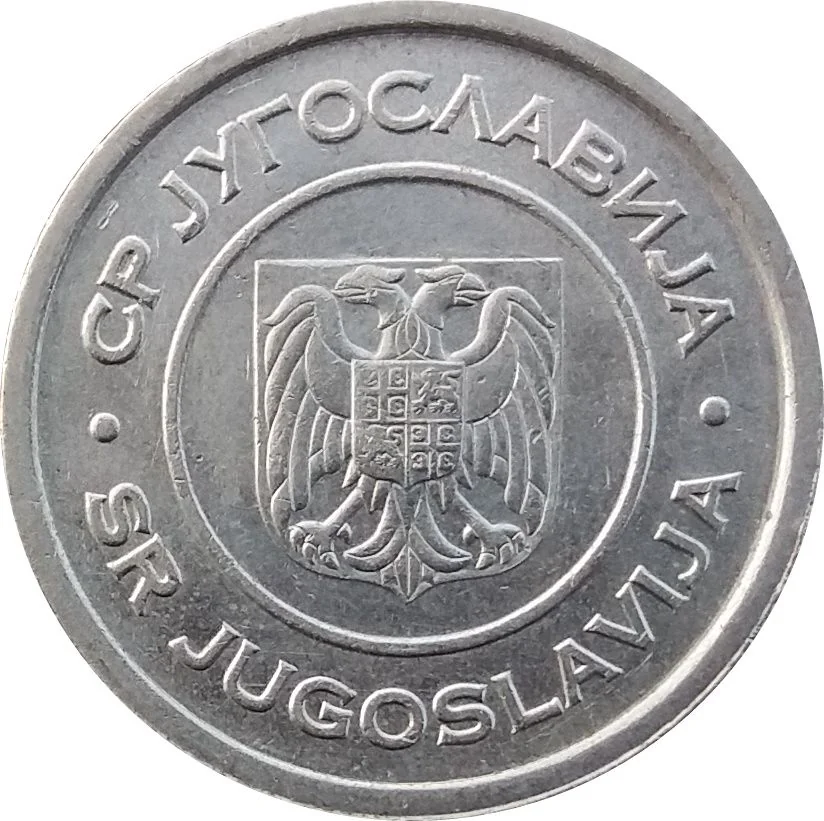
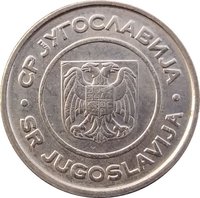
Obverse
Description:
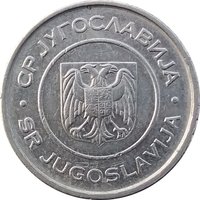
Yugoslavia coat of arms
Inscription:
· СР ЈУГОСЛАВИЈА ·
SR JUGOSLAVIJA
SR JUGOSLAVIJA
Translation:
SOCIALIST FEDERAL REPUBLIC OF YUGOSLAVIA
Languages: Serbo-Croatian, Serbian
Engraver: Mitar Petković
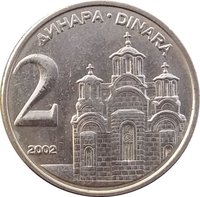
Reverse
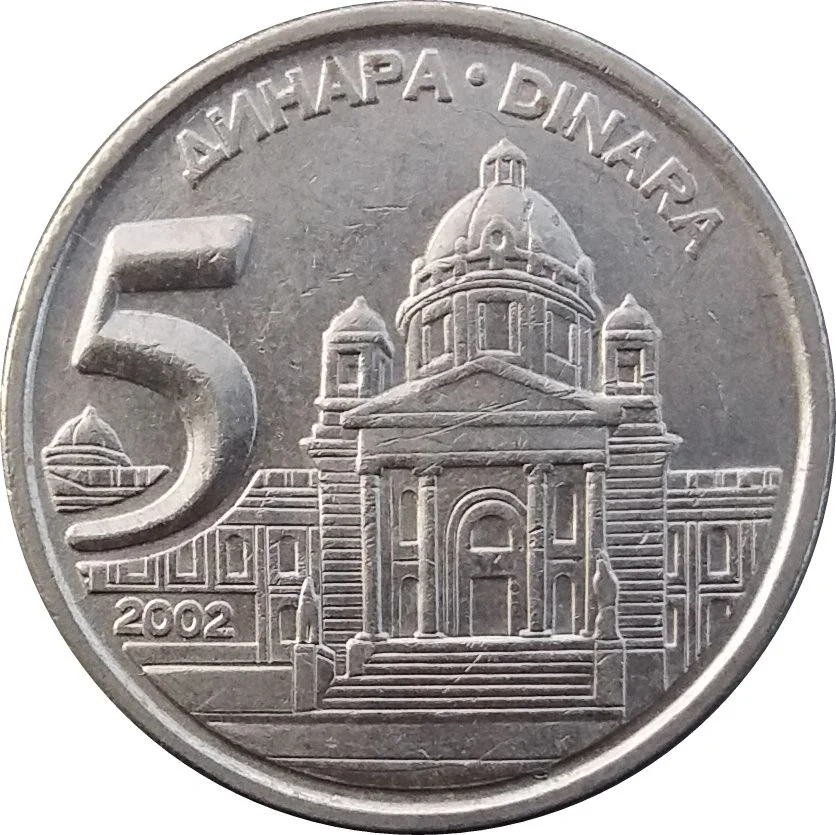
Description:
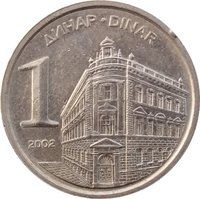
Federal Assembly of Yugoslavia
Inscription:
ДИНАРА · DINARA
5
2002
5
2002
Translation:
DINARA · DINARA
5
2002
5
2002
Engraver: Mitar Petković
Edge
Reeded
Categories
| Animal> Bird |
| Building> Governmental building |
| Symbols> Coat of Arms |
| Symbol> Double-headed eagle |
Mintings
| Year | Mint Mark | Mintage | Quality | Collection |
|---|---|---|---|---|
| 2000 | — | 32,762,500 | ||
| 2002 | — | 30,966,000 |
Historical background
By the year 2000, the currency situation in the Federal Republic of Yugoslavia (consisting of Serbia and Montenegro) was one of profound instability and hyperinflationary legacy. The national currency, the Yugoslav dinar, had been destroyed twice in the previous decade due to hyperinflation, most catastrophically in 1993-94. In response, from 1994 onward, the regime of Slobodan Milošević had pegged the "new dinar" to the Deutsche Mark at a fixed rate, attempting to impose stability through strict foreign exchange controls and the use of hard currency reserves. However, this stability was artificial and unsustainable.
The core problem was a vicious cycle of fiscal deficit monetization. The state, isolated by international sanctions and weakened by the Kosovo War of 1999, continued to fund massive public spending and prop up loss-making state-owned enterprises by compelling the central bank to print money. Since the dinar was officially pegged, this new money creation was not immediately reflected in the official exchange rate but instead flooded the limited domestic market for goods, causing severe repressed inflation. A vast black market for foreign currency flourished, where the dinar traded at a fraction of its official value, creating a crippling dual economy.
Consequently, by mid-2000, the system was on the brink of collapse. Foreign reserves were nearly exhausted, unable to defend the peg. Shortages of basic goods were common, and the economy was effectively "euroized," with the population desperately holding Deutsche Marks for any meaningful transaction or savings. This currency crisis was a direct manifestation of the broader economic and political collapse, becoming a key factor in the public discontent that led to the ousting of Milošević in October 2000. The new government would soon abandon the failed peg and undertake a sweeping monetary reform.
The core problem was a vicious cycle of fiscal deficit monetization. The state, isolated by international sanctions and weakened by the Kosovo War of 1999, continued to fund massive public spending and prop up loss-making state-owned enterprises by compelling the central bank to print money. Since the dinar was officially pegged, this new money creation was not immediately reflected in the official exchange rate but instead flooded the limited domestic market for goods, causing severe repressed inflation. A vast black market for foreign currency flourished, where the dinar traded at a fraction of its official value, creating a crippling dual economy.
Consequently, by mid-2000, the system was on the brink of collapse. Foreign reserves were nearly exhausted, unable to defend the peg. Shortages of basic goods were common, and the economy was effectively "euroized," with the population desperately holding Deutsche Marks for any meaningful transaction or savings. This currency crisis was a direct manifestation of the broader economic and political collapse, becoming a key factor in the public discontent that led to the ousting of Milošević in October 2000. The new government would soon abandon the failed peg and undertake a sweeping monetary reform.
🌱 Very Common