

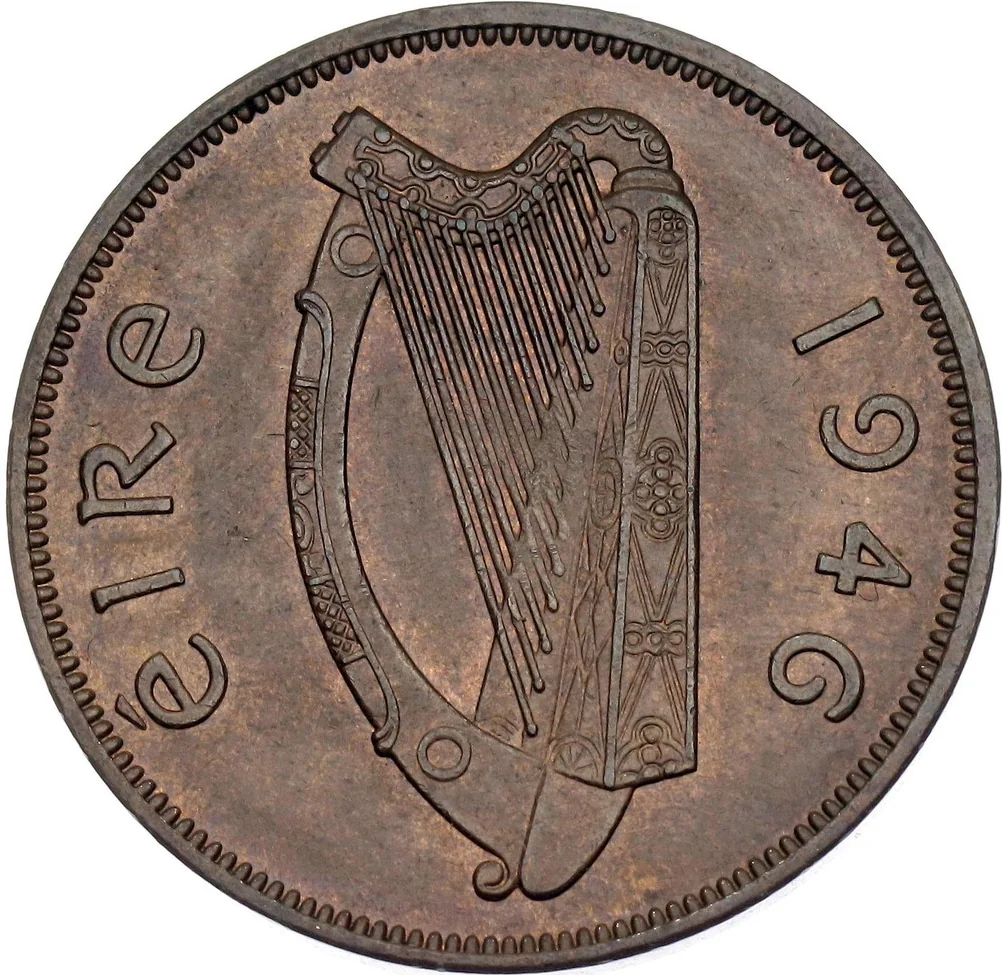
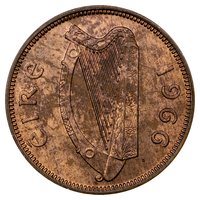
Obverse
Description:
Celtic string instrument
Inscription:
éire
1968
1968
Translation:
Ireland
1968
1968
Script: Latin (Gaelic)
Language: Irish
Designer: Percy Metcalfe
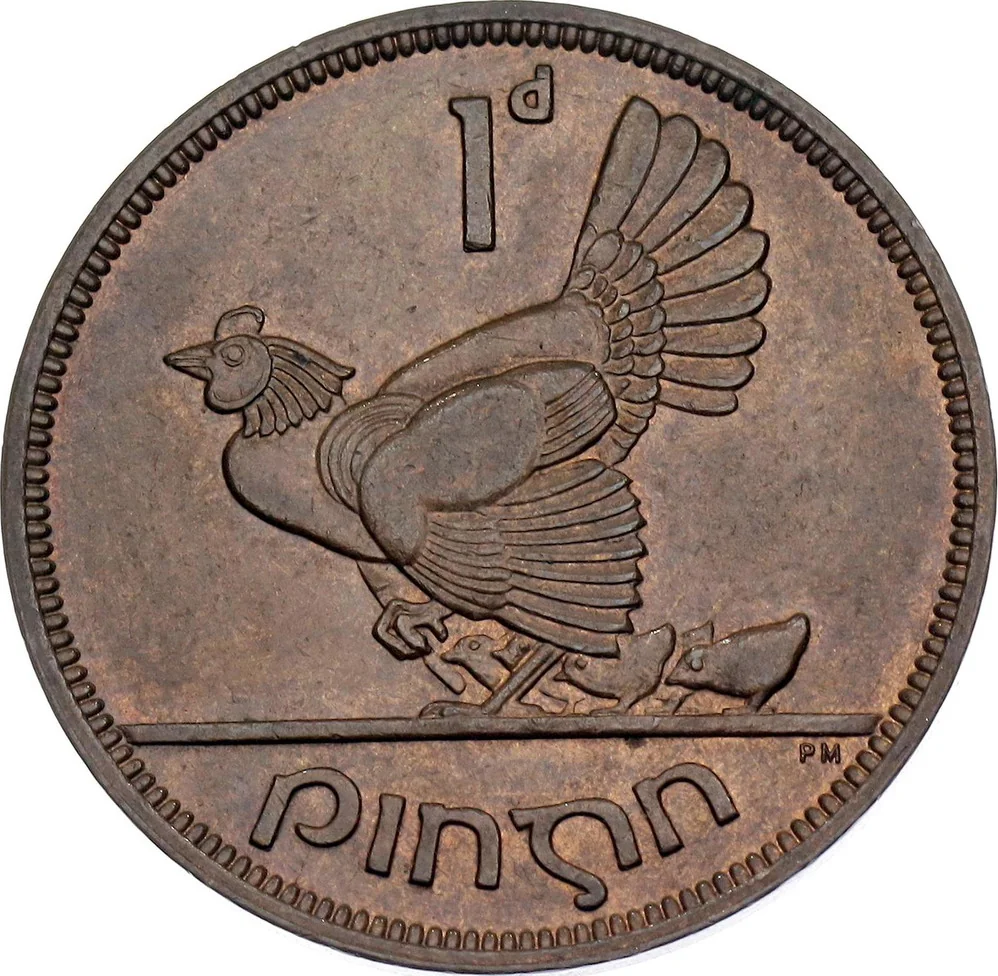
Reverse
Description:
Hen with chicks
Inscription:
1d
pingin PM
pingin PM
Script: Latin (Gaelic)
Designer: Percy Metcalfe
Edge
Plain
Mints
| Name | Mark |
|---|---|
| Royal Mint (Tower Hill) | — |
Mintings
| Year | Mint Mark | Mintage | Quality | Collection |
|---|---|---|---|---|
| 1940 | — | 312,000 | ||
| 1940 | — | — | Proof | |
| 1941 | — | 4,680,000 | ||
| 1941 | — | — | Proof | |
| 1942 | — | 17,520,000 | ||
| 1942 | — | — | Proof | |
| 1943 | — | 3,360,000 | ||
| 1946 | — | 4,800,000 | ||
| 1946 | — | — | Proof | |
| 1948 | — | 4,800,000 | ||
| 1948 | — | — | Proof | |
| 1949 | — | 4,080,000 | ||
| 1949 | — | — | Proof | |
| 1950 | — | 2,400,000 | ||
| 1950 | — | — | Proof | |
| 1952 | — | 2,400,000 | ||
| 1952 | — | — | Proof | |
| 1962 | — | 1,200,000 | ||
| 1962 | — | — | Proof | |
| 1963 | — | 9,600,000 | ||
| 1963 | — | — | Proof | |
| 1964 | — | 6,000,000 | ||
| 1964 | — | — | Proof | |
| 1965 | — | 11,160,000 | ||
| 1966 | — | 6,000,000 | ||
| 1967 | — | 2,400,000 | ||
| 1968 | — | — | Proof | |
| 1968 | — | 21,000,000 |
Historical background
In 1940, Ireland’s currency situation was defined by its recent economic separation from the United Kingdom and the pressures of wartime neutrality. Just three years earlier, the 1937 Constitution and the Currency Act of 1927 had laid the groundwork for an independent monetary system, culminating in the introduction of the distinct Irish pound (or punt) in 1928. However, this new currency remained pegged at par with the British pound sterling, and the two circulated interchangeably within Ireland. This linkage meant that Ireland’s monetary policy was still effectively dictated by the Bank of England, a necessary but limiting arrangement given Ireland’s deep economic ties to its larger neighbour.
The outbreak of World War II in 1939 created immediate strains. As a neutral state, Ireland faced severe trade disruptions, leading to shortages of essential goods and inflationary pressures. To conserve foreign exchange reserves and prevent a flight of capital to Britain, the government under Taoiseach Éamon de Valera introduced strict exchange controls in 1939. These measures made the Irish pound and sterling legally distinct for the first time, as it became illegal to export Irish banknotes to Britain or to exchange funds without official permission. This effectively created a separate, non-convertible Irish currency for international purposes, though domestically, sterling notes still circulated.
Consequently, by 1940, Ireland operated a dual currency system under tight control. The Central Bank of Ireland was still a year away from being established (1942), so the Currency Commission managed this fragile equilibrium. The primary challenges were financing essential imports from non-British sources with limited gold and dollar reserves, and managing inflation caused by scarcity. The peg to sterling provided stability but also imported Britain’s wartime inflation, while the exchange controls were a crucial, if burdensome, tool for preserving national economic autonomy in a perilous and isolated world.
The outbreak of World War II in 1939 created immediate strains. As a neutral state, Ireland faced severe trade disruptions, leading to shortages of essential goods and inflationary pressures. To conserve foreign exchange reserves and prevent a flight of capital to Britain, the government under Taoiseach Éamon de Valera introduced strict exchange controls in 1939. These measures made the Irish pound and sterling legally distinct for the first time, as it became illegal to export Irish banknotes to Britain or to exchange funds without official permission. This effectively created a separate, non-convertible Irish currency for international purposes, though domestically, sterling notes still circulated.
Consequently, by 1940, Ireland operated a dual currency system under tight control. The Central Bank of Ireland was still a year away from being established (1942), so the Currency Commission managed this fragile equilibrium. The primary challenges were financing essential imports from non-British sources with limited gold and dollar reserves, and managing inflation caused by scarcity. The peg to sterling provided stability but also imported Britain’s wartime inflation, while the exchange controls were a crucial, if burdensome, tool for preserving national economic autonomy in a perilous and isolated world.
🌱 Very Common