


25 cents (Canadian Confederation) – Canada
Add to wishlist
Circulating commemorative coins
Commemoration: 125th Anniversary of Canadian Confederation
Canada
Context
Material

References
KM: #
Numista: #360
Value
Exchange value: 0.25 CAD
Inflation-adjusted value: 0.49 CAD
Obverse
Description:
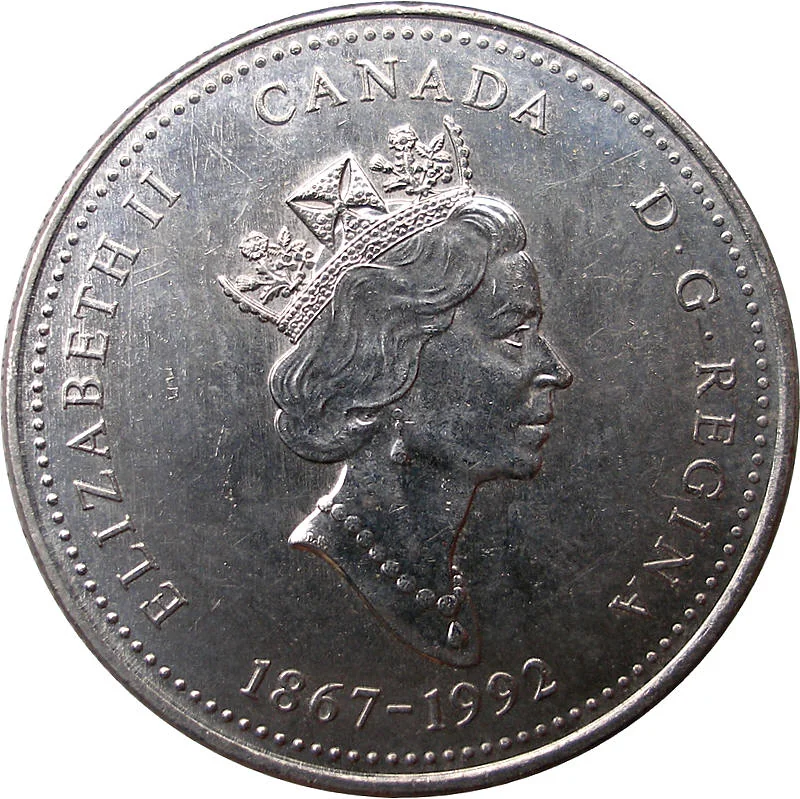
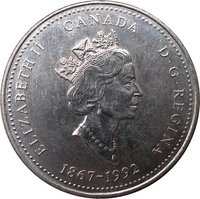
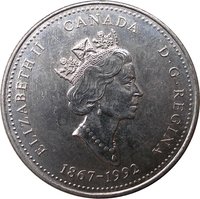
Queen Elizabeth II at age 64, wearing royal regalia, facing right. "1867-1992" marks Canada's 125th anniversary.
Inscription:
ELIZABETH II CANADA D·G·REGINA
1867-1992
1867-1992
Translation:
Elizabeth II Canada by the Grace of God Queen
1867-1992
1867-1992
Script: Latin
Engraver: Ago Aarand
Designer: Dora de Pédery-Hunt
Reverse
Description:
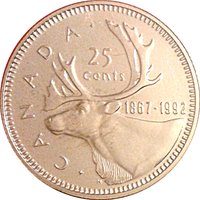
New Brunswick’s Smith Creek No. 5 Covered Bridge, with face value and bilingual legend.
Inscription:
NEW BRUNSWICK · NOUVEAU-BRUNSWICK
25 CENTS
RL
25 CENTS
RL
Script: Latin
Engraver: Sheldon Beveridge
Designer: Ronald Lambert
Edge
Reeded
Mints
| Name | Mark |
|---|---|
| Royal Canadian Mint of Winnipeg | — |
Mintings
| Year | Mint Mark | Mintage | Quality | Collection |
|---|---|---|---|---|
| 1992 | — | 2,174,000 |
Historical background
In 1992, Canada's currency situation was dominated by the final, turbulent years of operating under a high-interest-rate policy to defend the Canadian dollar within a managed float. The Bank of Canada, under Governor John Crow, was firmly committed to a policy of "price stability," which in practice meant aggressively fighting inflation with high benchmark interest rates that peaked near 14% in 1990. This strong-currency policy aimed to bolster international confidence and curb inflationary expectations, but it came at a significant economic cost, exacerbating the severe recession of the early 1990s and contributing to unemployment rates soaring above 11%.
The Canadian dollar itself traded within a relatively narrow band, generally between 82 and 89 cents U.S., but was under persistent downward pressure. This pressure stemmed from several factors: a large current account deficit, high levels of public and private debt, political uncertainty surrounding the contentious constitutional debates (the Charlottetown Accord referendum was held in October 1992), and a general lack of investor confidence in Canada's fiscal outlook. Markets questioned the sustainability of fighting inflation with high rates while government deficits remained stubbornly high, a tension often called the "Crow disconnect."
By the end of 1992, the political and economic criticism of the Bank of Canada's restrictive policy reached a peak. The severe recession had eroded public and political support for Governor Crow's unwavering stance. While the inflation fight was ultimately successful—with CPI inflation falling from over 5% in 1991 to under 2% by the end of 1992—the social and economic pain set the stage for a major policy shift. This culminated in early 1993 with the federal government clarifying the Bank's mandate to explicitly target inflation reduction, and later with Governor Crow's departure, marking the end of an era and paving the way for the formal inflation-targeting regime that began in 1995.
The Canadian dollar itself traded within a relatively narrow band, generally between 82 and 89 cents U.S., but was under persistent downward pressure. This pressure stemmed from several factors: a large current account deficit, high levels of public and private debt, political uncertainty surrounding the contentious constitutional debates (the Charlottetown Accord referendum was held in October 1992), and a general lack of investor confidence in Canada's fiscal outlook. Markets questioned the sustainability of fighting inflation with high rates while government deficits remained stubbornly high, a tension often called the "Crow disconnect."
By the end of 1992, the political and economic criticism of the Bank of Canada's restrictive policy reached a peak. The severe recession had eroded public and political support for Governor Crow's unwavering stance. While the inflation fight was ultimately successful—with CPI inflation falling from over 5% in 1991 to under 2% by the end of 1992—the social and economic pain set the stage for a major policy shift. This culminated in early 1993 with the federal government clarifying the Bank's mandate to explicitly target inflation reduction, and later with Governor Crow's departure, marking the end of an era and paving the way for the formal inflation-targeting regime that began in 1995.










🌱 Very Common