

⅕ crown – Gibraltar
Add to wishlist
United Kingdom
Context
Year: 1993
Country: United Kingdom
Issuer: Gibraltar
Ruler: Elizabeth II
Currency:
(since 1967)
Total mintage: 5,000
Material
References
KM: #
Numista: #358922
Value
Bullion value: $957.40
Obverse
Description:
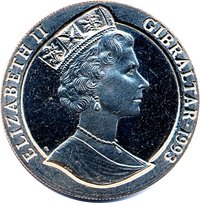
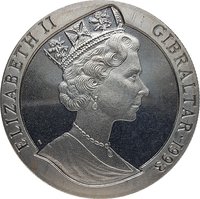
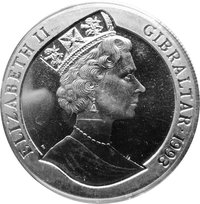
Queen Elizabeth II facing right, wearing the George IV State Diadem, surrounded by legend and date.
Inscription:
ELIZABETH II GIBRALTAR · 1993
RDM
PM
RDM
PM
Script: Latin
Designer: Raphael David Maklouf
Reverse
Description:
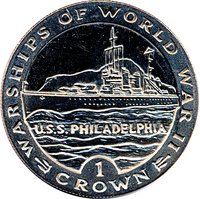
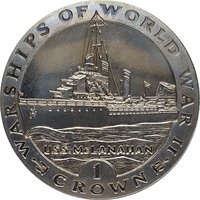
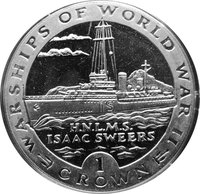
H.M.A.S. Waterhen
Inscription:
WARSHIPS OF WORLD WAR II
H.M.A.S. WATERHEN
1/5 CROWN
H.M.A.S. WATERHEN
1/5 CROWN
Script: Latin
Edge
Reeded
Categories
| Transportation> Watercraft |
| History> War |
Mints
| Name | Mark |
|---|---|
| Pobjoy Mint | (PM) |
Mintings
| Year | Mint Mark | Mintage | Quality | Collection |
|---|---|---|---|---|
| 1993 | — | 5,000 | Proof |
Historical background
In 1993, Gibraltar's currency situation was defined by its unique constitutional position and its practical economic ties. As a British Overseas Territory, its official currency was (and remains) the Gibraltar pound (GIP), issued by the Government of Gibraltar and pegged at par with the Pound Sterling (GBP). While Sterling notes circulated freely and were accepted, locally issued Gibraltar pound notes and coins were the distinctive legal tender, symbolizing the territory's autonomy while being underpinned by the UK's monetary stability.
This period was one of quiet transition and modernization. The 1988 Banking Ordinance had recently established a formal regulatory framework, fostering growth in the financial services sector. Furthermore, 1993 saw the issuance of a new series of Gibraltar banknotes, a practical move to update security features but also a reaffirmation of the territory's separate monetary identity. Economically, the system functioned seamlessly with the UK, with no exchange controls and full interchangeability with Sterling, which was crucial for trade, tourism, and cross-border work with neighbouring Spain.
However, the arrangement was not without its subtle tensions. Gibraltar's currency was not internationally traded and was viewed externally as a variant of Sterling. Its acceptance outside Gibraltar, particularly in the UK, was sometimes at the discretion of individual retailers, though banks would always exchange it. This period preceded the major European monetary integration of the late 1990s; as a UK dependency, Gibraltar's currency policy was tied to Britain's decision to remain outside the European Exchange Rate Mechanism after the 1992 crisis, thereby also keeping Gibraltar outside the early framework of the Euro.
This period was one of quiet transition and modernization. The 1988 Banking Ordinance had recently established a formal regulatory framework, fostering growth in the financial services sector. Furthermore, 1993 saw the issuance of a new series of Gibraltar banknotes, a practical move to update security features but also a reaffirmation of the territory's separate monetary identity. Economically, the system functioned seamlessly with the UK, with no exchange controls and full interchangeability with Sterling, which was crucial for trade, tourism, and cross-border work with neighbouring Spain.
However, the arrangement was not without its subtle tensions. Gibraltar's currency was not internationally traded and was viewed externally as a variant of Sterling. Its acceptance outside Gibraltar, particularly in the UK, was sometimes at the discretion of individual retailers, though banks would always exchange it. This period preceded the major European monetary integration of the late 1990s; as a UK dependency, Gibraltar's currency policy was tied to Britain's decision to remain outside the European Exchange Rate Mechanism after the 1992 crisis, thereby also keeping Gibraltar outside the early framework of the Euro.
Series: Warships of World War II

✨ Legendary