

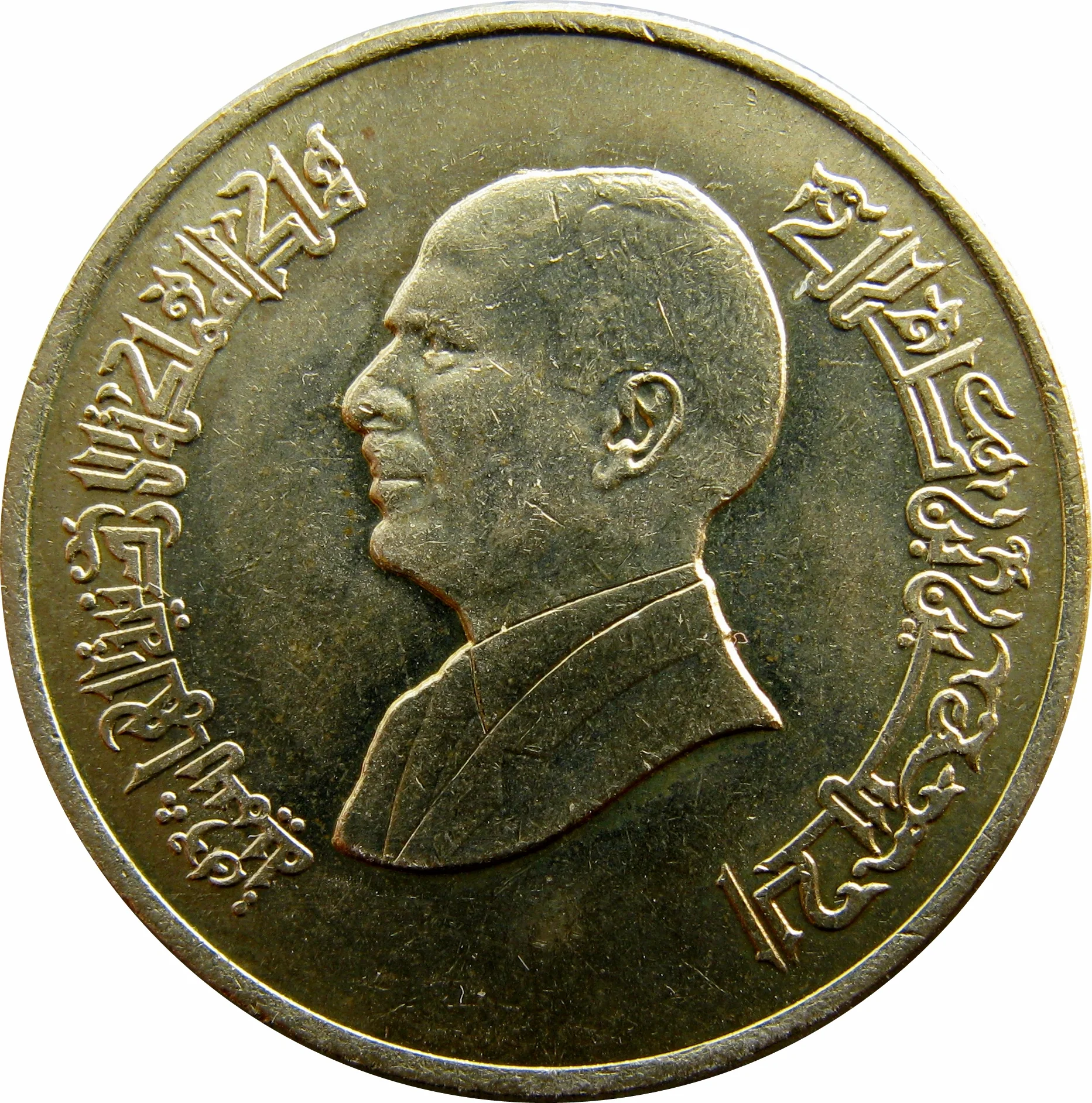
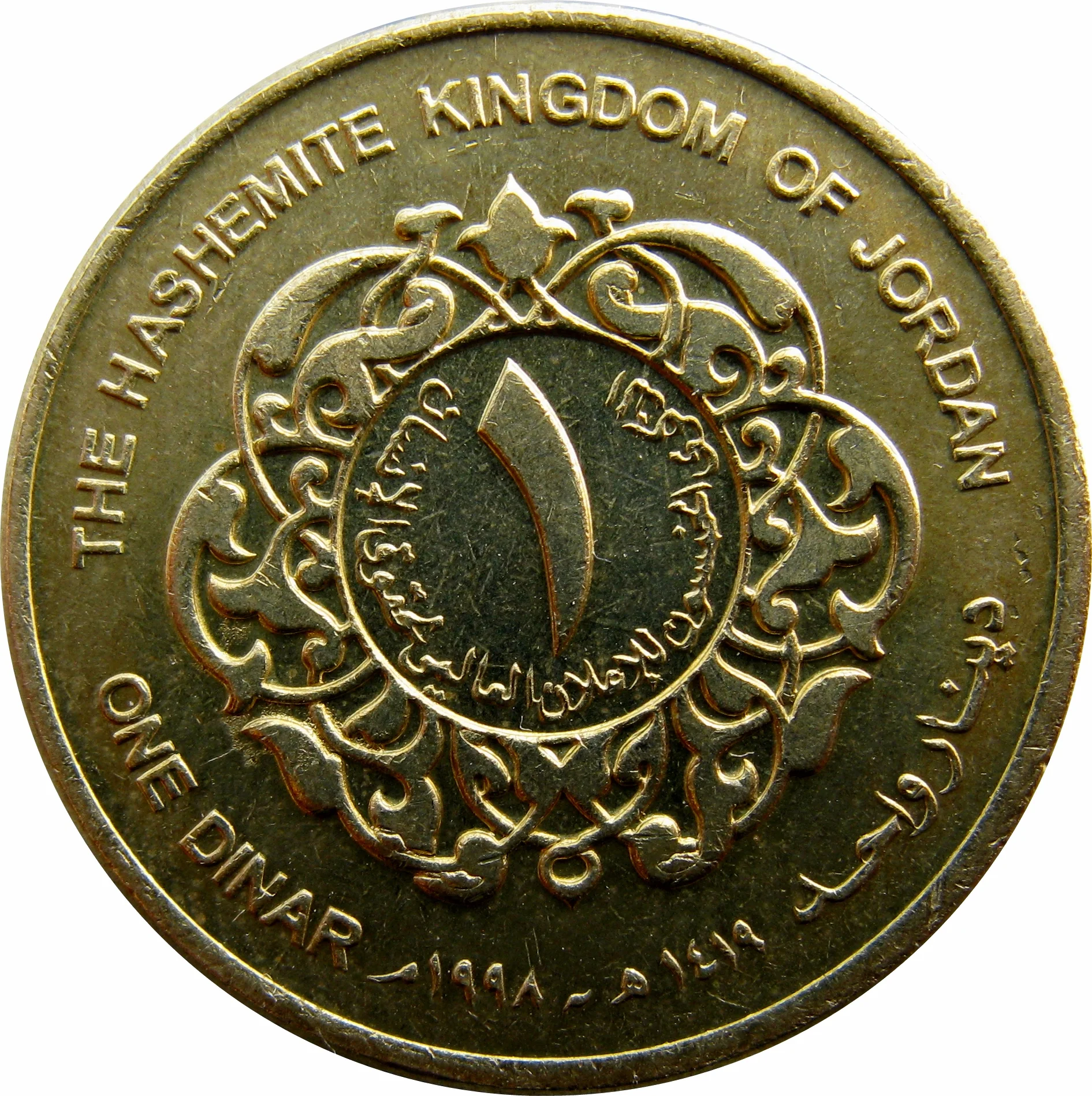
1 dīnar (Declaration of Human Rights) – Jordan
Add to wishlist
Circulating commemorative coins
Commemoration: 50th Anniversary of the Declaration of Human Rights
Jordan
Context
Year: 1998
Islamic (Hijri) Year:: 1419
Issuer: Jordan
Ruler: Hussein bin Talal
Currency:
(since 1949)
Demonetization: 7 January 2003
Material
References
KM: #
Numista: #35833
Value
Exchange value: 1 JOD
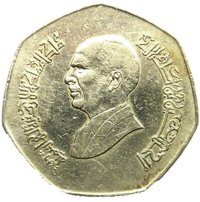
Obverse
Description:
Left turn
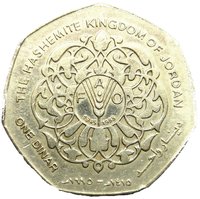
Reverse
Description:
Commemorative legend in decorative circle.
Edge
Milled
Categories
| Person> Monarch |
| Mustache/Beard |
| Human rights |
Mintings
| Year | Mint Mark | Mintage | Quality | Collection |
|---|---|---|---|---|
| 1998 | — | — |
Historical background
In 1998, Jordan's currency situation was defined by the unwavering stability of the Jordanian dinar (JOD), which was firmly pegged to the U.S. dollar at a fixed rate of 1 JOD = 1.4104 USD (or USD 1 = JOD 0.709). This peg, established in 1995, was a cornerstone of the country's economic policy, engineered to provide monetary stability, control inflation, and foster confidence among foreign investors and international financial institutions. The stability was particularly crucial given the regional volatility and Jordan's history of economic shocks, including a severe financial crisis in 1989.
However, this stability came at a significant cost. The fixed exchange rate, combined with a relatively high-interest rate policy to defend the peg, limited the Central Bank of Jordan's ability to use monetary policy as a tool for stimulating domestic growth. The economy was sluggish, with GDP growth averaging only around 2% in the late 1990s, and unemployment remained persistently high, officially around 14-15% but likely higher in practice. The currency's strength also made Jordanian exports less competitive regionally, contributing to a chronic and widening trade deficit.
The broader context was one of fiscal strain and external dependency. Jordan relied heavily on remittances from workers abroad, foreign aid (particularly from the Gulf states and the United States), and access to international capital markets. Maintaining the dollar peg was seen as essential to securing this external support and ensuring the country's financial credibility. Therefore, in 1998, despite domestic economic pressures, the government and the Central Bank remained unequivocally committed to the fixed exchange rate, prioritizing currency stability over other economic objectives as the nation navigated a challenging period of low growth and high debt.
However, this stability came at a significant cost. The fixed exchange rate, combined with a relatively high-interest rate policy to defend the peg, limited the Central Bank of Jordan's ability to use monetary policy as a tool for stimulating domestic growth. The economy was sluggish, with GDP growth averaging only around 2% in the late 1990s, and unemployment remained persistently high, officially around 14-15% but likely higher in practice. The currency's strength also made Jordanian exports less competitive regionally, contributing to a chronic and widening trade deficit.
The broader context was one of fiscal strain and external dependency. Jordan relied heavily on remittances from workers abroad, foreign aid (particularly from the Gulf states and the United States), and access to international capital markets. Maintaining the dollar peg was seen as essential to securing this external support and ensuring the country's financial credibility. Therefore, in 1998, despite domestic economic pressures, the government and the Central Bank remained unequivocally committed to the fixed exchange rate, prioritizing currency stability over other economic objectives as the nation navigated a challenging period of low growth and high debt.
🌟 Uncommon