

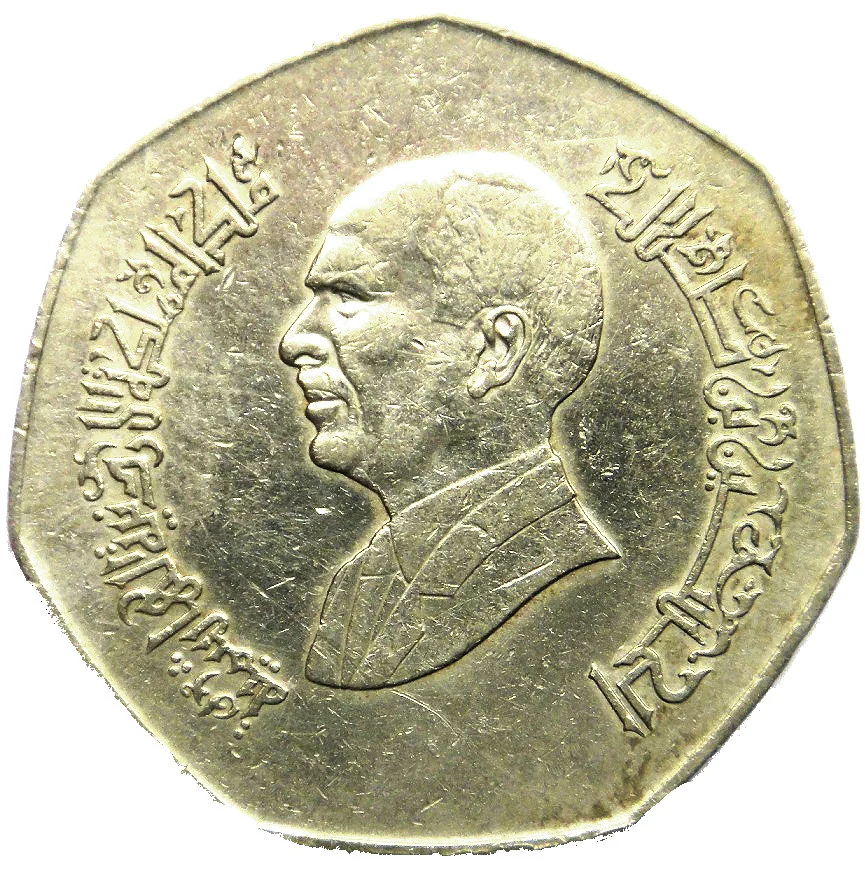
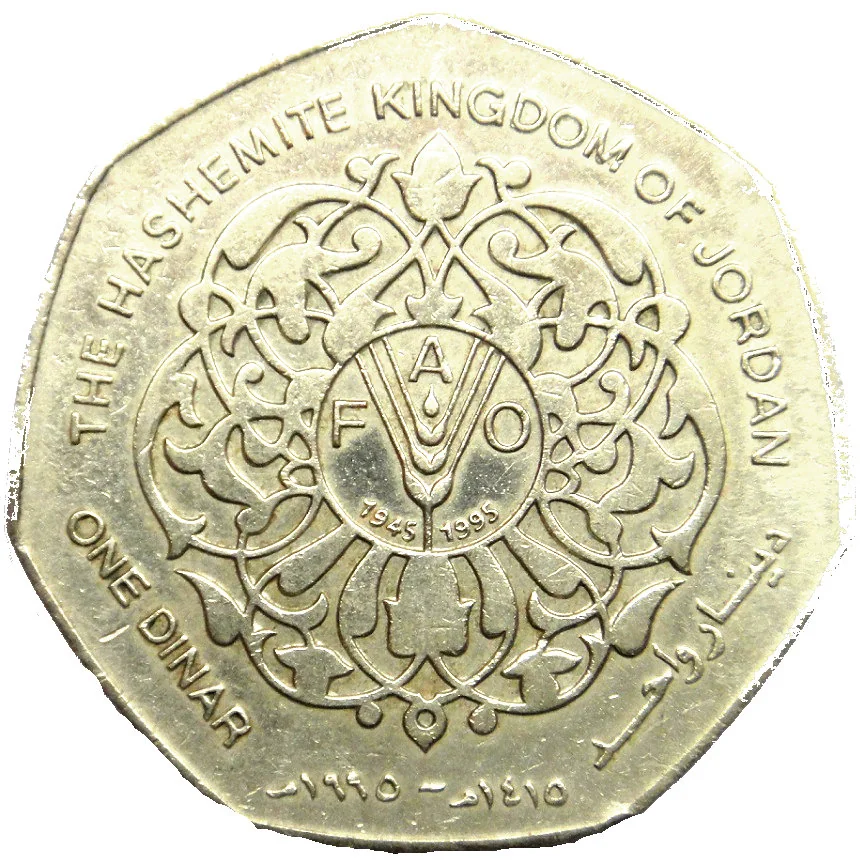
1 dīnar (Food and Agriculture Organization) – Jordan
Add to wishlist
Circulating commemorative coins
Commemoration: 50th Anniversary of the Food and Agriculture Organization
Jordan
Context
Year: 1995
Islamic (Hijri) Year:: 1415
Issuer: Jordan
Ruler: Hussein bin Talal
Currency:
(since 1949)
Demonetization: 1 July 2003
Total mintage: 110,000
Material
Diameter: 32 mm
Weight: 12.5 g
Shape: Equilateral curve heptagon
Composition: Brass
Magnetic: No
Technique: Milled
Alignment: Medal alignment
flip
References
KM: #
Numista: #23256
Value
Exchange value: 1 JOD
Obverse
Reverse
Edge
Plain
Categories
| Organization> FAO |
| Person> Monarch |
| Mustache/Beard |
Mints
| Name | Mark |
|---|---|
| Royal Mint | — |
Mintings
| Year | Mint Mark | Mintage | Quality | Collection |
|---|---|---|---|---|
| 1995 | — | 110,000 |
Historical background
In 1995, Jordan's currency, the dinar (JOD), was a notable pillar of stability in a region often marked by economic volatility. This stability was largely artificial and meticulously managed, as the dinar was officially pegged to a basket of currencies, heavily weighted toward the U.S. dollar. This peg, maintained by the Central Bank of Jordan (CBJ), provided crucial predictability for foreign trade and investment, but it also meant Jordan's monetary policy was largely dictated by the U.S. Federal Reserve, limiting domestic tools to address local economic conditions.
The broader economic backdrop in 1995 was one of cautious optimism under King Hussein's reign, following the economic turbulence of the late 1980s and the 1990-91 Gulf Crisis. The country was in the early stages of implementing structural adjustment programs agreed upon with the International Monetary Fund (IMF) and the World Bank, initiated in 1989. These programs aimed to reduce budget deficits, liberalize trade, and privatize state-owned enterprises. Consequently, while the currency itself was stable, the economy was undergoing significant transformation, with the government grappling with high public debt, unemployment, and the pressures of absorbing a large influx of refugees from the first Gulf War.
Therefore, the currency situation in 1995 was a tale of two realities: a strong and stable dinar externally, which bolstered confidence and facilitated critical imports like oil, and a challenging domestic economic environment of austerity and reform. The peg was a double-edged sword—it provided an anchor against inflation and currency risk but also constrained Jordan's ability to use exchange rate adjustments as a shock absorber. This setup placed the onus for economic adjustment squarely on fiscal policy and structural reforms, setting the stage for the economic challenges and opportunities of the late 1990s.
The broader economic backdrop in 1995 was one of cautious optimism under King Hussein's reign, following the economic turbulence of the late 1980s and the 1990-91 Gulf Crisis. The country was in the early stages of implementing structural adjustment programs agreed upon with the International Monetary Fund (IMF) and the World Bank, initiated in 1989. These programs aimed to reduce budget deficits, liberalize trade, and privatize state-owned enterprises. Consequently, while the currency itself was stable, the economy was undergoing significant transformation, with the government grappling with high public debt, unemployment, and the pressures of absorbing a large influx of refugees from the first Gulf War.
Therefore, the currency situation in 1995 was a tale of two realities: a strong and stable dinar externally, which bolstered confidence and facilitated critical imports like oil, and a challenging domestic economic environment of austerity and reform. The peg was a double-edged sword—it provided an anchor against inflation and currency risk but also constrained Jordan's ability to use exchange rate adjustments as a shock absorber. This setup placed the onus for economic adjustment squarely on fiscal policy and structural reforms, setting the stage for the economic challenges and opportunities of the late 1990s.
🌱 Fairly Common