

5 dollars – Canada
Add to wishlist
Non-circulating coins
Commemoration: Montreal Olympics, 1976
Canada
Context
Material
References
KM: #
Numista: #35734
Value
Exchange value: 5 CAD
Bullion value: $55.64
Inflation-adjusted value: 34.34 CAD
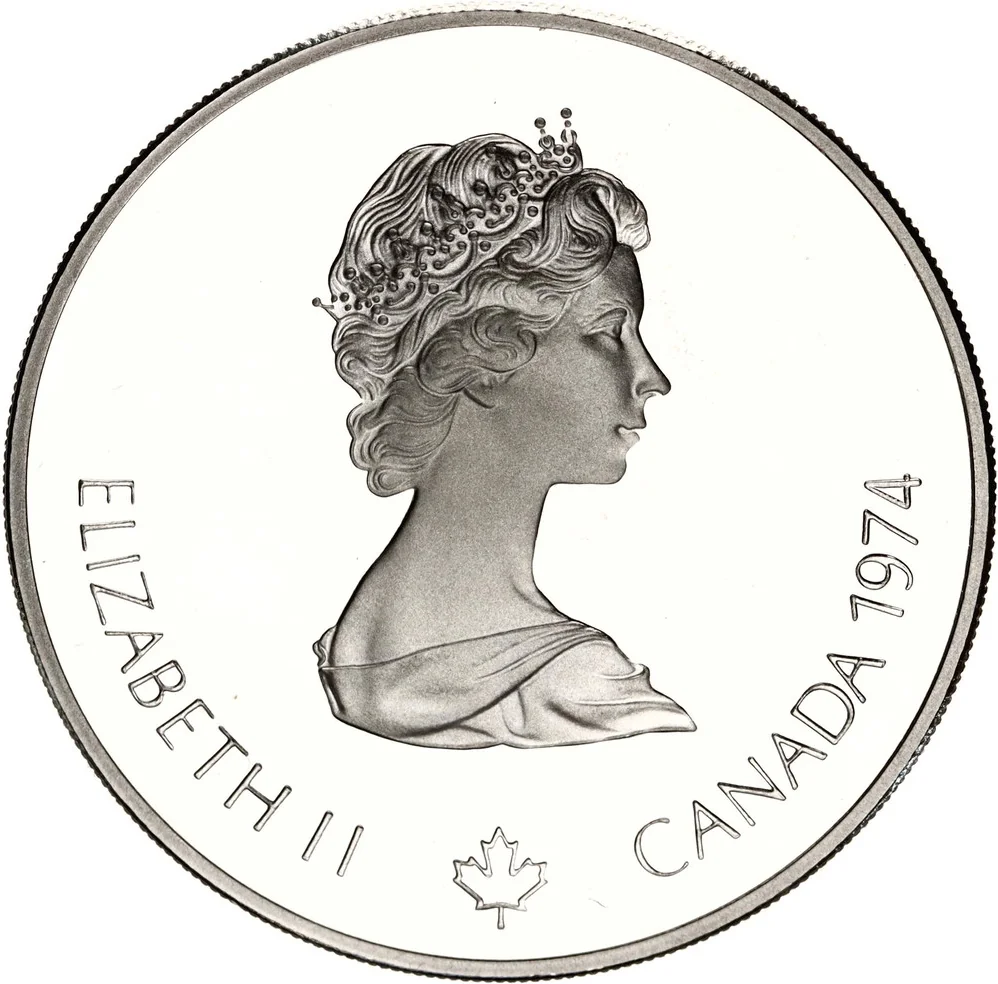
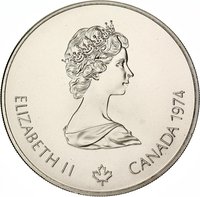
Obverse
Description:
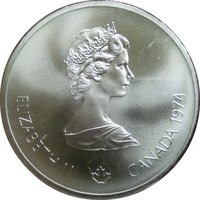
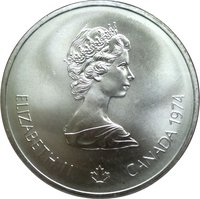
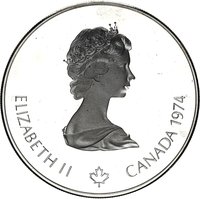
Bust of Queen Elizabeth II at age 37, wearing a tiara and facing right.
Inscription:
ELIZABETH II CANADA 1974
Script: Latin
Engraver: Patrick Brindley
Designer: Arnold Machin
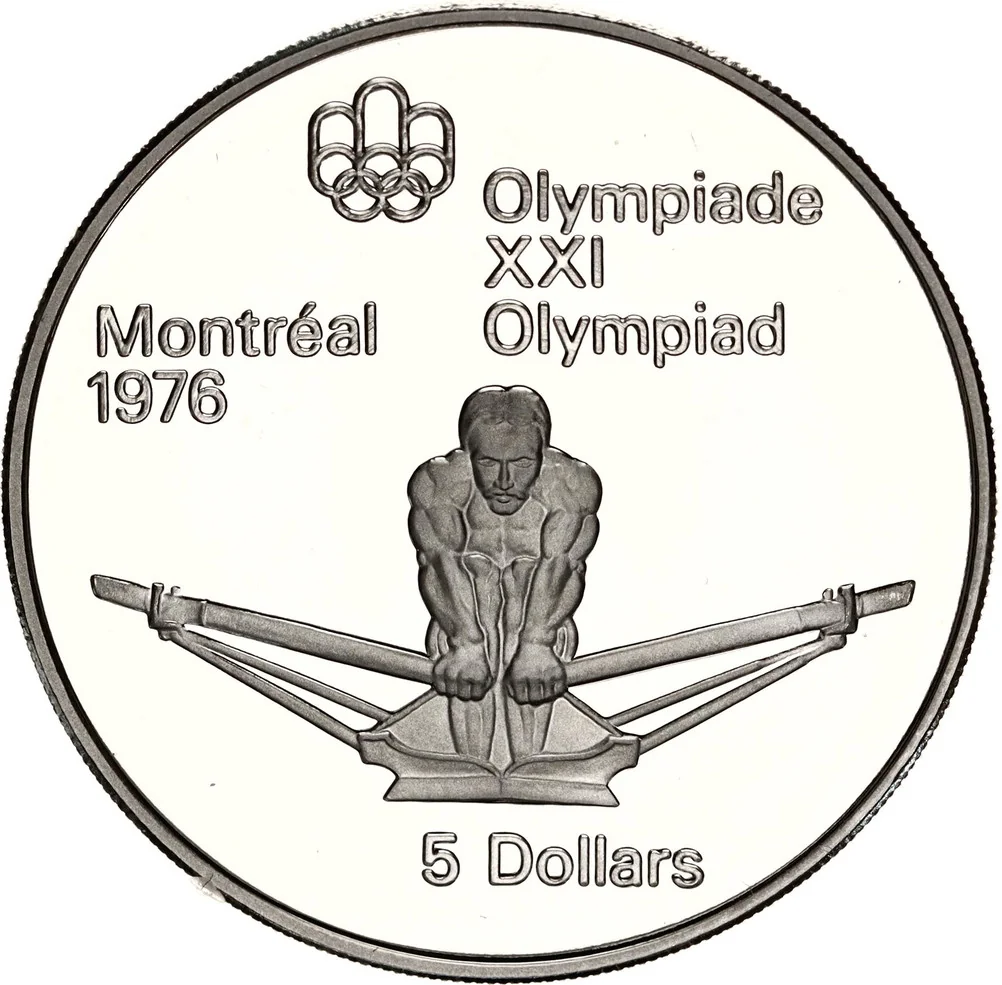
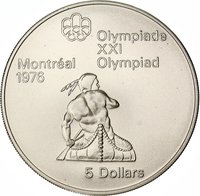
Reverse
Description:
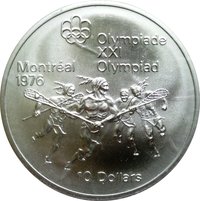
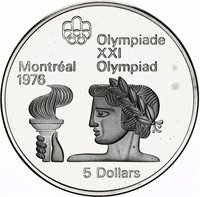
Rower with Olympic rings
Inscription:
Olympiade XXI Olympiad
Montréal 1976
5 Dollars
Montréal 1976
5 Dollars
Translation:
Twenty-first Olympiad
Montreal 1976
5 Dollars
Montreal 1976
5 Dollars
Script: Latin
Engraver: Terrence Smith
Designer: Ken Danby
Edge
Reeded
Categories
| Sport> Summer Olympic Games |
Mints
| Name | Mark |
|---|---|
| Royal Canadian Mint of Ottawa | — |
Mintings
| Year | Mint Mark | Mintage | Quality | Collection |
|---|---|---|---|---|
| 1974 | — | 1,990,570 | ||
| 1974 | — | 104,684 | Proof |
Historical background
In 1974, Canada’s currency situation was defined by a period of significant transition and uncertainty, emerging from the collapse of the Bretton Woods international monetary system. For decades, the Canadian dollar had been pegged, either to the U.S. dollar or within a fixed band against gold via the U.S. dollar. However, following global monetary turmoil in the early 1970s, Canada had already taken a bold step by allowing its dollar to float freely in 1970. By 1974, this float was well-established, making the currency's value primarily determined by market forces of supply and demand, a notable contrast to many major economies still managing fixed rates.
The year itself was characterized by a strong and appreciating Canadian dollar, which traded near or even above parity with the U.S. dollar for much of the period. This strength was largely driven by powerful external factors: the 1973 oil crisis had led to soaring global energy prices, and as a significant net exporter of energy and natural resources, Canada experienced substantial capital inflows and a improved trade balance. This "petrodollar" effect, combined with high global inflation for commodities, created upward pressure on the currency, which policymakers viewed with mixed feelings due to its potential to hurt manufacturing and export sectors outside of resources.
Domestically, the Bank of Canada, under Governor Gerald Bouey, was grappling with the new challenges of a floating regime in an inflationary world. With the dollar unpegged, monetary policy was freed to focus more directly on domestic inflation, which was becoming a growing concern. However, the central bank did occasionally intervene in foreign exchange markets to smooth out what it considered excessive volatility, a practice known as a "dirty float." Thus, the 1974 currency landscape was one of a robust, market-driven dollar testing new highs, while monetary authorities navigated the complex trade-offs between a strong currency, inflation control, and broader economic competitiveness.
The year itself was characterized by a strong and appreciating Canadian dollar, which traded near or even above parity with the U.S. dollar for much of the period. This strength was largely driven by powerful external factors: the 1973 oil crisis had led to soaring global energy prices, and as a significant net exporter of energy and natural resources, Canada experienced substantial capital inflows and a improved trade balance. This "petrodollar" effect, combined with high global inflation for commodities, created upward pressure on the currency, which policymakers viewed with mixed feelings due to its potential to hurt manufacturing and export sectors outside of resources.
Domestically, the Bank of Canada, under Governor Gerald Bouey, was grappling with the new challenges of a floating regime in an inflationary world. With the dollar unpegged, monetary policy was freed to focus more directly on domestic inflation, which was becoming a growing concern. However, the central bank did occasionally intervene in foreign exchange markets to smooth out what it considered excessive volatility, a practice known as a "dirty float." Thus, the 1974 currency landscape was one of a robust, market-driven dollar testing new highs, while monetary authorities navigated the complex trade-offs between a strong currency, inflation control, and broader economic competitiveness.
🌱 Fairly Common