

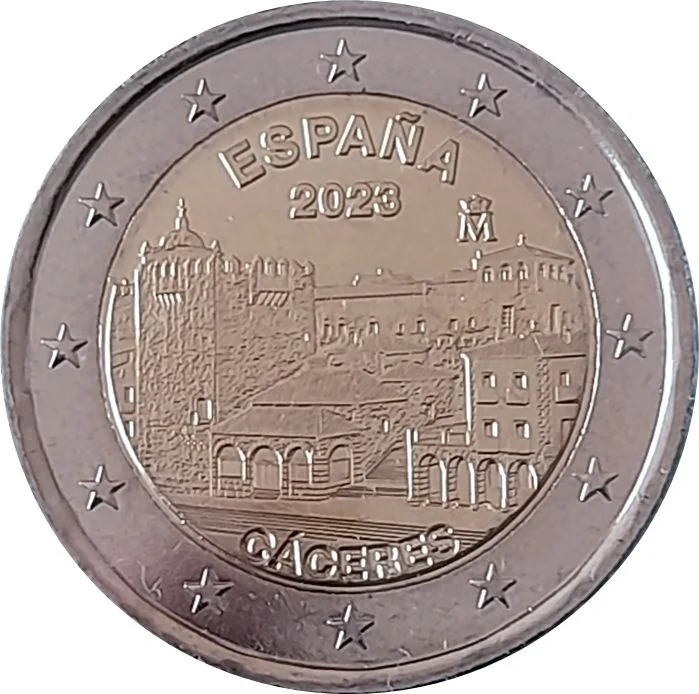

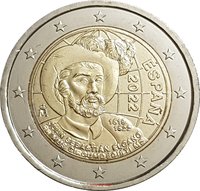
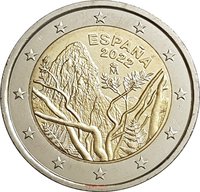
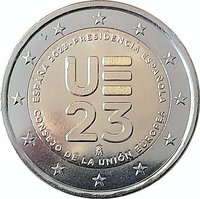
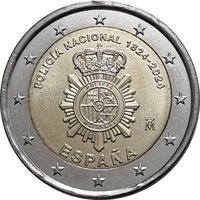
Obverse
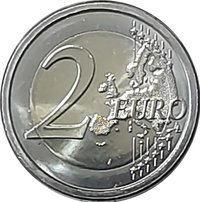
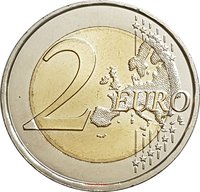
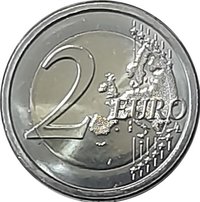
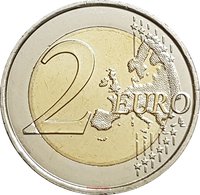
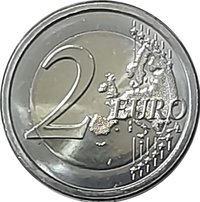
Reverse
Edge
Legend:
2 ★ ★ 2 ★ ★ 2 ★ ★ 2 ★ ★ 2 ★ ★ 2 ★ ★
Mints
| Name | Mark |
|---|---|
| Royal Mint of Madrid | (M) |
Mintings
| Year | Mint Mark | Mintage | Quality | Collection |
|---|---|---|---|---|
| 2023 | M | 1,481,500 | ||
| 2023 | M | 12,000 | BU | |
| 2023 | M | 6,500 | Proof |
Historical background
In 2023, Spain, as a member of the Eurozone, operated under the monetary policy of the European Central Bank (ECB). The primary currency situation was defined by the ECB's aggressive response to persistent inflation, which peaked in the Eurozone at over 10% in late 2022 and remained stubbornly high through much of 2023. The ECB embarked on a historic series of interest rate hikes, raising its key deposit facility rate from 0% in mid-2022 to 4% by September 2023. This tightening cycle aimed to cool demand and bring inflation back towards the 2% target, directly impacting borrowing costs for Spanish businesses, mortgages, and government debt.
Domestically, these measures had a mixed economic impact. While helping to gradually lower Spain's inflation rate throughout the year, the high-interest environment began to slow economic growth, particularly in interest-sensitive sectors like construction. However, Spain's economy proved relatively resilient compared to other major Eurozone nations, buoyed by a strong recovery in tourism, robust consumer spending supported by a resilient labor market, and significant inflows of European Union recovery funds (NextGenerationEU). The government also implemented targeted fiscal measures, such as VAT reductions on essential food items and extended energy subsidies, to mitigate the cost-of-living crisis for households.
Looking externally, the euro's value against major currencies like the US dollar fluctuated significantly. Initially weakened by economic uncertainty and energy crises, the euro strengthened in the latter half of 2023 as the ECB maintained a hawkish stance and the region avoided a worst-case recession scenario. For Spain, a stronger euro in this period helped curb import inflation, particularly for energy, but also posed challenges for export competitiveness. Overall, Spain's 2023 currency situation was one of navigating the trade-offs of the ECB's anti-inflation policy within a national context of moderate economic resilience.
Domestically, these measures had a mixed economic impact. While helping to gradually lower Spain's inflation rate throughout the year, the high-interest environment began to slow economic growth, particularly in interest-sensitive sectors like construction. However, Spain's economy proved relatively resilient compared to other major Eurozone nations, buoyed by a strong recovery in tourism, robust consumer spending supported by a resilient labor market, and significant inflows of European Union recovery funds (NextGenerationEU). The government also implemented targeted fiscal measures, such as VAT reductions on essential food items and extended energy subsidies, to mitigate the cost-of-living crisis for households.
Looking externally, the euro's value against major currencies like the US dollar fluctuated significantly. Initially weakened by economic uncertainty and energy crises, the euro strengthened in the latter half of 2023 as the ECB maintained a hawkish stance and the region avoided a worst-case recession scenario. For Spain, a stronger euro in this period helped curb import inflation, particularly for energy, but also posed challenges for export competitiveness. Overall, Spain's 2023 currency situation was one of navigating the trade-offs of the ECB's anti-inflation policy within a national context of moderate economic resilience.
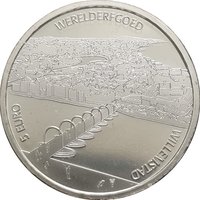
Series: UNESCO World Heritage










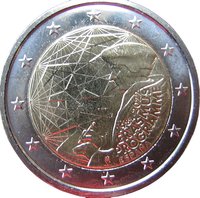
Series: Spain 2 euro commemoratives

🌱 Very Common