

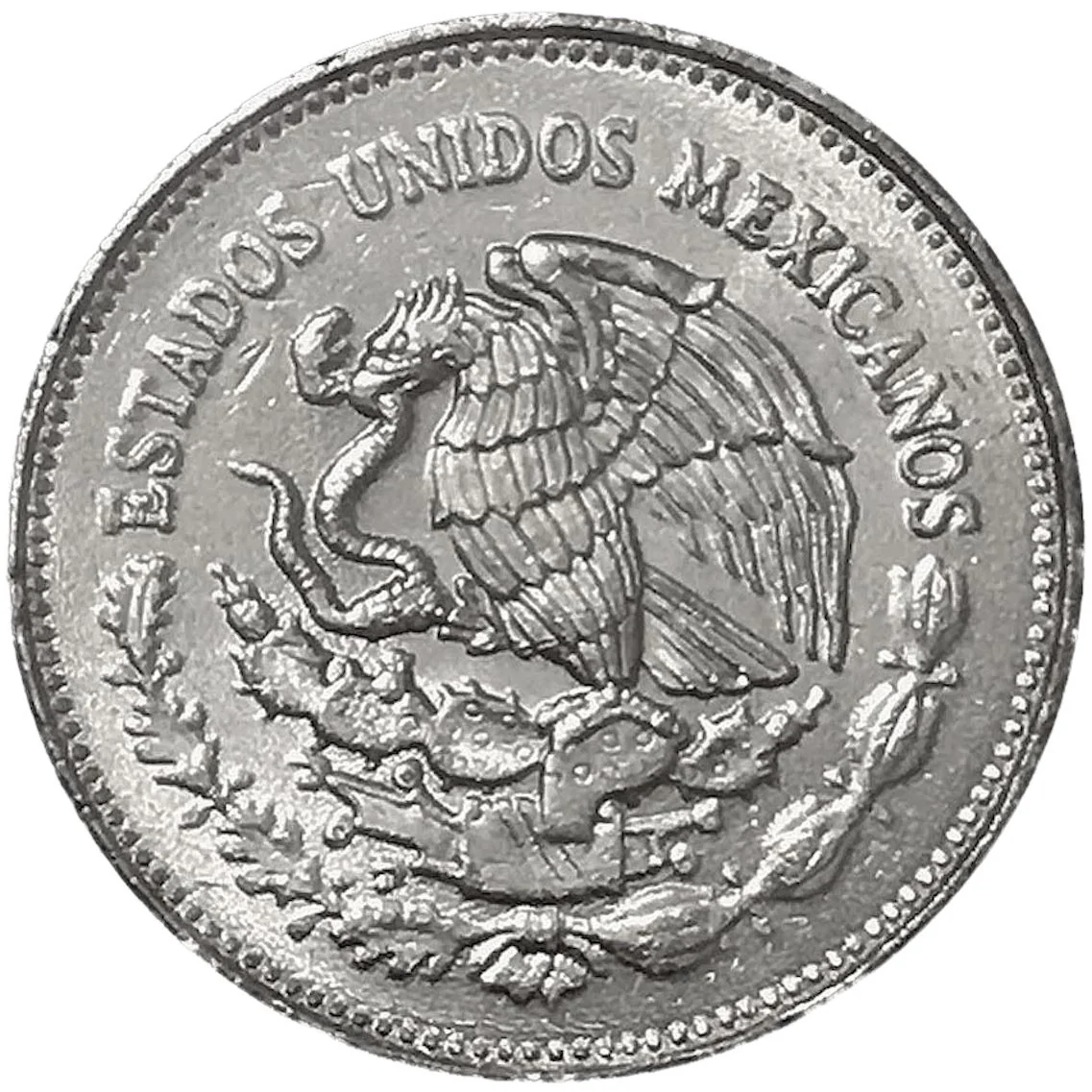
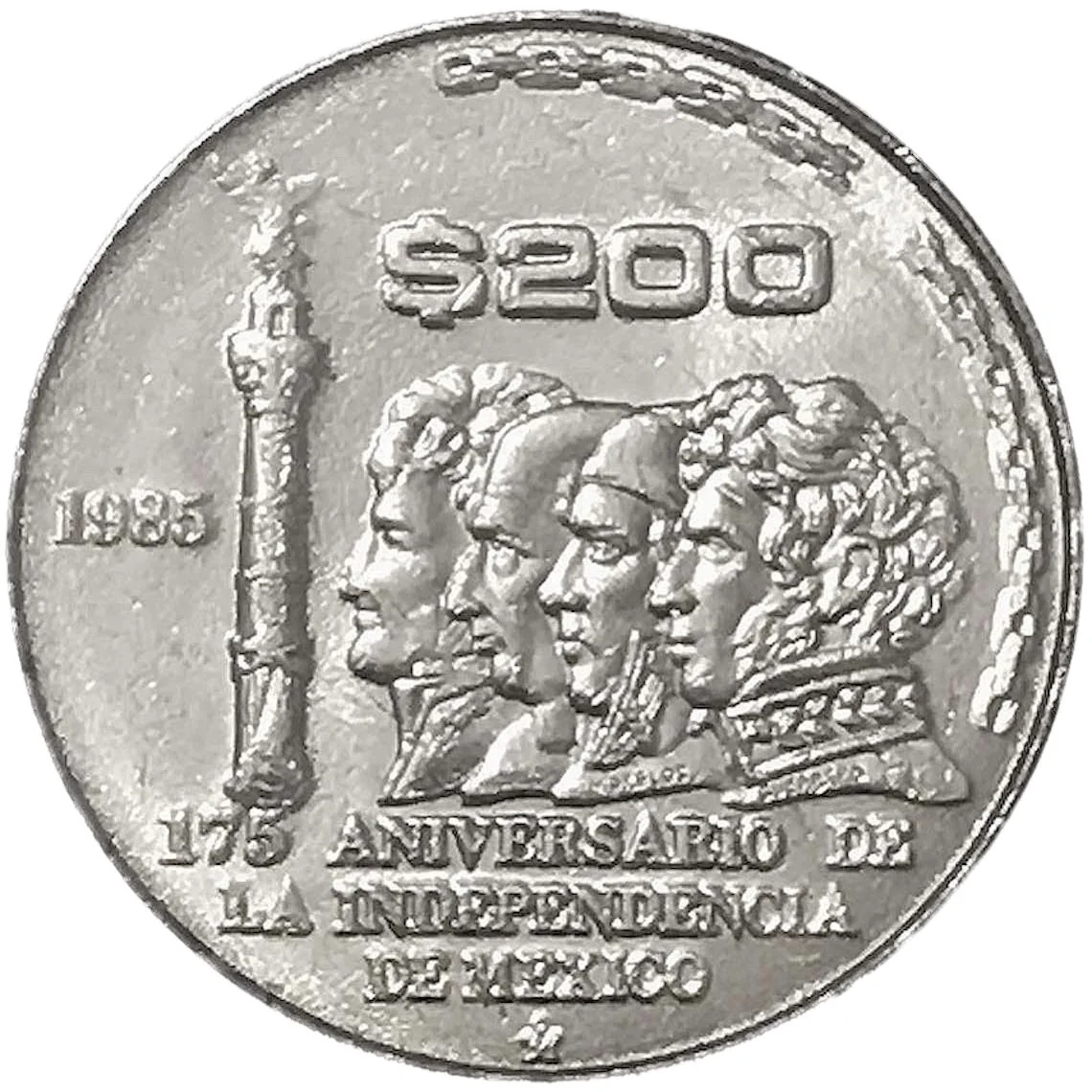
200 pesos (Independence) – Mexico
Add to wishlist
Circulating commemorative coins
Commemoration: 175th Anniversary of Independence
Mexico
Context
Year: 1985
Issuer: Mexico
Period:
(since 1823)
Currency:
(1863—1992)
Demonetization: 15 November 1995
Total mintage: 75,000,000
Material
Diameter: 29.5 mm
Weight: 17.25 g
Thickness: 3.2 mm
Shape: Round
Composition: Copper-nickel
Technique: Milled
Alignment: Coin alignment
flip
References
KM: #
Numista: #3567
Value
Exchange value: 200 MXP
Inflation-adjusted value: 69208.60 MXP
Obverse
Reverse
Description:
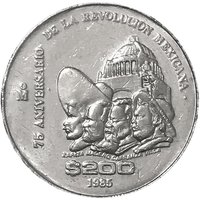
From left: "1985", the Independence Monument, and busts of Ignacio Allende, Miguel Hidalgo, José María Morelos, and Vicente Guerrero facing left, each labeled with their name. "175 Aniversario De La Independencia De México" is inscribed at the base.
Inscription:
$200
1985
ALLENDE HIDALGO MORELOS GUERRERO
175 ANIVERSARIO DE
LA INDEPENDENCIA
DE MEXICO
Mo
1985
ALLENDE HIDALGO MORELOS GUERRERO
175 ANIVERSARIO DE
LA INDEPENDENCIA
DE MEXICO
Mo
Translation:
$200
1985
ALLENDE HIDALGO MORELOS GUERRERO
175TH ANNIVERSARY OF
THE INDEPENDENCE
OF MEXICO
1985
ALLENDE HIDALGO MORELOS GUERRERO
175TH ANNIVERSARY OF
THE INDEPENDENCE
OF MEXICO
Script: Latin
Language: Spanish
Edge
Plain with incuse lettering
Legend:
INDEPENDENCIA Y LIBERTAD
Translation:
Independence and Liberty
Language: Spanish
Categories
| Person> Politician |
| Event> Independence |
Mints
| Name | Mark |
|---|---|
| Mexican Mint | (Mo) |
Mintings
| Year | Mint Mark | Mintage | Quality | Collection |
|---|---|---|---|---|
| 1985 | Mo | 75,000,000 |
Historical background
In 1985, Mexico's currency situation was defined by profound crisis and a pivotal shift in economic policy. The nation was still grappling with the aftermath of the 1982 debt default, which had shattered international confidence and led to years of austerity, capital flight, and reliance on IMF restructuring. The Mexican peso, which had been pegged and artificially supported for decades, was under severe pressure. Despite massive oil exports, falling global prices for petroleum—Mexico's chief source of revenue—combined with rampant inflation (over 60% annually) and a massive external debt burden, created an unsustainable reality where the official exchange rate bore little relation to the currency's actual value.
The government of President Miguel de la Madrid maintained a complex system of controlled exchange rates, primarily a preferential rate for debt servicing and essential imports, and a free-market rate for other transactions. This dual system fostered a thriving black market and widespread speculation, as the gap between the two rates widened significantly. The economic strain was catastrophically compounded by the devastating Mexico City earthquake in September 1985, which not only caused immense human tragedy but also inflicted billions in damages, further draining state resources and exacerbating the fiscal crisis.
This confluence of events forced a dramatic policy rupture. In late 1985, the government initiated a secret program of gradual but controlled devaluations of the peso, moving away from rigid pegs. This process, however, was merely a prelude to a more radical solution. The unsustainable pressures of 1985 set the stage for the decisive break that would come the following year: Mexico's entry into the GATT and, most significantly, the launch of the "Pacto de Solidaridad Económica" in 1987, which introduced a crawling peg and wage and price controls. Thus, 1985 stands as the final, tumultuous year of the old protectionist model, immediately preceding the country's decisive turn toward trade liberalization and neoliberal economic restructuring.
The government of President Miguel de la Madrid maintained a complex system of controlled exchange rates, primarily a preferential rate for debt servicing and essential imports, and a free-market rate for other transactions. This dual system fostered a thriving black market and widespread speculation, as the gap between the two rates widened significantly. The economic strain was catastrophically compounded by the devastating Mexico City earthquake in September 1985, which not only caused immense human tragedy but also inflicted billions in damages, further draining state resources and exacerbating the fiscal crisis.
This confluence of events forced a dramatic policy rupture. In late 1985, the government initiated a secret program of gradual but controlled devaluations of the peso, moving away from rigid pegs. This process, however, was merely a prelude to a more radical solution. The unsustainable pressures of 1985 set the stage for the decisive break that would come the following year: Mexico's entry into the GATT and, most significantly, the launch of the "Pacto de Solidaridad Económica" in 1987, which introduced a crawling peg and wage and price controls. Thus, 1985 stands as the final, tumultuous year of the old protectionist model, immediately preceding the country's decisive turn toward trade liberalization and neoliberal economic restructuring.
🌱 Very Common