

Obverse
Description:
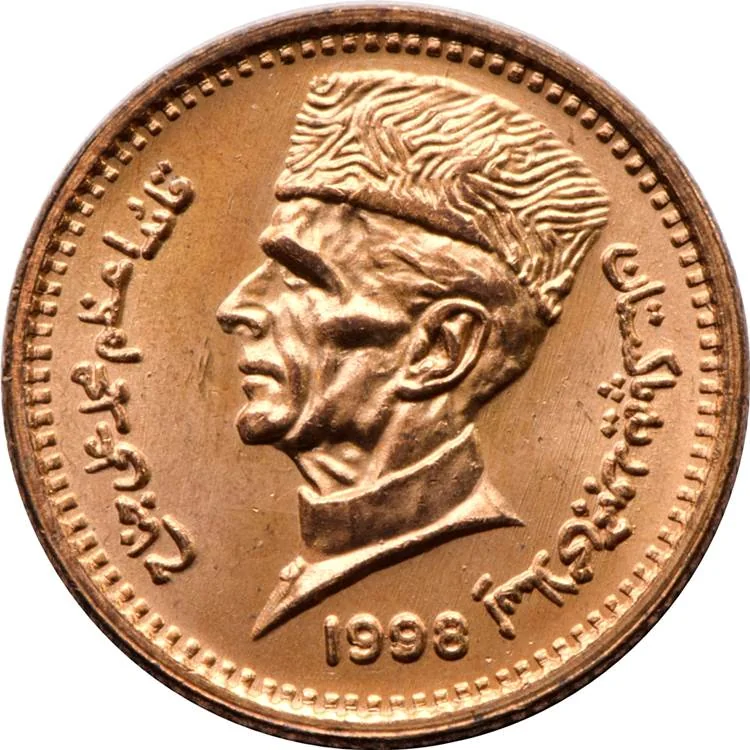
Mohammad Ali Jinnah in profile.
Inscription:
قائد اعظم محمد علی جناح
اسلامی جمہوریۂ پاکِستان
1998
اسلامی جمہوریۂ پاکِستان
1998
Translation:
Quaid-e-Azam Muhammad Ali Jinnah
Islamic Republic of Pakistan
1998
Islamic Republic of Pakistan
1998
Language: Urdu
Reverse
Description:
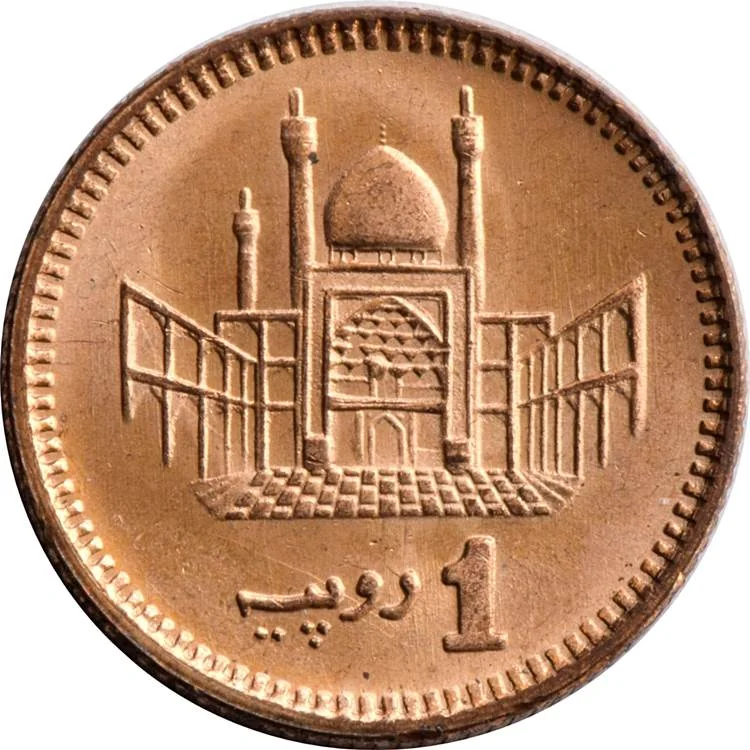
Lal Shahbaz Qalandar Shrine in Sehwan, Sindh, Pakistan.
Inscription:
1
روپیہ
روپیہ
Translation:
One Rupee
Language: Urdu
Edge
Milled
Categories
| Building> Religious building |
| Person> Politician |
Mintings
| Year | Mint Mark | Mintage | Quality | Collection |
|---|---|---|---|---|
| 1998 | — | 42,292,000 | ||
| 1999 | — | 150,128,000 | ||
| 2000 | — | 72,600,000 | ||
| 2001 | — | 146,996,000 | ||
| 2002 | — | 192,252,000 | ||
| 2003 | — | 217,996,000 | ||
| 2004 | — | 162,210,000 | ||
| 2005 | — | 202,330,000 | BU | |
| 2006 | — | 113,135,000 |
Historical background
In 1998, Pakistan faced a severe currency crisis rooted in a perfect storm of geopolitical and economic shocks. The immediate trigger was the country's nuclear tests in May, which led to swift international sanctions and a freeze on foreign currency accounts held by Pakistani citizens and entities. This catastrophic loss of confidence triggered a capital flight crisis, as depositors rushed to withdraw foreign currency, draining the State Bank of Pakistan's already meager reserves. Concurrently, the fallout from the 1997 Asian Financial Crisis was limiting access to international capital markets, leaving Pakistan with dangerously low reserves to defend its pegged exchange rate.
The government's response was drastic and controversial. In July 1998, it froze all foreign currency accounts, effectively defaulting on its obligations to depositors, and forcibly converted them into Pakistani rupees at a state-mandated rate. This move, while stemming the immediate hemorrhage of dollars, shattered public trust in the banking system for a generation. By mid-1998, with reserves nearly exhausted, Pakistan was forced to abandon its managed exchange rate regime. The rupee, which had been artificially pegged around 40-45 to the US dollar, was allowed to float freely, leading to a sharp and immediate devaluation.
The aftermath of the 1998 crisis defined Pakistan's economic trajectory for years. The rupee's plunge exacerbated inflation and increased the burden of foreign-denominated debt. The country narrowly avoided sovereign default through an emergency bailout from the International Monetary Fund in late 1998, which came with stringent structural adjustment conditions. Thus, 1998 marked a pivotal year of economic emergency, where currency controls, devaluation, and an IMF program became necessary tools to manage a balance of payments crisis born from geopolitical isolation and profound financial instability.
The government's response was drastic and controversial. In July 1998, it froze all foreign currency accounts, effectively defaulting on its obligations to depositors, and forcibly converted them into Pakistani rupees at a state-mandated rate. This move, while stemming the immediate hemorrhage of dollars, shattered public trust in the banking system for a generation. By mid-1998, with reserves nearly exhausted, Pakistan was forced to abandon its managed exchange rate regime. The rupee, which had been artificially pegged around 40-45 to the US dollar, was allowed to float freely, leading to a sharp and immediate devaluation.
The aftermath of the 1998 crisis defined Pakistan's economic trajectory for years. The rupee's plunge exacerbated inflation and increased the burden of foreign-denominated debt. The country narrowly avoided sovereign default through an emergency bailout from the International Monetary Fund in late 1998, which came with stringent structural adjustment conditions. Thus, 1998 marked a pivotal year of economic emergency, where currency controls, devaluation, and an IMF program became necessary tools to manage a balance of payments crisis born from geopolitical isolation and profound financial instability.
Series: 1998 Pakistan circulation coins

🌱 Very Common