

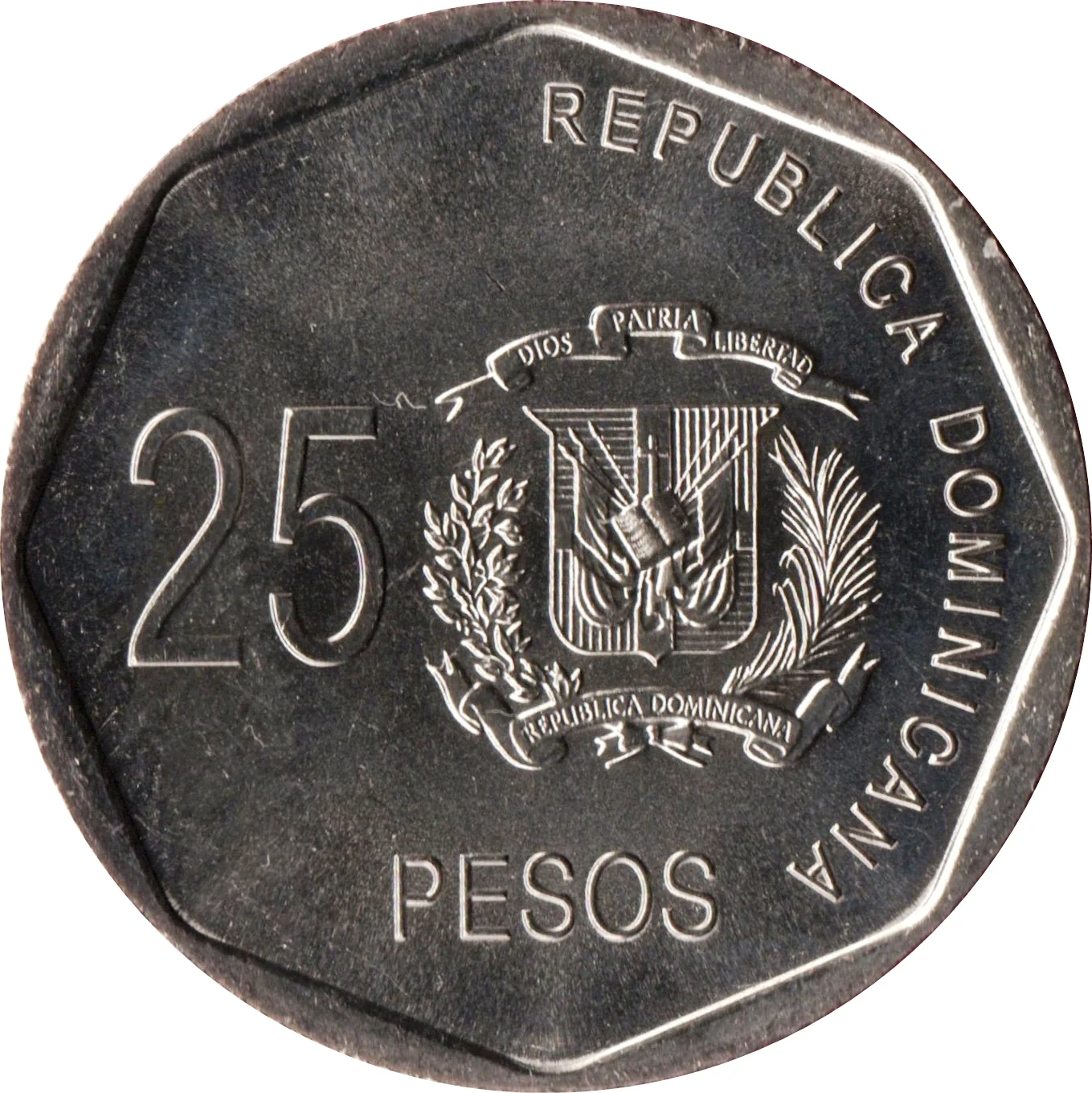
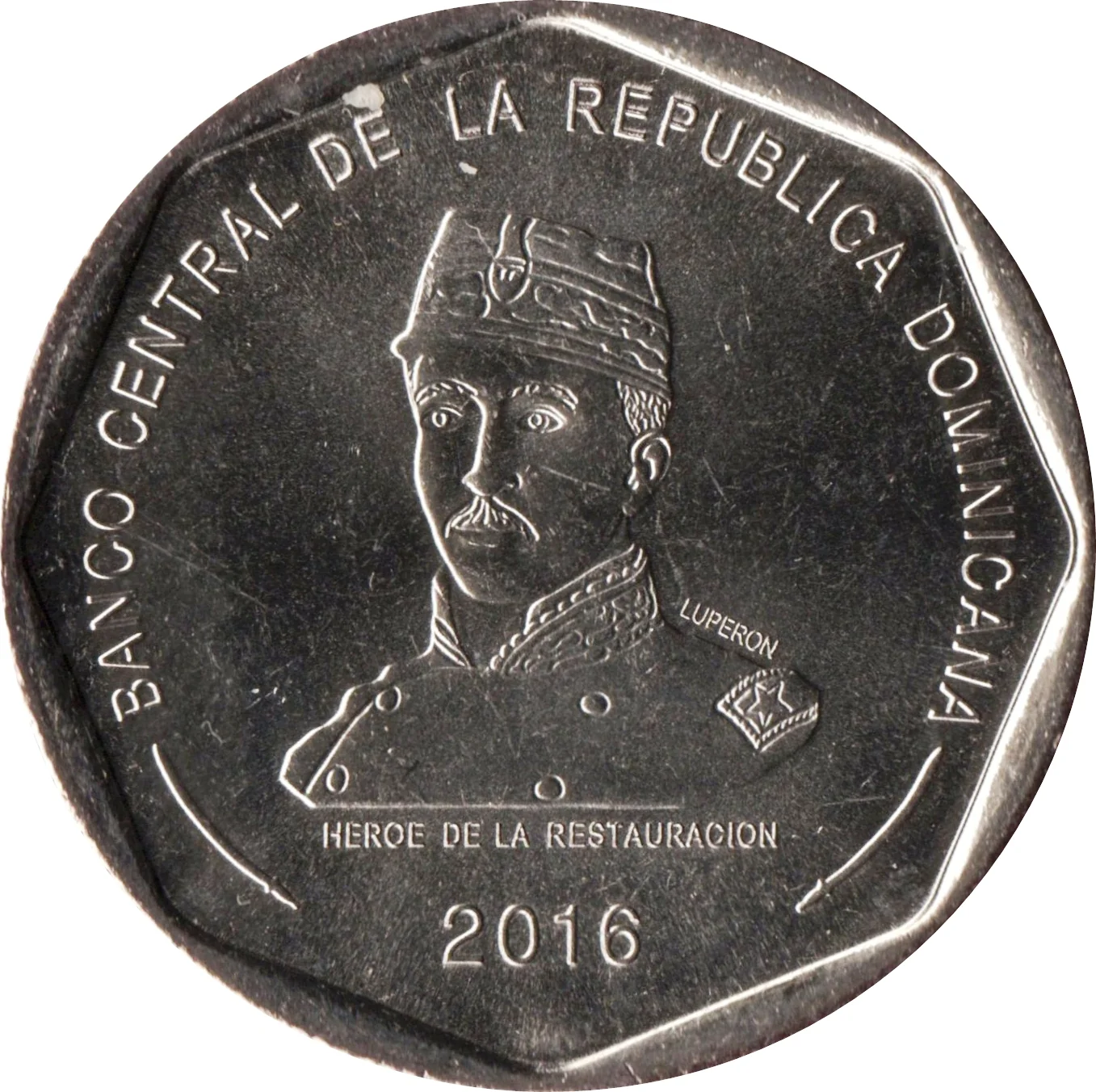
25 pesos – Dominican Republic
Add to wishlist
Dominican Republic
Context
Years: 2005–2017
Issuer: Dominican Republic
Period:
(since 1966)
Currency:
(since 1937)
Total mintage: 35,035,000
Material
Diameter: 29 mm
Weight: 8.56 g
Thickness: 1.7 mm
Shape: Round
Composition: Copper-nickel
Technique: Milled
Alignment: Coin alignment
flip
References
KM: #
Numista: #3563
Value
Exchange value: 25 DOP
Obverse
Reverse
Edge
Reeded
Categories
| Person> Politician |
| Symbols> Coat of Arms |
| Event> Independence |
Mints
| Name | Mark |
|---|---|
| Casa de Moneda de Chile | — |
| Mint of Poland | — |
| Monnaie de Paris | — |
| Royal Canadian Mint of Winnipeg | — |
| Royal Mint of Madrid | — |
Mintings
| Year | Mint Mark | Mintage | Quality | Collection |
|---|---|---|---|---|
| 2005 | — | 35,000 | ||
| 2008 | — | 15,000,000 | ||
| 2010 | — | 20,000,000 | ||
| 2015 | — | — | ||
| 2016 | — | — | ||
| 2017 | — | — |
Historical background
In 2005, the Dominican Republic was in a period of significant economic stabilization and recovery following a severe banking and currency crisis in 2003-2004. That earlier crisis, triggered by the collapse of the country's third-largest bank (Baninter), had led to massive government bailouts, soaring inflation, and a sharp devaluation of the Dominican peso (DOP). By 2005, the government, under President Leonel Fernández (who returned to office in August 2004), had implemented a stringent austerity program in agreement with the International Monetary Fund (IMF). A key focus was on restoring monetary stability and rebuilding foreign reserves, which had been nearly depleted during the crisis.
The currency situation in 2005 was characterized by a managed float exchange rate regime, with the Central Bank (Banco Central de la República Dominicana) actively intervening in the foreign exchange market to curb excessive volatility. After the peso had lost over 50% of its value against the US dollar in 2003-2004, 2005 saw a period of relative stabilization. The exchange rate, which had ended 2004 at around DOP 31 per USD, experienced moderate depreciation throughout the year, closing 2005 near DOP 33 per USD. This controlled adjustment was seen as a success, reflecting restored, though cautious, market confidence and the effects of tighter fiscal and monetary policies aimed at curbing inflation.
Overall, 2005 marked a turning point from crisis management to fragile recovery. The Central Bank's efforts to mop up excess liquidity from the earlier bailouts helped reduce inflationary pressures, allowing for a gradual decline in interest rates by year's end. While challenges remained, including high public debt and persistent poverty, the currency stability achieved in 2005 provided a crucial foundation for the sustained economic growth that followed in the subsequent years.
The currency situation in 2005 was characterized by a managed float exchange rate regime, with the Central Bank (Banco Central de la República Dominicana) actively intervening in the foreign exchange market to curb excessive volatility. After the peso had lost over 50% of its value against the US dollar in 2003-2004, 2005 saw a period of relative stabilization. The exchange rate, which had ended 2004 at around DOP 31 per USD, experienced moderate depreciation throughout the year, closing 2005 near DOP 33 per USD. This controlled adjustment was seen as a success, reflecting restored, though cautious, market confidence and the effects of tighter fiscal and monetary policies aimed at curbing inflation.
Overall, 2005 marked a turning point from crisis management to fragile recovery. The Central Bank's efforts to mop up excess liquidity from the earlier bailouts helped reduce inflationary pressures, allowing for a gradual decline in interest rates by year's end. While challenges remained, including high public debt and persistent poverty, the currency stability achieved in 2005 provided a crucial foundation for the sustained economic growth that followed in the subsequent years.
🌱 Very Common