

20 pence – Ireland
Add to wishlist
Ireland
Context
Years: 1985–2000
Issuer: Ireland
Period:
(since 1937)
Currency:
(1971—2001)
Demonetization: 9 February 2002
Total mintage: 208,920,250
Material
Diameter: 27.1 mm
Weight: 8.47 g
Thickness: 2 mm
Shape: Round
Composition: Nickel brass
Magnetic: No
Technique: Milled
Alignment: Medal alignment
flip
References
KM: #
Numista: #1403
Value
Exchange value: 0.20 IEP
Inflation-adjusted value: 0.53 IEP
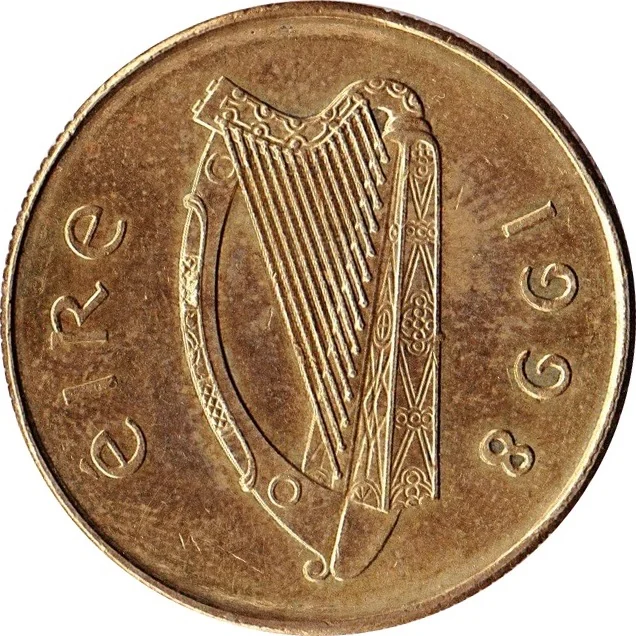
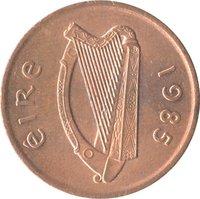
Obverse
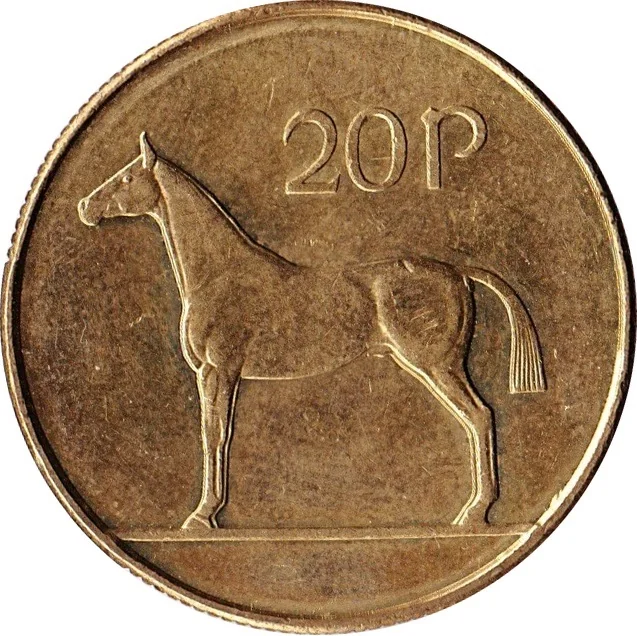
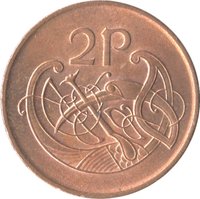
Reverse
Edge
Segmented reeding
Mints
| Name | Mark |
|---|---|
| Irish Mint | — |
Mintings
| Year | Mint Mark | Mintage | Quality | Collection |
|---|---|---|---|---|
| 1985 | — | 500 | ||
| 1986 | — | 6,750 | Proof | |
| 1986 | — | 50,430,000 | ||
| 1988 | — | 20,661,000 | ||
| 1992 | — | 14,761,000 | ||
| 1994 | — | 11,086,000 | ||
| 1995 | — | 18,160,000 | ||
| 1996 | — | 29,291,000 | ||
| 1998 | — | 25,024,000 | ||
| 1999 | — | 11,000,000 | ||
| 2000 | — | 28,500,000 |
Historical background
In 1985, the Republic of Ireland’s currency situation was defined by its membership in the European Monetary System (EMS) and its Exchange Rate Mechanism (ERM). The Irish pound, or punt, was pegged within the ERM, but not to sterling. This was a significant and deliberate policy shift that had occurred in 1979, breaking a centuries-old one-for-one link with the British pound. The primary aim was to align Ireland more closely with continental European economies and stabilize the currency against the volatility of sterling, though this move initially brought its own challenges, including higher interest rates and inflation.
The domestic economic context in 1985 was one of deep recession, characterised by high unemployment, emigration, and substantial government debt. The fixed exchange rate regime of the ERM imposed strict discipline on fiscal and monetary policy, limiting the government's ability to devalue the currency to boost competitiveness. Consequently, maintaining the punt's parity within the ERM band required high interest rates to defend its value, which further stifled economic growth and investment. This period was often described as one of "austerity," with tight controls on public spending being a direct consequence of the commitment to the fixed exchange rate.
Despite the short-term pain, the 1985 currency framework was viewed by policymakers as a necessary anchor for long-term stability and a foundational step toward deeper European integration. The discipline of the ERM was intended to curb inflation and create a stable environment for trade with Ireland's main European partners. This commitment ultimately paved the way for Ireland's later adoption of the euro, as the EMS experience was seen as a crucial proving ground for operating within a broader, multi-national monetary system.
The domestic economic context in 1985 was one of deep recession, characterised by high unemployment, emigration, and substantial government debt. The fixed exchange rate regime of the ERM imposed strict discipline on fiscal and monetary policy, limiting the government's ability to devalue the currency to boost competitiveness. Consequently, maintaining the punt's parity within the ERM band required high interest rates to defend its value, which further stifled economic growth and investment. This period was often described as one of "austerity," with tight controls on public spending being a direct consequence of the commitment to the fixed exchange rate.
Despite the short-term pain, the 1985 currency framework was viewed by policymakers as a necessary anchor for long-term stability and a foundational step toward deeper European integration. The discipline of the ERM was intended to curb inflation and create a stable environment for trade with Ireland's main European partners. This commitment ultimately paved the way for Ireland's later adoption of the euro, as the EMS experience was seen as a crucial proving ground for operating within a broader, multi-national monetary system.
🌱 Very Common