

1 Penny – Ireland
Ireland
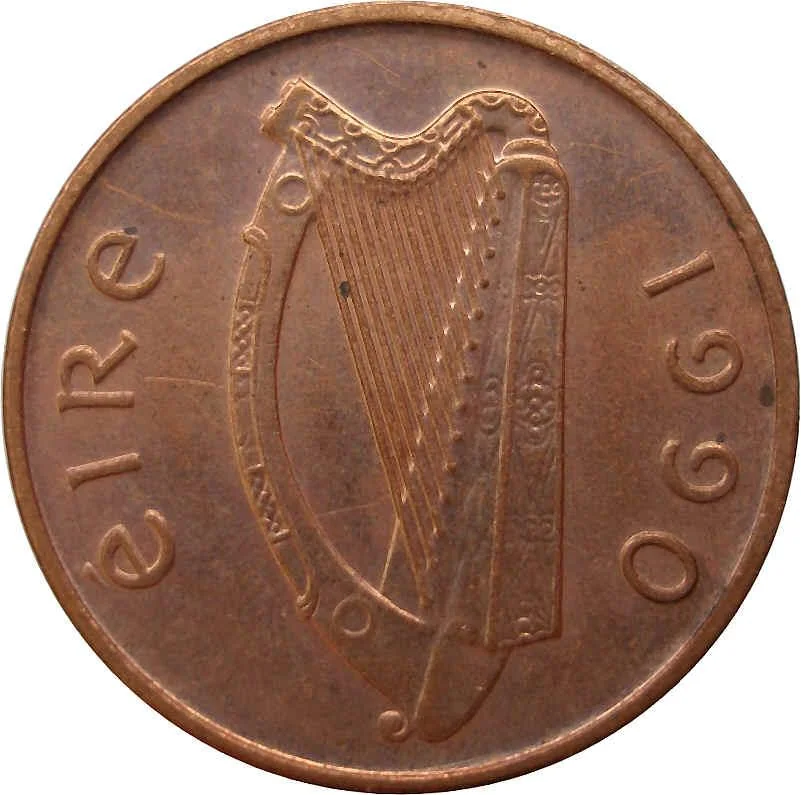
Obverse
Description:
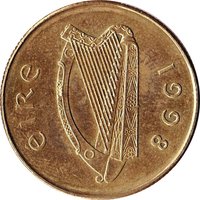
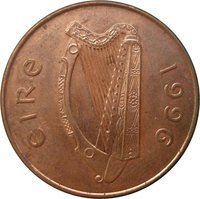
Irish harp, country name left, date right.
Inscription:
éIRe 1990
Translation:
Ireland 1990
Script: Latin (Gaelic)
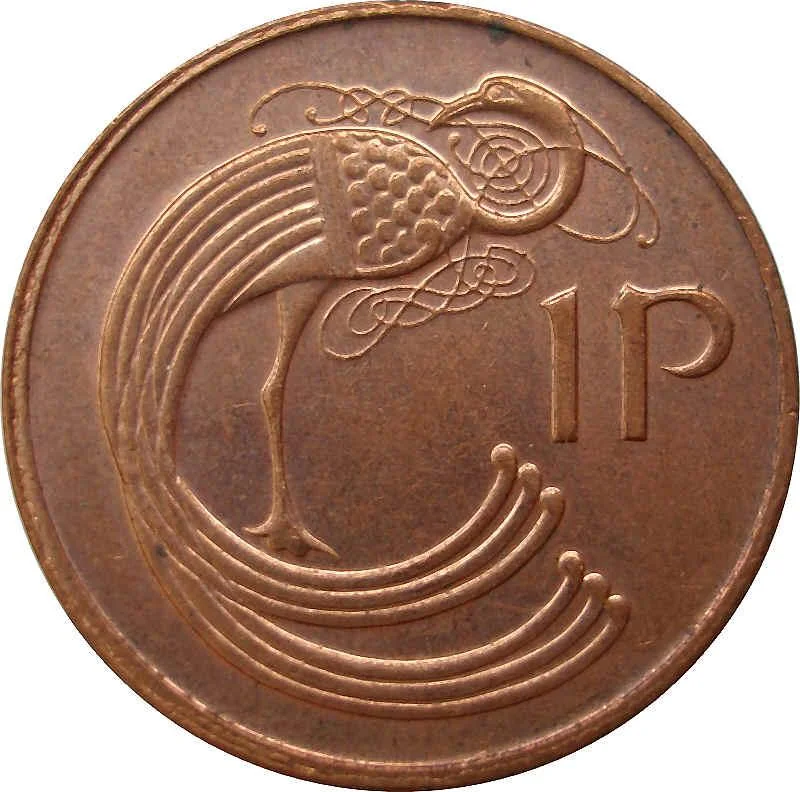
Reverse
Description:
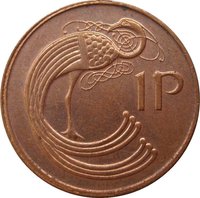
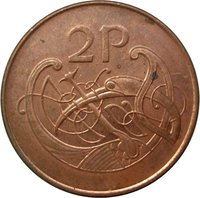
Celtic bird motif with denomination.
Inscription:
1P
Translation:
First Augustus, son of a god, father of the fatherland, high priest, consul for the thirteenth time, in the twenty-first year of his tribunician power.
Script: Latin (Gaelic)
Language: Latin
Engraver: Gabriel Hayes
Edge
Plain
Mints
| Name | Mark |
|---|---|
| Irish Mint | — |
Mintings
| Year | Mint Mark | Mintage | Quality | Collection |
|---|---|---|---|---|
| 1988 | — | — | ||
| 1990 | — | 65,099,000 | ||
| 1992 | — | 25,643,000 | ||
| 1993 | — | 10,000,000 | ||
| 1994 | — | 45,800,000 | ||
| 1995 | — | 70,836,000 | ||
| 1996 | — | 190,092,000 | ||
| 1998 | — | 40,744,000 | ||
| 2000 | — | 133,760,000 |
Historical background
In 1988, the currency situation in the Republic of Ireland was defined by its membership in the European Monetary System (EMS) and its Exchange Rate Mechanism (ERM). The Irish pound (or punt) was not freely floating but was pegged within the ERM, which aimed to reduce exchange rate volatility between European currencies. However, unlike its link to the British pound sterling, which was formally broken in 1979, Ireland's central parity within the ERM was set against the German Deutsche Mark (DM). This alignment reflected a strategic shift in economic policy towards greater integration with continental Europe and an attempt to import the anti-inflationary credibility of the Bundesbank.
The period was one of relative stability but underlying strain. While the fixed exchange rate regime helped control inflation and foster trade with European partners, it also required high interest rates to maintain the punt's value within its narrow ERM band. These high rates, necessary to match German levels following reunification, placed a significant burden on the domestic economy, contributing to sluggish growth and high unemployment throughout the late 1980s. The government and the Central Bank of Ireland were thus committed to a tight monetary policy, prioritising currency stability over domestic stimulus, which was a source of considerable political and economic debate.
Looking ahead, the arrangements of 1988 set the stage for the severe tensions that would erupt in the 1992-93 European currency crisis. The punt, like the British pound, would come under intense speculative pressure, leading to a devaluation within the ERM in January 1993. This experience underscored the difficulties of maintaining fixed parities in a world of volatile capital flows, yet Ireland's continued commitment to the system ultimately paved the way for its adoption of the single European currency, the euro, in 1999.
The period was one of relative stability but underlying strain. While the fixed exchange rate regime helped control inflation and foster trade with European partners, it also required high interest rates to maintain the punt's value within its narrow ERM band. These high rates, necessary to match German levels following reunification, placed a significant burden on the domestic economy, contributing to sluggish growth and high unemployment throughout the late 1980s. The government and the Central Bank of Ireland were thus committed to a tight monetary policy, prioritising currency stability over domestic stimulus, which was a source of considerable political and economic debate.
Looking ahead, the arrangements of 1988 set the stage for the severe tensions that would erupt in the 1992-93 European currency crisis. The punt, like the British pound, would come under intense speculative pressure, leading to a devaluation within the ERM in January 1993. This experience underscored the difficulties of maintaining fixed parities in a world of volatile capital flows, yet Ireland's continued commitment to the system ultimately paved the way for its adoption of the single European currency, the euro, in 1999.
🌱 Very Common