

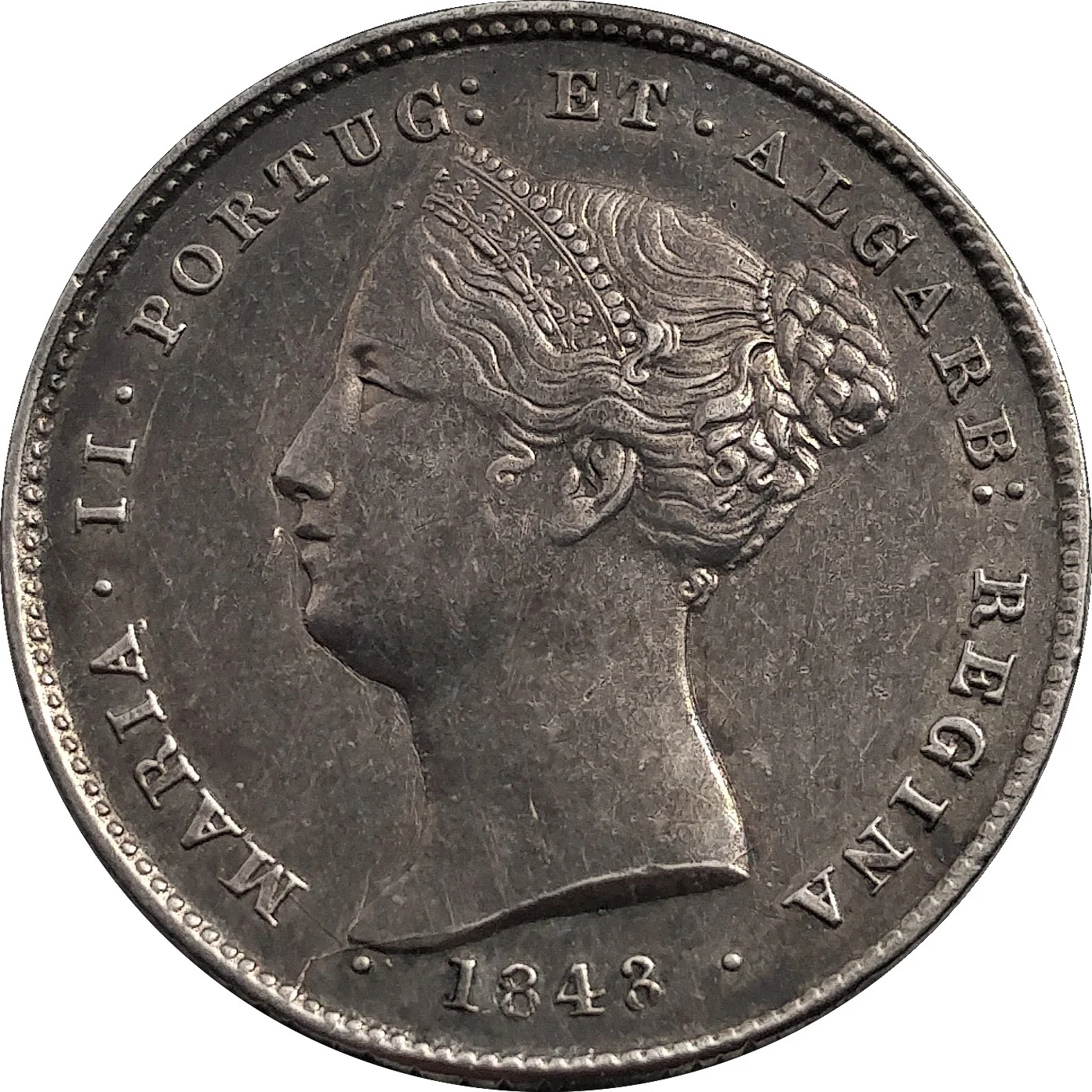
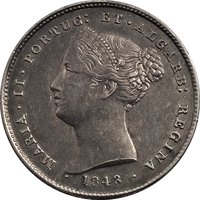
Obverse
Inscription:
MARIA·II·PORTUG:ET·ALGARG:REGINA
·1843·
·1843·
Translation:
Maria II, Queen of Portugal and the Algarves.
1843.
1843.
Script: Latin
Languages: Portuguese, Latin
Engraver: William Wyon
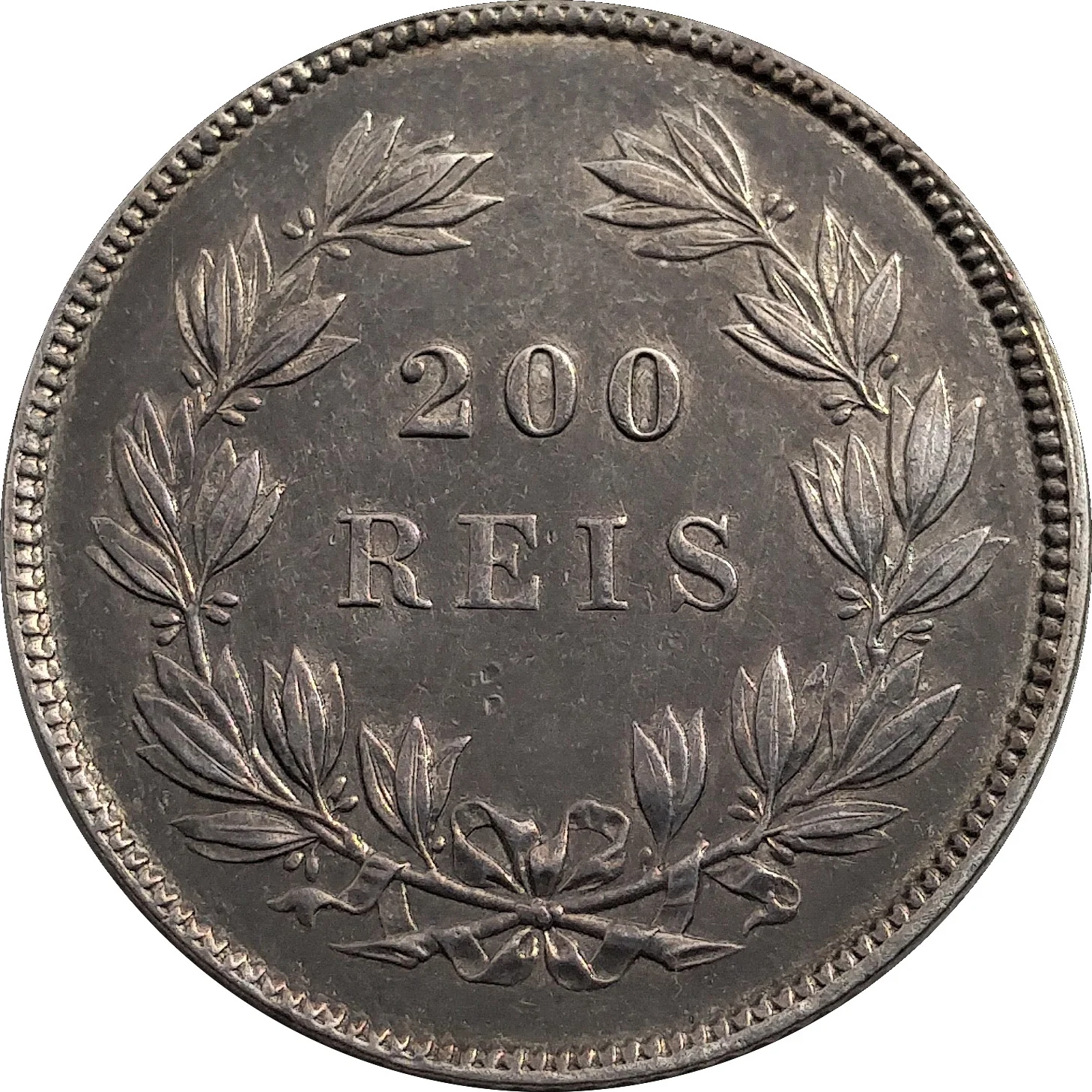
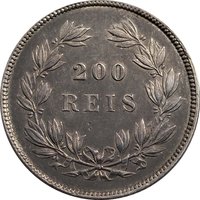
Reverse
Edge
Reeded
Mints
| Name | Mark |
|---|---|
| Imprensa Nacional - Casa da Moeda | — |
Mintings
| Year | Mint Mark | Mintage | Quality | Collection |
|---|---|---|---|---|
| 1836 | — | — | ||
| 1838 | — | 2,177 | ||
| 1841 | — | 868 | ||
| 1843 | — | 1,181 |
Historical background
In 1836, Portugal’s currency situation was chaotic and symptomatic of the broader political and economic turmoil following the Liberal Wars (1828-1834). The victorious Liberal government, led by Queen Maria II, inherited a bankrupt treasury, a massive public debt, and a monetary system in disarray. The country circulated a confusing mix of coins, including old Portuguese réis, foreign coins (particularly British), and Brazilian gold, while paper money issued by the Banco de Lisboa was deeply distrusted and had depreciated significantly. This fragmentation crippled commerce and state finances, as there was no reliable, uniform national currency.
The central problem was the severe shortage of precious metal, especially gold and silver, leading to a proliferation of low-quality copper coins and unstable paper notes. The government's response was the landmark monetary reform decreed on November 22, 1836, which aimed to create a unified decimal system. The real (plural: réis) remained the base unit, but the reform officially introduced the milréis (1,000 réis) as the main accounting standard. Crucially, it planned for the minting of new gold and silver coins to restore confidence and drive out foreign and obsolete currency, though the full implementation would take years.
This reform of 1836 was a foundational step toward stability, establishing the monetary framework that would last until the introduction of the escudo in 1911. However, its immediate effects were limited by the state's continued fiscal weakness and lack of bullion. The chronic budget deficits and reliance on debt meant that paper money issues continued, and the ideal of a fully convertible, metallic currency remained elusive. Thus, while 1836 marked a critical legislative turning point, Portugal's currency instability persisted throughout the 19th century as a reflection of its deeper economic struggles.
The central problem was the severe shortage of precious metal, especially gold and silver, leading to a proliferation of low-quality copper coins and unstable paper notes. The government's response was the landmark monetary reform decreed on November 22, 1836, which aimed to create a unified decimal system. The real (plural: réis) remained the base unit, but the reform officially introduced the milréis (1,000 réis) as the main accounting standard. Crucially, it planned for the minting of new gold and silver coins to restore confidence and drive out foreign and obsolete currency, though the full implementation would take years.
This reform of 1836 was a foundational step toward stability, establishing the monetary framework that would last until the introduction of the escudo in 1911. However, its immediate effects were limited by the state's continued fiscal weakness and lack of bullion. The chronic budget deficits and reliance on debt meant that paper money issues continued, and the ideal of a fully convertible, metallic currency remained elusive. Thus, while 1836 marked a critical legislative turning point, Portugal's currency instability persisted throughout the 19th century as a reflection of its deeper economic struggles.
💎 Extremely Rare